


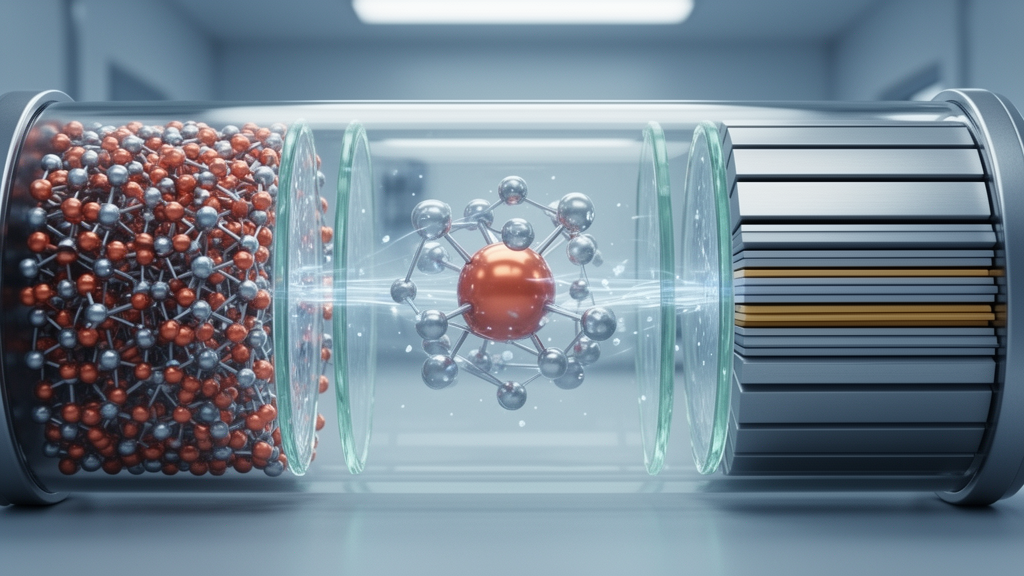
Researchers have developed an atomic-level strategy that uses isolated, high-spin cobalt atoms to improve the capacity and cycling life of aqueous zinc–manganese batteries. The approach embeds cobalt in layered manganese dioxide through an in situ phase transformation, activating both bulk and interfacial manganese redox reactions. In the reported laboratory tests, the resulting Co–MnO₂ cathode delivered a reversible capacity of 658 mAh g⁻¹ at 0.2 A g⁻¹ and retained about 100 mAh g⁻¹ after 15,000 cycles at 5 A g⁻¹, corresponding to a reported capacity decay of 0.0014% per cycle.
The work addresses a central limitation of manganese dioxide cathodes in aqueous zinc batteries. Manganese-related reactions can be insufficiently reversible: the formation of Mn³⁺ can distort the host crystal structure, while manganese dioxide deposited during discharge may not fully dissolve, leaving electrochemically inactive material that raises interfacial resistance and accelerates capacity loss. The researchers therefore sought a way to stabilize the manganese dioxide structure while accelerating electron transfer and making interfacial deposition and dissolution reversible, without adding acid or external redox mediators that could introduce corrosion, self-discharge, or other stability problems.
The team fabricated the Co–MnO₂ nanoarray by electrochemically oxidizing a cobalt–manganese layered double hydroxide precursor. This topological phase transformation dispersed Co³⁺ ions atomically throughout the layered MnO₂ framework and placed them in a high-spin electronic configuration. According to the reported mechanism, the cobalt changes the local symmetry of the [MnO₆] octahedra, suppressing Jahn–Teller distortion and improving structural stability. Weaker Co–O bond covalency also increases electron availability around lattice oxygen, facilitating Mn²⁺ adsorption and charge transfer at the cathode–electrolyte interface. Together, these effects support two coupled storage processes: MnO₂/Mn³⁺ redox reactions within the bulk and MnO₂/Mn²⁺ deposition–dissolution reactions at the interface in an electrolyte containing Mn²⁺.
At a current density of 2 A g⁻¹, the optimized electrode retained 185 mAh g⁻¹ after 3,000 cycles. It also showed recovery after a rate test, reaching 280 mAh g⁻¹ at 2 A g⁻¹ and returning to 516 mAh g⁻¹ when the current was reduced to 0.2 A g⁻¹. By comparison, the unmodified MnO₂ cathode deteriorated rapidly in the reported tests. The cobalt-containing electrode also showed lower self-discharge over 24 hours, retaining 81.23% of capacity compared with 76.02% for pristine MnO₂. These results are laboratory measurements from the research system; the release does not establish performance under commercial cell formats, broad operating conditions, or extended service beyond the tested conditions.
The study also included a zinc pouch cell with a Co–MnO₂ cathode loading of 45 mg, which showed no observable capacity decay over 100 cycles. This demonstration suggests that the design can operate beyond a small laboratory electrode, although it does not amount to a validation of pack-level energy density, manufacturing scalability, or long-term field reliability. More broadly, the findings identify transition-metal spin-state regulation as a possible design principle for enabling reversible multielectron chemistry in manganese-based cathodes. Whether the approach can be translated into practical aqueous zinc batteries, or extended to other electrode materials and larger energy-storage systems, remains to be tested through additional device engineering and validation.
Subject of Research: Atomic high-spin cobalt engineering of manganese dioxide cathodes for long-lived aqueous zinc–manganese batteries
Article Title: High-spin cobalt unlocks a new era of long-life zinc–manganese batteries
Article References: High-spin cobalt unlocks a new era of long-life zinc–manganese batteries. Original publication (Bibliographic details unavailable.)
Image Credits: AI Generated
DOI: Not provided
Keywords: aqueous zinc batteries, manganese dioxide cathodes, high-spin cobalt, atomic doping, multielectron storage, manganese redox, cycling stability, Jahn–Teller distortion, zinc pouch cell, High-spin, cobalt, unlocks
Cite Scienmag News
Faith Mcneil. (October 20, 2026). High-spin cobalt enables long-lived zinc–manganese batteries. Scienmag. https://scienmag.com/high-spin-cobalt-enables-long-lived-zinc-manganese-batteries/
Faith Mcneil. "High-spin cobalt enables long-lived zinc–manganese batteries." Scienmag, 20 October 2026, https://scienmag.com/high-spin-cobalt-enables-long-lived-zinc-manganese-batteries/. Accessed 20 October 2026.
Faith Mcneil. "High-spin cobalt enables long-lived zinc–manganese batteries." Scienmag. October 20, 2026. https://scienmag.com/high-spin-cobalt-enables-long-lived-zinc-manganese-batteries/


