


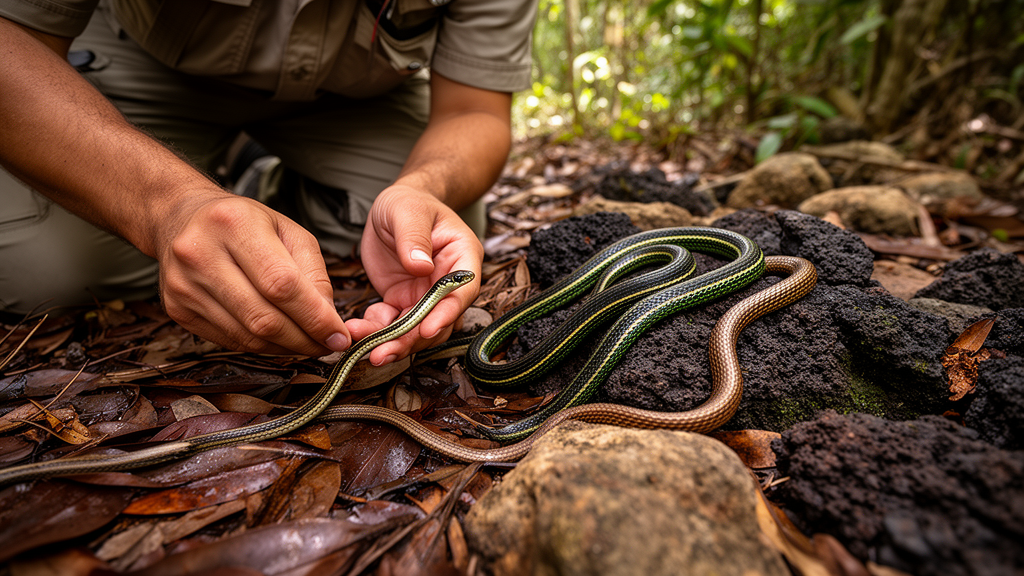
A combined molecular and morphological study has identified a garter snake from the highlands of Jalisco, Mexico, as a new species, Thamnophis ahumadai. Researchers analyzed populations of Thamnophis collected from Mexican highlands between 2015 and 2022, using two mitochondrial genes and detailed measurements of body proportions, scale counts and coloration. The study also revised the taxonomy and known distributions of several related snakes, including confirming a population in Querétaro as T. scalaris and proposing that three species described in 2005 represent one evolutionary unit.
The proposed English name for the new species is Ahumada’s Alpine Garter Snake, while the suggested Spanish name is Culebra Listonada de Montaña de Ahumada. It is named for Mexican herpetologist Iván Trinidad Ahumada-Carrillo, who collected the first known specimen in the Sierra Cacoma in 2015 and recognized that it differed from both the Longtail Alpine Garter Snake, Thamnophis scalaris, and T. errans. The holotype is an adult male found beneath a log in a marshy meadow near a pond, 2.8 km east of Cumbre de Guadalupe in Jalisco.
It had a snout-to-vent length of 357 mm, a tail length of 122 mm and a total length of 479 mm. Thamnophis ahumadai is a relatively small garter snake with a narrow head that is scarcely wider than the neck, a short muzzle and a comparatively long tail. Its diagnostic dorsal scale formula is consistently 19-17-17, meaning that the number of scale rows falls from 19 behind the head to 17 at midbody and remains 17 near the tail.
Adult males have 134-142 ventral scales and 61-69 divided subcaudal scales, while the two known females each have 139-141 ventral scales and 54-55 subcaudal scales. The largest examined specimen measured 565 mm in snout-to-vent length and 705 mm overall, whereas the smallest measured 255 mm in snout-to-vent length and 333 mm in total length. The species has a conspicuous combination of stripes and dark markings.
In life, the body is chocolate brown with a pale vertebral stripe that is yellow over the anterior half and fades to cream posteriorly. A second pale stripe runs along the side, initially covering the first three dorsal scale rows before narrowing to the second row over most of the body. Dark brown or black dorsolateral blotches occur in two alternating rows, at least some of which fuse toward the front of the body.
A black nuchal blotch lies behind the head, and the underside changes from cream at the front to dark gray or black over the posterior portion. Although the vertebral stripe varies among specimens from orange and yellow to cream, the study found little variation in the major scale-count characters. For the molecular analysis, the researchers extracted DNA from preserved liver or muscle and sequenced the mitochondrial cytochrome b and NADH dehydrogenase subunit 4 loci.
The final alignment contained 1,828 base pairs—1,104 base pairs from cytochrome b and 724 from ND4—from 81 representatives of Thamnophis, together with specimens of two species historically placed in Adelophis and two outgroup species. Maximum-likelihood and Bayesian analyses produced almost identical tree topologies, and most nodes in the maximum-likelihood tree had bootstrap support above 95%. Samples from two isolated Jalisco highlands, the Sierra Cacoma and Sierra de Tapalpa, formed a strongly supported pair with 100% bootstrap support.
Those Jalisco populations were recovered within the Mexican clade of Thamnophis, but their relationship to the closest named lineages required careful interpretation. The maximum-likelihood analysis placed the new species in a polytomy with T. scalaris, T. sumichrasti and T. mendax, rather than demonstrating a simple sister relationship among all four. The node linking the Jalisco group to that three-species grouping had a comparatively modest bootstrap value of 67%.
Pairwise mitochondrial distances also showed that T. ahumadai was separated from several superficially similar species by amounts comparable to the distances among other interspecific comparisons. For example, ND4 distances were 0.04-0.06 from T. scalaris, 0.05-0.07 from geographically proximate T. errans and 0.04-0.05 from T. exsul; cytochrome b distances were 0.03-0.04, 0.04-0.05 and 0.04, respectively. The study found that T. scalaris and T. scaliger are each monophyletic, based on 11 and five genetic samples respectively, but they are not sister species.
A GenBank sample labeled T. scaliger was consistently recovered in the clade containing morphologically verified T. scalaris in every analysis, leading the authors to hypothesize that it had been misidentified. The species T. copei was also included in a molecular phylogeny for the first time. Its placement within Thamnophis supported the earlier sinking of the genus Adelophis into Thamnophis.
Unexpectedly, the morphologically similar T. copei and T. foxi were not recovered as sister species, although both were nested within the Mexican clade. The authors stated that more extensive sequence data would be required to resolve their exact relationship. Uncertainty also remains for a population near Nahuatzen in central Michoacán.
Its coloration resembles that of T. ahumadai, but the researchers could not obtain molecular data because the available museum specimens were fixed in formalin. The population could represent an isolated population of T. ahumadai, T. scalaris or another undescribed species. The study likewise reported that historical Jalisco specimens previously identified as “T. scalaris” are likely referable to T. ahumadai, although their assignment was described as tentative where T. scaliger could not be excluded from a published description alone.
With the description of the new species, T. scalaris is removed from the herpetofauna of Jalisco in the study’s taxonomic treatment. The authors also assessed three snakes described from the Sierra Madre del Sur region in 2005: T. bogerti, T. conanti and T. lineri. Mitochondrial distances among them were very small.
ND4 distance between T. bogerti and T. conanti was as low as 0.002, while cytochrome b distances among all three ranged from 0.00 to 0.01. The phylogeny recovered T. bogerti as paraphyletic with respect to T. conanti and T. lineri, and the three taxa were separated by only 0.03-0.04 in cytochrome b from the newly described T. ahumadai. Based on that pattern, the authors concluded that the three belong to the same evolutionary unit and invoked Article 24.2 of the International Code of Zoological Nomenclature to propose T. lineri and T. conanti as junior synonyms of T. bogerti.
They could not test the relationship between this grouping and genuine T. godmani because no genetic material of T. godmani was available. Records of T. ahumadai are currently limited to the Cumbre de Guadalupe region of the Sierra Cacoma and the vicinity of Atemajac de Brizuela and Juanacatlán in the Sierra de Tapalpa. The species has been collected at elevations of approximately 2,140-2,450 m in grasslands and meadows within pine-oak woodland and pine forest.
Because its known distribution occupies two relatively small high-elevation areas, the authors recommended the highest level of protection possible from the Mexican government. They noted that logging and agriculture are continuing at both locations and said the species might qualify as Endangered under the International Union for Conservation of Nature criteria. They also considered a Data Deficient category appropriate because its presence in Michoacán and other unsurveyed parts of Jalisco remains uncertain.
Among the study’s clearest additional resolutions was the identity of an unusual Thamnophis population near Pinal de Amoles in the Sierra Gorda region of Querétaro. Two specimens collected in 2020 matched T. scalaris in several respects, including seven supralabials, 141 ventral scales and molecular placement within the species. Their short tails and low subcaudal counts departed somewhat from eastern T. scalaris, but their ND4 distances from nearby Veracruz specimens were 0.00-0.01, and their cytochrome b distances from populations in Puebla and northern Veracruz were also 0.00-0.01.
The authors therefore formally assigned the Pinal de Amoles population to T. scalaris and confirmed the species’ presence in Querétaro. Taken together, the findings describe a new species from a restricted Mexican mountain environment while using mitochondrial and morphological evidence to resolve several long-standing questions about Thamnophis scalaris and its relatives.
Subject of Research: Taxonomic and phylogenetic analysis of highland garter snakes in Mexico
Article Title: A new species of Thamnophis ( Serpentes , Colubridae ) from Jalisco, Mexico, with a discussion on the phylogeny, taxonomy, and distribution of snakes related to Thamnophis scalaris
Article References: Grünwald, C. I., Mendoza-Portilla, M. D. C. G., Grünwald, A. J., Montaño-Ruvalcaba, C., Franz-Chávez, H., García-Vázquez, U. O., & Reyes-Velasco, J. (2024). A new species of Thamnophis (Serpentes, Colubridae) from Jalisco, Mexico, with a discussion on the phylogeny, taxonomy, and distribution of snakes related to Thamnophis scalaris. Herpetozoa, 37, 157-179. https://doi.org/10.3897/herpetozoa.37.e122213
Image Credits: AI Generated
DOI: 10.3897/herpetozoa.37.e122213
Keywords: new snake species, Thamnophis ahumadai, garter snakes, Jalisco, Mexico, mitochondrial DNA, phylogenetics, taxonomy, species distribution, conservation, species, Thamnophis
Cite Scienmag News
Drew Townsend. (October 20, 2026). Jalisco garter snake study identifies new species and clarifies taxonomy. Scienmag. https://scienmag.com/jalisco-garter-snake-study-identifies-new-species-and-clarifies-taxonomy/
Drew Townsend. "Jalisco garter snake study identifies new species and clarifies taxonomy." Scienmag, 20 October 2026, https://scienmag.com/jalisco-garter-snake-study-identifies-new-species-and-clarifies-taxonomy/. Accessed 20 October 2026.
Drew Townsend. "Jalisco garter snake study identifies new species and clarifies taxonomy." Scienmag. October 20, 2026. https://scienmag.com/jalisco-garter-snake-study-identifies-new-species-and-clarifies-taxonomy/


