


A qualitative documentary case study of Riau Province, Indonesia, found that regional authorities possess basic systems for identifying agrarian disputes, forest and land fires, social conflicts and political tensions, but fragmented information and weak cross-sector coordination often prevent early warnings from producing preventive action before crises escalate. The research, published in Frontiers in Political Science, treats early warning as more than collecting and circulating risk reports: it examines whether government agencies can integrate strategic information, coordinate responses and adapt policy before emerging threats become open disturbances. The study does not measure the success of a new system in operation. Instead, it analyses 96 documents published from 2017 to 2026 and develops a conceptual model for connecting regional warning with intelligence governance and anticipatory action.
The documentary corpus consisted of five organisational or government reports, 76 research articles and 15 media publications. Materials were selected through purposive sampling for their direct relevance to Riau, early warning, anticipatory action, intelligence governance and documented regional risks, with more recent sources prioritised. Researchers coded the documents in NVivo through data preparation, exploratory open coding, axial coding and theory-driven categorisation, then compared government records, regulations, media reporting and scientific studies to identify converging and divergent evidence. Expert consultations and “Ngopi” knowledge-co-creation sessions in April and May 2026 were used only to clarify concepts and check interpretations. They were not treated as an empirical sample, and no information from them was added to the documentary dataset as new findings.
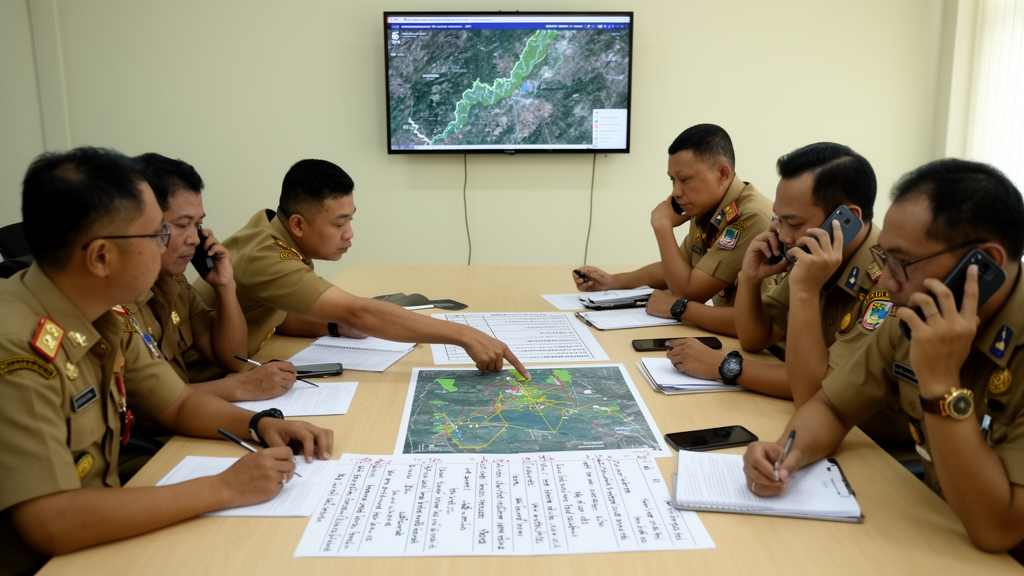
Riau’s warning architecture already involves the provincial Office of Political, Legal and Security Affairs, or Kesbangpol, district and city governments, regional agencies, security forces and community actors. Information enters through local government reports, social-conflict data, mass-media monitoring, security reports and assessments of strategic issues, while regional situation reports are used to support the governor’s decisions. A provincial disaster-risk assessment covering 2022–2026 and mechanisms for monitoring regional risks provide additional foundations. The case documents also describe the Community Early Awareness Forum, known by the Indonesian acronym FKDM, as part of the institutional network. These arrangements show that Riau is not operating without institutional capacity to see and report threats; the problem identified by the study lies in how scattered information moves between organisations and becomes policy.
The threats in the case materials span several interconnected domains. Agrarian and natural-resource conflicts feature prominently, involving overlapping land claims, oil-palm plantations, industrial timber areas and disputes between communities, companies and government. A report cited in the study attributes roughly 90% of Riau’s social conflicts to land issues and disputes between communities and companies, while the Agrarian Reform Consortium recorded 16 agrarian-conflict incidents in the province during 2023, placing Riau third among Indonesian provinces in the reported number that year. The case materials also identify forest and land fires, known locally as karhutla, demonstrations, crime, local political contests and broader security concerns. The environmental agency material reviewed for the study listed 840 forest-fire hotspots for April 2026 alone.
Despite this broad coverage, the documentary analysis indicates that Riau’s warning process remains more administrative and reactive than predictive. Inter-agency systems are not yet integrated in real time, and coordination is often sectoral rather than organised around a shared regional assessment. Regional risk analysis is described as capable of mapping existing conditions but less able to anticipate escalation or support rapid preventive measures. Media evidence cited in the research reports that government intervention in some conflicts has tended to follow escalation into open unrest. This does not mean authorities lacked relevant information, nor does the study establish a causal relationship between each coordination failure and any particular conflict. Instead, it identifies a recurring gap between the availability of warning information and the government’s capacity to turn that information into timely, coordinated intervention.
The study interprets that gap through three connected perspectives. Early warning systems theory highlights detection, information flow and response readiness. Anticipatory governance theory draws attention to foresight, preparedness, adaptive institutions and preventive policy orientation. Intelligence governance focuses on how agencies integrate information, coordinate with security actors and connect strategic assessment to executive decision-making. Taken together, the perspectives suggest that a warning system can detect a rising risk without producing anticipatory governance if agencies cannot share, interpret and act on the relevant evidence. Riau’s situation reports and risk assessments demonstrate an information-to-policy connection, but the documentary record suggests that this connection is uneven and often strongest when a threat has already become visible.
From the coded evidence, the authors derive an Integrated Anticipatory Intelligence Governance model with five components. Integrated threat detection combines the various sources used to identify and map emerging risks. Strategic intelligence processing assesses those inputs to determine whether a threat is changing and what escalation might follow. Collaborative governance coordination connects the analysis with agencies, local governments, security forces and community actors. Anticipatory policy response translates the resulting assessment into preventive or adaptive measures before conflict becomes open. Adaptive monitoring and feedback then allow officials to track changing conditions and revise their response. The framework is therefore intended as a continuous governance cycle linking observation, interpretation, coordination, action and reassessment rather than as a one-time reporting mechanism.
The proposed model is a conceptual contribution, not an intervention whose effectiveness has been demonstrated. The authors identify political leadership, digital infrastructure, cross-sector arrangements, strategic data, collaborative institutional culture and community knowledge as literature-informed enabling conditions. They also stress that stronger information integration carries governance trade-offs. A shared intelligence system could improve timeliness, but it could also widen information asymmetry between institutions, security bodies and communities. Sensitive information would require protection, community-generated reports would need verification, and social disputes could be mischaracterised as security problems if accountability and democratic oversight were weak. Transparent rules for collecting and using information were therefore presented as safeguards for privacy, accountability, community trust and the possibility that some threats require developmental rather than securitised responses.
Several limitations constrain how far the findings can travel. The analysis relies on secondary documentary evidence, which may contain reporting bias, and it focuses on one Indonesian province rather than comparing regional systems. The consultations did not constitute a sampled human-participant study, while the coding process used peer checking rather than independent double coding, so no formal intercoder reliability coefficient was calculated. Coding frequencies describe the distribution of references within the documentary cases, not objective scores of institutional performance. The five-part model has also not been implemented or externally validated in other provinces. The study consequently supports a cautiously formulated conclusion: Riau has an institutional base for early warning, but its prospects for anticipatory action depend on whether fragmented information can become coordinated, accountable and adaptive policy before a threat becomes an open crisis.
Subject of Research: Regional early warning and anticipatory intelligence governance in Riau, Indonesia
Article Title: Early warning and anticipatory action in intelligence governance: a case of regional Government in Riau, Indonesia
Article References: Ginting, J. S., Sujianto, S., Albintani, M., Heriyanto, M., Abdillah, A., Soegiharto, S., & Sofiaturrohmah, S. (2026). Early warning and anticipatory action in intelligence governance: a case of regional Government in Riau, Indonesia. Frontiers in Political Science, 8, Article 1881359. https://doi.org/10.3389/fpos.2026.1881359
Image Credits: AI Generated
DOI: 10.3389/fpos.2026.1881359
Keywords: Riau Province, early warning systems, anticipatory governance, intelligence governance, agrarian conflict, forest fires, regional government, Indonesia, documentary analysis, multidimensional threats, Early, warning
Cite Scienmag News
Courtney Benton. (October 20, 2026). Documentary case study links Riau warnings to fragmented intelligence coordination. Scienmag. https://scienmag.com/documentary-case-study-links-riau-warnings-to-fragmented-intelligence-coordination/
Courtney Benton. "Documentary case study links Riau warnings to fragmented intelligence coordination." Scienmag, 20 October 2026, https://scienmag.com/documentary-case-study-links-riau-warnings-to-fragmented-intelligence-coordination/. Accessed 20 October 2026.
Courtney Benton. "Documentary case study links Riau warnings to fragmented intelligence coordination." Scienmag. October 20, 2026. https://scienmag.com/documentary-case-study-links-riau-warnings-to-fragmented-intelligence-coordination/


