


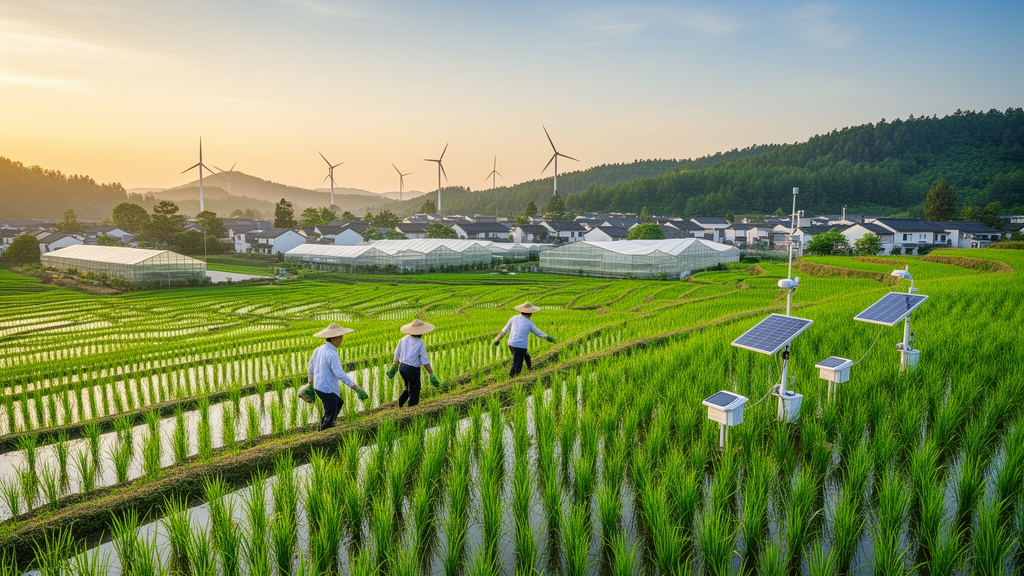
Jiangxi Province’s relative agricultural green development index rose from 11.37 in 2010 to 80.51 in 2025, according to a study that evaluated 18 indicators and modeled their trajectories for China’s 15th Five-Year Plan period. The projection places the index at 83.97 in 2026 and 86.97 in 2030, indicating continued but slower growth if historical patterns continue. Researchers describe the result as a baseline forecast rather than a guaranteed outcome because the models do not fully capture potential changes in climate, technology or policy. The composite score is also relative to Jiangxi’s own 2010–2025 data, so an index of 80.51 does not mean that 80.51% of agricultural development goals had been achieved.
The study, published in Frontiers in Sustainable Food Systems, focuses on Jiangxi as a major agricultural province and one of China’s first National Ecological Civilization Pilot Zones. Its indicator system covers resource conservation and efficient use, production-site environmental governance, agricultural ecological restoration, green industrial development, and green technological support. Together, these dimensions contain 18 secondary indicators, including farmland retention, irrigation efficiency, fertilizer use efficiency, pesticide intensity, crop-straw utilization, forest coverage, soil and water conservation, rural income, agricultural mechanization and scientific-technological progress. The design was tailored to Jiangxi’s mountainous and hilly terrain, abundant forests, extensive inland waterways and exposure to high temperatures, droughts and floods.
To calculate the historical index, the researchers range-standardized official data from 2010 through 2025 and assigned weights using the entropy weight method, which reflects the amount of temporal variation and information differentiation in each indicator. The resulting dimension weights were 29.42% for agricultural ecological restoration, 23.28% for green industrial development, 22.97% for production-site environmental governance, 16.29% for resource conservation and utilization, and 8.04% for green technological support. These weights describe statistical variation within the observed sample, not causal influence or policy importance. A robustness check using the CRITIC method produced the same ranking of the five dimensions, while indicator-level weights had a Spearman correlation of 0.91, with p<0.01.
The historical trajectory divided into three periods. During an initial exploration phase from 2010 to 2015, the index increased from 11.37 to 32.63, averaging 4.25 points per year. Growth accelerated between 2016 and 2020, when the score rose from 32.63 to 64.84, an average of 6.44 points annually. This fastest phase coincided with Jiangxi’s designation as a National Ecological Civilization Pilot Zone and the implementation of fertilizer and pesticide reduction programs, high-standard farmland construction and agricultural-waste utilization measures. From 2021 to 2025, the index advanced from 64.84 to 80.51, averaging 3.13 points per year as the transition moved from major input reductions toward more systematic improvement.
Several measured changes accompanied the faster middle phase. From 2016 to 2020, chemical fertilizer application intensity declined from 25.1 to 22.6 kilograms per mu, while pesticide application intensity fell from 0.82 to 0.61 kilograms per mu. Over the same interval, comprehensive livestock and poultry manure utilization increased from 70.3% to 85.2%, and crop-straw utilization rose from 82.1% to 89.7%. Over 2015–2025, fertilizer application intensity decreased from 26.8 to 21.3 kilograms per mu, while fertilizer-use efficiency increased from 33.2% to 41.5%. These indicators contributed to the modeled index, but the observational analysis does not establish that any one policy alone caused the composite change.
The forecasting method combined the entropy-weighted historical assessment with separate GM(1,1) grey prediction models for each of the 18 indicators rather than modeling only the final composite. For each nonnegative series, the first-order accumulated generating operation reduces short-term volatility and supports estimation of an exponential trend. Separate fitting windows were selected for the individual indicators, and the forecast values were then combined using the historical weights. The researchers retained the 2010–2025 minimum and maximum values as normalization bounds and restricted projected indicator values to that interval. All fitted models had mean absolute percentage errors below 10%, meeting what the authors describe as the Grade I accuracy standard for grey prediction.
Under this baseline, the projected composite score was 83.97 in 2026, 84.91 in 2027, 85.02 in 2028, 85.14 in 2029 and 86.97 in 2030. That is an increase of 6.46 points from the 2025 value, or about 1.29 points per year when measured across the full 2025–2030 interval; the average within 2026–2030 alone is approximately 0.75 points annually. At the dimension level, the model places faster growth in green technological support and green industrial development, slower growth in resource conservation and production-site governance, and steady improvement in ecological restoration. The increasing importance of mechanization in the forecast is associated with expected expansion of machinery suited to hilly farming.
The projection’s principal uncertainty lies in the conditions it assumes. Jiangxi’s 2024 comprehensive mechanization rate for crop cultivation, sowing and harvesting was 71.2%, nearly five percentage points below the national average, and machinery levels were lower in cash crops, facilities, livestock and aquaculture. Farmers operating less than 2 mu represented more than 60% of the total, limiting their capacity to purchase and maintain specialized equipment. At the same time, agricultural non-point source pollution control is becoming more costly as fertilizer and pesticide use becomes harder to reduce, while the frequency of heat, drought and flood events could disrupt trends in yields, input demand and infrastructure use. These are structural uncertainties that the historical-series models do not explicitly simulate.
Jiangxi’s certified agricultural sector provides a commercial context for the forecast. The combined number of products under the “Three Certifications and One Geographical Indication” framework rose from 3,363 in 2020 to 8,496 in 2025, while green-food products increased from 942 to 3,742 and organic products from 2,317 to 4,219. High-quality distinctive agricultural products increased from seven to 430, and green-food production bases expanded from 8.543 million to 9.294 million mu. The study notes that certification categories can overlap, creating a measurement limitation, and that growth in certification does not guarantee a market premium or higher farmer returns. It concludes that the projected index is best read as a reference trajectory for identifying likely progress and policy gaps, not as a certain future outcome or a substitute for direct assessment of environmental, economic and social effects.
Subject of Research: Entropy-weighted measurement and grey-model forecasting of agricultural green development in Jiangxi Province
Article Title: Construction of an agricultural green development indicator system and trend projection for the 15th five-year plan period in Jiangxi Province
Article References: Dai, T., Yu, W., Li, Y., & Liu, F. (2026). Construction of an agricultural green development indicator system and trend projection for the 15th five-year plan period in Jiangxi Province. Frontiers in Sustainable Food Systems, 10, Article 1942701. https://doi.org/10.3389/fsufs.2026.1942701
Image Credits: AI Generated
DOI: 10.3389/fsufs.2026.1942701
Keywords: Jiangxi Province, agricultural green development, green agriculture, GM(1,1) model, entropy weighting, indicator system, food security, agricultural mechanization, environmental governance, trend projection, Construction, agricultural
Cite Scienmag News
Alan Morgan. (October 20, 2026). Jiangxi’s green agriculture index projected to rise through 2030. Scienmag. https://scienmag.com/jiangxis-green-agriculture-index-projected-to-rise-through-2030/
Alan Morgan. "Jiangxi’s green agriculture index projected to rise through 2030." Scienmag, 20 October 2026, https://scienmag.com/jiangxis-green-agriculture-index-projected-to-rise-through-2030/. Accessed 20 October 2026.
Alan Morgan. "Jiangxi’s green agriculture index projected to rise through 2030." Scienmag. October 20, 2026. https://scienmag.com/jiangxis-green-agriculture-index-projected-to-rise-through-2030/


