


A comparison of the principal macrophyte-based indices used across Mediterranean Europe found that they share some species but assign different ecological indicator values to them. The study also found that only 23 of the aquatic plant taxa recorded at 39 stations in Morocco’s HBS river basin appeared in the Euro-Mediterranean indices examined. Indices based only on family- or order-level taxonomic resolution, including the Macroscopic Aquatic Vegetation Index and the index of macrophytes, were excluded.
The study also considered the British Mean Trophic Rank, the German Trophic Index of Macrophytes, Poland’s Macrophyte Index for Rivers and Zambia’s Macrophyte Trophic Ranking scheme when interpreting differences in the ecological meaning assigned to individual species. The central question was whether hydromorphological and ecoregional differentiation helps explain variation in the taxa and indicator values included in Mediterranean indices. Such differences are plausible because macrophyte assemblages depend on multiple abiotic and biotic factors.
Nutrients are important, but altitude, flow velocity, water depth, riverbed width and substrate type also influence the development of aquatic plant communities. The researchers therefore examined not only whether the indices agreed numerically, but also whether the same species carried comparable ecological interpretations in different national systems and whether the systems could be transferred to the HBS basin in Morocco. The analysis combined published index data with an extensive field survey of aquatic and riparian macrophytes at 39 stations in the HBS basin and its tributaries.
Macrophytes were identified using field guides, and scientific names were screened for synonyms and harmonized when necessary so that taxa could be compared consistently with the indices. The three Mediterranean systems differed substantially in taxonomic coverage. IBMR contained 226 indicator taxa, IMF contained 124 and BMS contained 105.
Across all three were 331 species representing 98 families, 66 orders and 24 classes. Potamogetonaceae, Cyperaceae, Ranunculaceae, Amblystegiaceae, Typhaceae and Plantaginaceae were among the most diverse families, while Potamogeton and Ranunculus were the most frequently represented genera. Indicator values were significantly correlated in all three pairwise comparisons, although the strength of the relationships varied.
IBMR and BMS shared 47 taxa and had the strongest association, with an R-squared value of 0.57. IBMR and IMF shared 68 taxa but had the weakest relationship, with an R-squared of 0.30. IMF and BMS shared only 35 taxa and had an R-squared of 0.34.
All three comparisons reported p-values of 0.000. The results indicate that the indices encode partly overlapping ecological concepts, but the limited explanatory power of the regression relationships also shows that their classifications of shared species are not interchangeable. Individual taxa illustrated the practical consequences of moving an index between regions.
The French IBMR assigned lower values than the Spanish IMF to Zannichellia palustris and Potamogeton pectinatus. Both species are commonly associated with nutrient-rich conditions. Germany’s Trophic Index of Macrophytes and Poland’s Macrophyte Index for Rivers classified them as indicators of eutrophic conditions, while Britain’s Mean Trophic Rank described them as tolerant of eutrophication or broadly cosmopolitan.
Potamogeton nodosus, Amblystegium riparium and Lycopus europaeus received more oligotrophic indicator values in Portugal’s BMS than in the French IBMR and Spanish IMF. For Potamogeton nodosus, the authors interpret the differing classifications as evidence that its ecological amplitude may be broader than a single national index suggests. Comparison with the Moroccan survey exposed a more fundamental problem: limited overlap with the floristic reference lists used in Europe.
Only 23 HBS taxa had indicator values in at least one of the three Mediterranean systems. Fourteen appeared in IBMR, while 13 each appeared in BMS and IMF. Those 23 represented only 6.76% of the indicator species in the French index, 10.48% in the Portuguese index and 12.38% in the Spanish index.
Only ten taxa recorded in HBS had British Mean Trophic Rank values, and only eight had German Trophic Index of Macrophytes values. The HBS survey recorded 31 aquatic species, a limited total consistent with previous research on the area’s aquatic flora. The comparison with the richer French assemblage was associated by the authors with the climatic transition from temperate central Europe to arid northern Africa.
Afro-Mediterranean conditions strongly affect stream flows, including the coexistence of perennial and intermittent rivers, and can consequently influence which aquatic species occur. The low similarity between Moroccan communities and the floristic reference lists of the three Euro-Mediterranean indices therefore reflects more than the absence of a few characteristic species. It involves a restricted regional flora, differing species distributions and the physical conditions that structure river habitats.
On this basis, the study concludes that Euro-Mediterranean trophic indices cannot be applied easily to Afro-Mediterranean rivers, particularly in the HBS basin of Morocco. The evidence supports the conclusion that ecological amplitudes and species optima vary among Mediterranean ecoregions and that indicator taxa differ among countries. The authors consequently favor developing a biotic-integrity approach for the HBS basin rather than attempting to use the existing trophic-score systems directly.
Such an approach would place more emphasis on the biological community, including aquatic and riparian species, rather than on a small set of taxa assigned fixed values for particular trophic states. The proposed index would compare reference sites, representing undisturbed or least-disturbed conditions, with impaired sites affected to different degrees. Candidate community metrics include species richness, the proportions of endemic, native and exotic species, annual versus perennial life cycles, terrestrial, hygrophytic, helophytic and hydrophyte life forms, ruderal and nitrophilous species, woody riparian structure, and the richness of sensitive and tolerant taxa.
Each candidate metric would be tested for its ability to distinguish reference from impaired sites before being retained and scored. This remains future work: the study did not select the final core metrics or demonstrate the performance of a completed HBS biotic-integrity index. The wider implication is that a familiar aquatic plant may carry a different ecological signal in another climate and river network.
Macrophytes are valuable indicators because they respond to environmental stresses and can reflect the dynamic and cumulative effects of stressing factors, yet the national lists and numeric values used to classify them are not universally transferable. For Morocco’s HBS basin, where perennial and intermittent waterways and a comparatively small aquatic flora shape local conditions, ecological monitoring may need to be built around regional reference communities and a broader set of aquatic and riparian traits. The study’s evidence supports that regionalization of the method, while leaving the selection and validation of the proposed metrics to future research.
Subject of Research: Regional limits of macrophyte-based indices for assessing ecological water quality in Mediterranean and Moroccan rivers
Article Title: Impact of hydromorphological pressures on the macrophytes bioindicators of the ecological water quality in Mediterranean rivers
Article References: Abdellah, M., & Saad, B. (2019). Impact of hydromorphological pressures on the macrophytes bioindicators of the ecological water quality in Mediterranean rivers. BioRisk, 14, 1-14. https://doi.org/10.3897/biorisk.14.30319
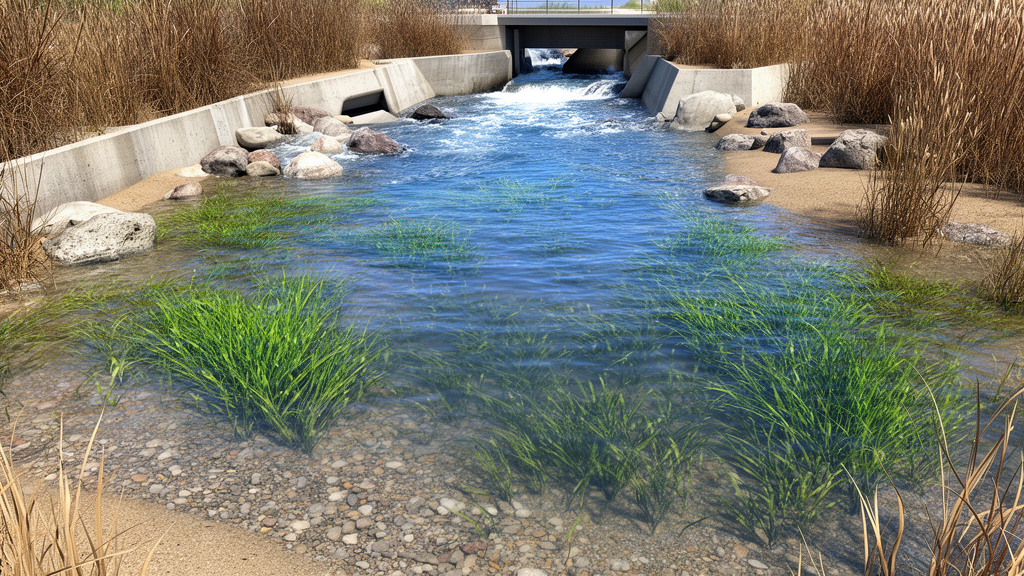
Image Credits: AI Generated
Keywords: macrophyte bioindicators, Mediterranean rivers, ecological water quality, river trophic status, biotic integrity, hydromorphology, aquatic vegetation, Morocco, HBS basin, European indices, Impact, hydromorphological
Cite Scienmag News
Gavin Prescott. (October 20, 2026). Research report: Impact of hydromorphological pressures on the macrophytes bioindicators of the ecological water quality in Mediterranean rivers. Scienmag. https://scienmag.com/research-report-impact-of-hydromorphological-pressures-on-the-macrophytes-bioindicators-of-the-ecological-water-quality-in-mediterranean-rivers/
Gavin Prescott. "Research report: Impact of hydromorphological pressures on the macrophytes bioindicators of the ecological water quality in Mediterranean rivers." Scienmag, 20 October 2026, https://scienmag.com/research-report-impact-of-hydromorphological-pressures-on-the-macrophytes-bioindicators-of-the-ecological-water-quality-in-mediterranean-rivers/. Accessed 20 October 2026.
Gavin Prescott. "Research report: Impact of hydromorphological pressures on the macrophytes bioindicators of the ecological water quality in Mediterranean rivers." Scienmag. October 20, 2026. https://scienmag.com/research-report-impact-of-hydromorphological-pressures-on-the-macrophytes-bioindicators-of-the-ecological-water-quality-in-mediterranean-rivers/


