

Tuesday, October 20, 2026
Science
No Result
View All Result
  • Login
  • HOME
  • SCIENCE NEWS
  • CONTACT US
  • HOME
  • SCIENCE NEWS
  • CONTACT US
No Result
View All Result
Scienmag
No Result
View All Result
Home Science News Medicine

Prompted VesselSAM outperforms standard LoRA in aortic vessel segmentation

October 20, 2026
in Medicine
Ophelia Keating
By Ophelia Keating Scienmag Editorial Profile - Health Services Research
Reading Time: 3 mins read
0
Prompted VesselSAM outperforms standard LoRA in aortic vessel segmentation

Prompted VesselSAM outperforms standard LoRA in aortic vessel segmentation

65
SHARES
587
VIEWS
Share on FacebookShare on Twitter
ADVERTISEMENT

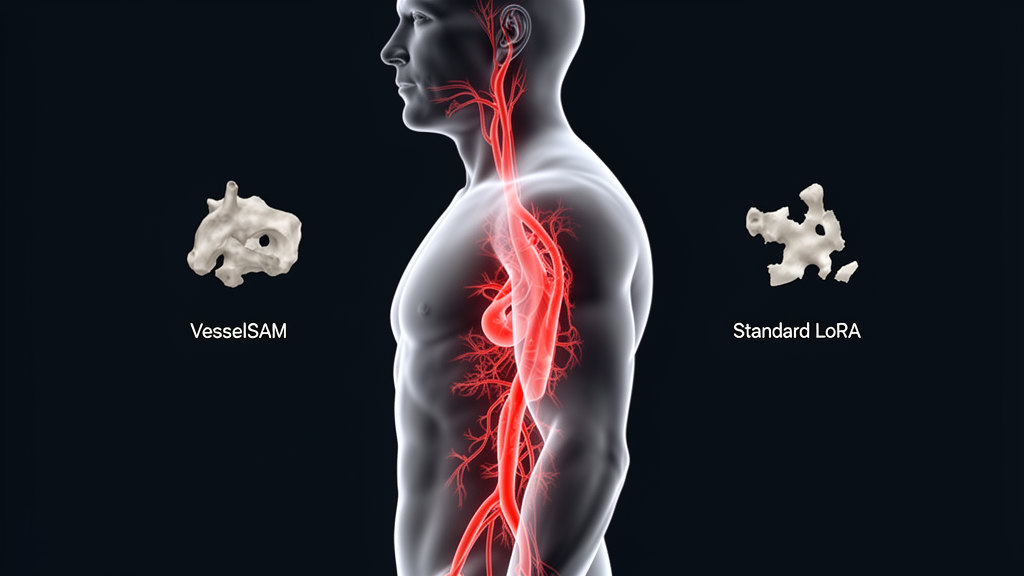
VesselSAM, a parameter-efficient adaptation of the Segment Anything Model, achieved slice-averaged Dice similarity coefficients above 93% for aortic vessel segmentation in an evaluation of computed tomography angiography images. The study assessed the system with tight ground-truth-derived box prompts across three cohorts from the multicenter Aortic Vessel Tree dataset and one Type-B Aortic Dissection dataset, reporting scores from 93.02% to 93.50%. The results indicate that the model’s advantage over standard Low-Rank Adaptation was associated with its AtrousLoRA design, which added multi-scale spatial processing to task-specific updates.

Across the four cohorts and two model initializations, AtrousLoRA produced Dice scores between 1.14 and 4.50 percentage points higher than standard LoRA. These findings apply to the evaluated datasets, prompt conditions and initialization settings rather than to unrestricted automatic segmentation. Accurate aortic segmentation involves delineating vessels with different calibers and irregular boundaries.

The researchers noted that full encoder fine-tuning of SAM updates many parameters, while conventional LoRA does not aggregate image context across different receptive fields within its task-specific update. VesselSAM was developed to accommodate both considerations by modifying the query and value projections in each image-encoder block of the base ViT-B vision transformer. At the technical level, the researchers inserted a multi-branch Atrous Attention Module into each rank-4 residual path associated with the selected query and value projections.

This architecture allowed the low-rank adaptation to process image context at multiple receptive-field scales while retaining a relatively small trainable parameter set. VesselSAM was initialized from MedSAM for the binary segmentation task, and the comparative evaluation considered both SAM and MedSAM initialization. The Aortic Vessel Tree cohorts were Dongyang, Rider and KiTS.

Tight bounding boxes derived from the ground-truth annotations were supplied at validation and test time, making the reported scores specific to a prompted segmentation setting rather than a fully automatic detection task. VesselSAM attained a slice-averaged Dice similarity coefficient of 93.50% on the Dongyang cohort, 93.25% on Rider and 93.02% on KiTS. The corresponding result for the Type-B Aortic Dissection dataset was 93.26%.

The consistent performance across these four evaluated cohorts shows that the reported numerical results were not confined to a single named dataset, although the evidence does not establish how the method would perform in other clinical settings or without ground-truth-derived prompts. The model updated 6.8 million parameters, equivalent to 7.2% of its total parameters, underscoring the parameter-efficient nature of the adaptation. The study’s central finding is therefore twofold: AtrousLoRA outperformed standard LoRA under the specified evaluation, and VesselSAM achieved high overlap scores for binary aortic vessel segmentation without full encoder fine-tuning.

Those results support the approach as a prompt-dependent adaptation of pretrained segmentation models, not as evidence of clinical benefit or clinical deployment. Overall, the research presents AtrousLoRA as a way to incorporate multiscale spatial processing into low-rank adaptation for aortic vessel segmentation. The reported gains over standard LoRA were measured across four cohorts and two initializations, with the strongest absolute DSC reaching 93.50%.

Important limits remain: the system relied on tight ground-truth-derived box prompts, and the supplied evidence does not demonstrate performance for prompt-free segmentation, unseen populations, or routine clinical use.

Subject of Research: Prompted parameter-efficient adaptation of SAM for aortic vessel segmentation in CT angiography

Article Title: VesselSAM: a parameter-efficient adaptation of SAM to aortic vessel segmentation with AtrousLoRA

Article References: Zhao, X., Zhuang, P., Zhang, Z., Iltaf, A., Ahmed, R. M., & Li, B. (2026). VesselSAM: a parameter-efficient adaptation of SAM to aortic vessel segmentation with AtrousLoRA. BMC Medical Imaging. https://doi.org/10.1186/s12880-026-02911-1

Image Credits: AI Generated

DOI: 10.1186/s12880-026-02911-1

Keywords: VesselSAM, AtrousLoRA, aortic segmentation, CT angiography, Segment Anything Model, MedSAM, low-rank adaptation, Dice coefficient, vision transformer, medical imaging, parameter-efficient, adaptation

Cite Scienmag News

Ophelia Keating. (October 20, 2026). Prompted VesselSAM outperforms standard LoRA in aortic vessel segmentation. Scienmag. https://scienmag.com/prompted-vesselsam-outperforms-standard-lora-in-aortic-vessel-segmentation/

Ophelia Keating. "Prompted VesselSAM outperforms standard LoRA in aortic vessel segmentation." Scienmag, 20 October 2026, https://scienmag.com/prompted-vesselsam-outperforms-standard-lora-in-aortic-vessel-segmentation/. Accessed 20 October 2026.

Ophelia Keating. "Prompted VesselSAM outperforms standard LoRA in aortic vessel segmentation." Scienmag. October 20, 2026. https://scienmag.com/prompted-vesselsam-outperforms-standard-lora-in-aortic-vessel-segmentation/


Tags: adaptationaortic segmentationaortic vessel segmentationAtrousLoRAAtrousLoRA designcomputed tomography angiographyCT angiographyDice coefficientDice Similarity Coefficientlow-rank adaptationlow-rank adaptation comparisonMedical ImagingMedSAMmulti-scale spatial processingmulticenter Aortic Vessel Tree datasetparameter-efficientSegment Anything ModelSegment Anything Model adaptationType-B Aortic Dissection datasetvessel boundary delineationVesselSAMvision transformervision transformer modifications
Share26Tweet16
Previous Post

Research report: High-frequency sequence stratigraphy and organic matter enrichment patterns of the Carboniferous Karawuyi Formation, Southwestern Tarim Basin

Next Post

Robot Assistance May Aid Upper-Limb Recovery, but Evidence Remains Fragile

Related Posts

Robot Assistance May Aid Upper-Limb Recovery, but Evidence Remains Fragile
Medicine

Robot Assistance May Aid Upper-Limb Recovery, but Evidence Remains Fragile

October 20, 2026
Admission underweight linked to adverse outcomes in infants with cholestasis
Medicine

Admission underweight linked to adverse outcomes in infants with cholestasis

October 20, 2026
Automated MS imaging finds microstructural complexity beyond lesion burden
Medicine

Automated MS imaging finds microstructural complexity beyond lesion burden

October 20, 2026
Blood inflammation index associated with poorer sleep in substance use disorders
Medicine

Blood inflammation index associated with poorer sleep in substance use disorders

October 20, 2026
Mumps incidence linked to weather and air pollution in Chongqing study
Medicine

Mumps incidence linked to weather and air pollution in Chongqing study

October 20, 2026
Research report: Physicians’ use of a digital tool with information views to support chart review of complex patient cases
Medicine

Research report: Physicians’ use of a digital tool with information views to support chart review of complex patient cases

October 20, 2026
Next Post
Robot Assistance May Aid Upper-Limb Recovery, but Evidence Remains Fragile

Robot Assistance May Aid Upper-Limb Recovery, but Evidence Remains Fragile

  • Mothers who receive childcare support from maternal grandparents show more optimized

    Mothers who receive childcare support from maternal grandparents show more parental warmth, finds NTU Singapore study

    27656 shares
    Share 11059 Tweet 6912
  • University of Seville Breaks 120-Year-Old Mystery, Revises a Key Einstein Concept

    1061 shares
    Share 424 Tweet 265
  • Bee body mass, pathogens and local climate influence heat tolerance

    682 shares
    Share 273 Tweet 171
  • Researchers record first-ever images and data of a shark experiencing a boat strike

    546 shares
    Share 218 Tweet 137
  • Groundbreaking Clinical Trial Reveals Lubiprostone Enhances Kidney Function

    531 shares
    Share 212 Tweet 133
Science

Embark on a thrilling journey of discovery with Scienmag.com—your ultimate source for cutting-edge breakthroughs. Immerse yourself in a world where curiosity knows no limits and tomorrow’s possibilities become today’s reality!

RECENT NEWS

  • Robot Assistance May Aid Upper-Limb Recovery, but Evidence Remains Fragile
  • Prompted VesselSAM outperforms standard LoRA in aortic vessel segmentation
  • Research report: High-frequency sequence stratigraphy and organic matter enrichment patterns of the Carboniferous Karawuyi Formation, Southwestern Tarim Basin
  • High-dose cerium dioxide nanorods induce behavioral and electroencephalographic abnormalities through 5-HT1B receptor signaling disruption with an evaluation of anpirtoline’s therapeutic potential

Categories

  • Agriculture
  • Anthropology
  • Archaeology
  • Athmospheric
  • Biology
  • Biotechnology
  • Blog
  • Bussines
  • Cancer
  • Chemistry
  • Climate
  • Earth Science
  • Editorial Policy
  • Marine
  • Mathematics
  • Medicine
  • Pediatry
  • Policy
  • Psychology & Psychiatry
  • Science Education
  • Science News
  • Social Science
  • Space
  • Technology and Engineering

Subscribe to Blog via Email

Enter your email address to subscribe to this blog and receive notifications of new posts by email.

Join 5,149 other subscribers

© 2025 Scienmag - Science Magazine

Welcome Back!

Login to your account below

Forgotten Password?

Retrieve your password

Please enter your username or email address to reset your password.

Log In
No Result
View All Result
  • HOME
  • SCIENCE NEWS
  • CONTACT US

© 2025 Scienmag - Science Magazine

Discover more from Science

Subscribe now to keep reading and get access to the full archive.

Continue reading