


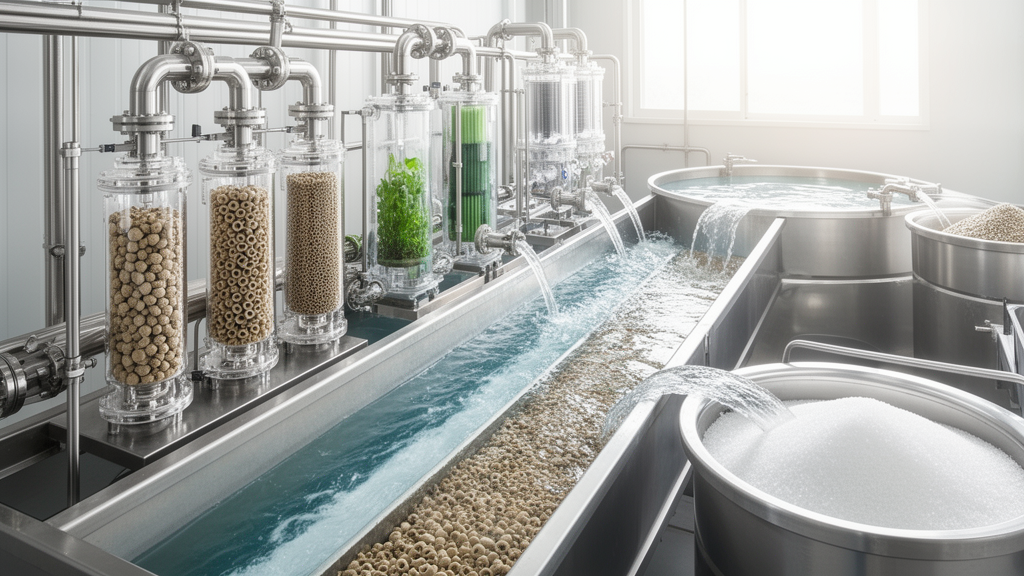
A 2026 perspective in Frontiers in Chemical Engineering argues that pollutant removal alone is insufficient to establish sustainable water treatment. The proposed material–process–resource framework traces a treatment material through its performance as part of an operating system, then examines final water quality, energy use, emissions, residual management and the usability of recovered products. Its three illustrative applications—ozonation, PFAS capture and destruction, and anaerobic membrane bioreactors—show how a favorable laboratory or pilot result may support a system-level benefit only after several additional checks.
The authors describe the framework as a decision aid that organizes established engineering and life-cycle methods, not a new life-cycle assessment method or a universal ranking of treatment technologies. The first step is to define the treatment service as one cubic metre of influent treated to a specified discharge or reuse quality. Comparisons must cover the complete final specification rather than a selected analyte, because the same percentage removal from different starting concentrations can produce water that meets very different requirements.
The operating boundary should include pretreatment, pumping, mixing, reaction, separation, cleaning, regeneration, conditioning and residual handling. A life-cycle inventory must additionally include the production and replacement of materials, chemicals and infrastructure, as well as downstream emissions and product use. Total volume treated and the volume of compliant product water should be reported separately, since an average concentration can conceal periods of inadequate treatment and because discharge and reuse may provide different services.
Energy accounting must then follow the physical plant and its metering arrangements. Gross demand includes all equipment needed to deliver the declared service: reaction, pumping, mixing, separation, cleaning, residual handling and energy-recovery equipment. Recovered energy can be credited only after conversion losses and only if it supplies a useful internal load or is delivered to an external user.
Methane qualifies as an electricity credit only after capture and conversion; flared methane and unused heat receive no credit. Electricity should be reported in kilowatt-hours per cubic metre and heat in kilowatt-hours of thermal energy per cubic metre, and the two should not be added without an explicit conversion basis. Recovered work must not be deducted twice, while gross demand should remain visible so that a large prospective recovery credit cannot obscure an inefficient operation.
Ozonation illustrates how a strong removal result can change meaning when the complete process is examined. In a full-scale study at the Neugut wastewater treatment plant, specific ozone doses of 0.35–0.97 grams of ozone per gram of dissolved organic carbon were tested. The site recommendation of 0.55 grams per gram achieved at least 80% average removal of 12 indicators across the plant.
However, seven quantified primary transformation products resisted biological post-treatment, and fresh granular activated carbon removed them less effectively than their parent compounds. The measured result therefore supported effective indicator removal but did not establish complete mineralization or control of final-effluent effects; the relevant treatment chain extended from ozone dose through the contactor and downstream filtration to the final water-quality requirement. An illustrative screening calculation shows how ozone input can be related to energy without pretending to provide a complete plant balance.
Secondary effluent containing 10 milligrams of dissolved organic carbon per litre, equivalent to 10 grams per cubic metre, would require 5.5 grams of ozone per cubic metre at the recommended dose. Applying an air-fed generation inventory of 18.8 kilowatt-hours per kilogram of ozone gives a generation electricity estimate of 0.1034 kilowatt-hours per cubic metre. The authors caution that this calculation combines inputs from different studies and is not a measured Neugut value.
Auxiliary loads, downstream treatment and other excluded demands must be checked before they are added, partly to avoid double counting. A published life-cycle comparison produced a more consequential result: assumed liquid-oxygen-fed generation used 25% less electricity than air-fed generation, but including oxygen production and transport yielded approximately four times the operating climate impact under the study’s Swedish electricity assumptions. Advanced-treatment benefits must also remain distinct from the burdens required to obtain them.
One comparative life-cycle assessment included 65 micropollutants and found that modelled benefits from their removal were outweighed by added energy and resource impacts. That finding did not establish that advanced treatment should be omitted, because uncharacterised toxicity effects and the required discharge quality still matter. A separate assessment found net toxicity benefits when bioassay-based effects were included.
Together, the results support reporting chemical removal, biological effects and life-cycle consequences separately and identifying the method and boundary behind any preference. A sustainability claim should therefore state whether it rests on measured pollutant reduction, modelled toxicity change, resource impacts or a defined combination, rather than presenting a removal percentage as the complete answer. PFAS treatment reveals another important distinction: capture is not destruction.
Activated carbon and ion-exchange media can transfer PFAS from water into a concentrated phase, while electrodes may transform or destroy compounds in that concentrate. Sorption performance leads to a capture process and creates spent media or regenerant, whereas electrochemical performance raises questions about transformation products, remaining fluorine and electricity demand. In landfill leachate treated at a current density of 75 milliamperes per square centimetre, one study reported average removals of 80% for PFOA and 78% for PFOS under its electrochemical conditions, but these were parent-compound endpoints.
A separate laboratory study combining graphite-based adsorption with electrochemical regeneration obtained 99.4% PFOA removal while detecting shorter-chain products. Neither result by itself establishes complete or safe PFAS destruction across other matrices or at plant scale. The framework calls for a staged mass balance using the same source water.
Capture followed by the proposed destruction step should be compared with a feasible capture-and-residual-management alternative, with the capture medium followed through breakthrough and regeneration, treated and concentrated volumes recorded, and PFAS mass assigned to each outlet. Three destruction endpoints must remain separate: loss of the target PFAS, reduction in measured organic fluorine, and recovery of fluorine as inorganic fluoride. Flow-weighted sampling should cover liquid, solids and any relevant gas outlet, while analytical recovery, detection limits and the unclosed fraction must be disclosed.
Missing mass is not evidence of mineralization. Where those measurements are unavailable, the claim should be restricted to disappearance of the compounds actually measured, and the PFAS-rich residual must still have a documented management route. Anaerobic membrane bioreactors show why estimated recovery is not yet a delivered energy benefit.
The membrane is the engineered treatment material, and its permeability, selectivity and fouling behaviour influence solids retention, permeate production, cleaning and fouling-control energy. At 15 degrees Celsius, one study measured permeate chemical oxygen demand of 76 ± 10 milligrams per litre and five-day biochemical oxygen demand of 24 ± 3 milligrams per litre. Dissolved methane represented 40%–50% of total methane production, representing both an unrealised recovery opportunity and a potential emission.
Effective carbon removal alone therefore cannot establish energy neutrality or a low-carbon outcome, because dissolved and fugitive methane, downstream polishing and residual nutrient management remain part of the system. A pilot assessment estimated an energy surplus of 0.55–0.74 kilowatt-hours per cubic metre for an anaerobic membrane bioreactor used as an initial anaerobic treatment stage. The estimate relied on a carbon balance for methane production, critical-flux tests, calculated fouling-control energy and assumptions about methane recovery and conversion.
Membrane reciprocation required an estimated 0.59 kilowatt-hours per cubic metre at a flux of 7 litres per square metre per hour, compared with 1.56 kilowatt-hours per cubic metre for biogas sparging at 6 litres per square metre per hour; because the fluxes differed, these were not measurements at identical operating conditions. The surplus was not metered electricity exported by a complete reuse facility. Deployment would require metering of recovery equipment and useful output, measurement of dissolved methane before and after recovery, and inclusion of polishing, leakage and nutrient management.
Across the three applications, the decisive question is whether a promising material or reactor result survives the checks for final-water quality, a complete process inventory, a credible destination for residuals and useful outputs, and transparent environmental and cost comparisons.
Subject of Research: A decision framework for assessing system-level sustainability in water treatment through treatment performance, energy accounting, resource recovery and residual fate.
Article Title: Beyond pollutant removal: a material–process–resource perspective on sustainable water treatment
Article References: Ogwu, M. C., Izah, S. C., Aseibai, E. R., & Promise, V. I. (2026). Beyond pollutant removal: a material–process–resource perspective on sustainable water treatment. Frontiers in Chemical Engineering, 8, Article 1957125. https://doi.org/10.3389/fceng.2026.1957125
Image Credits: AI Generated
DOI: 10.3389/fceng.2026.1957125
Keywords: water treatment, sustainability, ozonation, PFAS capture, PFAS destruction, anaerobic membrane bioreactor, life-cycle assessment, energy accounting, resource recovery, transformation products, Beyond, pollutant
Cite Scienmag News
Russell Cooper. (October 20, 2026). Research report: Beyond pollutant removal: a material–process–resource perspective on sustainable water treatment. Scienmag. https://scienmag.com/research-report-beyond-pollutant-removal-a-material-process-resource-perspective-on-sustainable-water-treatment/
Russell Cooper. "Research report: Beyond pollutant removal: a material–process–resource perspective on sustainable water treatment." Scienmag, 20 October 2026, https://scienmag.com/research-report-beyond-pollutant-removal-a-material-process-resource-perspective-on-sustainable-water-treatment/. Accessed 20 October 2026.
Russell Cooper. "Research report: Beyond pollutant removal: a material–process–resource perspective on sustainable water treatment." Scienmag. October 20, 2026. https://scienmag.com/research-report-beyond-pollutant-removal-a-material-process-resource-perspective-on-sustainable-water-treatment/


