


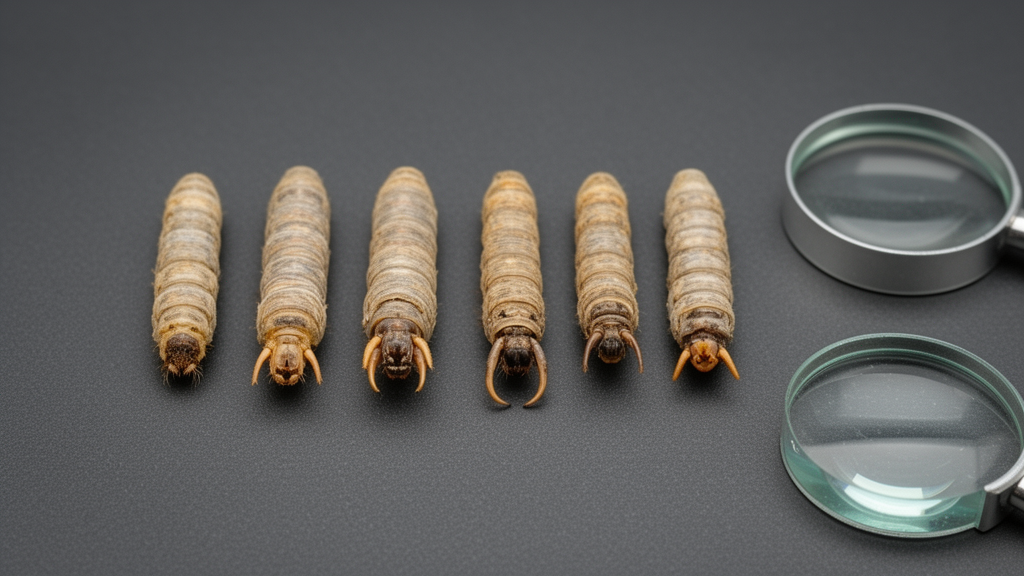
Scanning electron microscopy of six Notodontidae moth species found clear differences in the final-instar mouthparts of the caterpillars, including paired hollow maxillary sacs, species-specific labral notches and sensory structures, and six blunt teeth on the mandibles of Nerice davidi. The study compared Euhampsonia cristata, Fentonia ocypete, Phalera assimilis, Nerice davidi, Cerura erminea and Furcula furcula under the same imaging approach. It also recorded the caterpillars’ host plants, observed feeding positions, social behavior and pupation sites.
The observations provide additional characters for larval identification and document an exception to the previously reported mature-larva mandible form of Notodontidae, although the proposed links between particular structures and feeding or cocoon-building behaviors were not tested directly in feeding experiments. The species examined belong to a large family of Lepidoptera comprising approximately 3,800 recognized species in 734 genera worldwide. Its larvae are commonly called prominents and are recognized by relatively large head capsules and modified anal prolegs.
The caterpillars studied were all herbivorous and fed on leaves. The authors used these known host associations and life-history observations as context for comparing mouthpart form. The work was a comparative morphological study of laboratory-reared final-instar larvae, not a field test of performance on different plants or a broad survey of all Notodontidae species.
For the microscopy, adult females were collected under light traps, and fertilized eggs were maintained at 26 ± 1 °C with moist absorbent cotton. After emergence, the larvae received fresh leaves of their respective host plants and were photographed with a digital camera. Five final-instar individuals of each species were dissected, dehydrated in a graded ethanol series, transferred to tertiary butanol, freeze-dried for three hours and coated with gold.
They were then examined with a Hitachi S-3400N scanning electron microscope at 5 kV. All six species had the mandibulate arrangement of a labrum, a pair of mandibles and a maxilla-labial complex, but details of their shapes, setae, sensilla and silk-producing spinnerets differed. One conspicuous feature was shared across all six species.
The maxillae each possessed an elongate, sometimes hairy or apparently hollow maxillary sac on the inner surface of the galea. Such structures had previously been called stipital lobes and had been reported as diagnostic features of Notodontidae. Electron microscopy showed that the structures were internally hollow, while their position made placement on the stipes difficult to establish.
On that basis, the authors proposed that “maxillary sac” was the more appropriate term. They also suggested that the sacs might form seals between the mandibles and maxillae and help retain leaf tissue in the oral cavity, but that functional interpretation was not verified by the study. The shared presence of the sacs was an observed result; the name change and proposed sealing role were the authors’ interpretation.
N. davidi supplied the strongest departure from the pattern reported for the other five mature larvae. Its heavily sclerotized mandibles each carried six blunt dentitions on the distal margin, whereas the cutting edges of the other species were smooth. The finding was notable because Notodontidae larvae had previously been described as having serrate mandibles in the first instar but smooth mandibles in later stages.
The toothed mandibles of mature N. davidi were also similar to those reported for stem-chewing Sericinus montela larvae and polyphagous Spodoptera exigua larvae. The authors proposed that the teeth might be related to feeding on rough or wrinkled tissues of U. pumila, but the study did not directly measure feeding, test the elm leaves against alternative foods or establish the evolutionary cause of the condition. The front of the mouth also showed a suite of distinctions among species.
E. cristata, P. assimilis and F. furcula had V-shaped labral notches. F. ocypete had a much deeper central split, with two lateral lobes overlapping in the middle, while N. davidi had a shallow notch that did not extend to the center. C. erminea possessed a longitudinal central notch.
Every species had six pairs of labral setae, but their relative lengths and positions differed. The epipharynx carried sensilla chaetica, digitiform sensilla and epipharyngeal sensilla in differing numbers and arrangements. For example, E. cristata and P. assimilis had three pairs of sensilla chaetica, whereas F. ocypete had two pairs of similar length.
These characters expand the set of observable traits available for distinguishing the final-instar larvae, although the paper did not test how the differences affect the detection or handling of food. The caterpillars’ feeding behavior changed between the first and final instars. Newly hatched larvae were observed chewing the ventral surfaces of host leaves, while mature larvae usually bit leaf edges.
Mature E. cristata, F. ocypete and P. assimilis held onto twigs and leaves while feeding. P. assimilis was also unusual among the six species because its larvae lived gregariously; the other five were solitary. These observations were accompanied by specific life-history data.
When fully grown, E. cristata, F. ocypete, P. assimilis and N. davidi built cocoons in soil. C. erminea and F. furcula instead secreted thickened cocoons covering tree bark. The pupation locations and cocoon-building behaviors were therefore known parts of the study’s record, making it possible to compare them with spinneret structure without claiming that the morphology alone established the behavior.
Spinnerets showed several distinct forms. E. cristata had a generally tubular spinneret that tapered toward its apex and was longitudinally depressed along the dorsal distal surface. F. ocypete had a dorsoventrally flattened spinneret with a slightly separated distal opening.
P. assimilis and N. davidi likewise had dorsoventrally depressed distal openings, although their overall proportions differed. C. erminea had a short, dorsoventrally depressed spinneret with a widely separated opening, while F. furcula had a distinct broad, flat, lamellar spinneret. The four species that usually pupated in soil had longitudinally or dorsoventrally depressed tubular forms, whereas the two bark-associated species had broader or more flattened forms.
The authors considered the differences likely related to silk secretion or cocoon-spinning behavior, consistent with earlier observations, but no mechanical analysis of silk or controlled comparison of cocoon construction was performed. The study also placed the six species in relation to reported mouthpart patterns in other lepidopteran larvae. Smooth cutting edges occur in some leaf-feeding caterpillars, whereas dentate or combined cutting edges and cusps have been recorded in other groups.
The mature N. davidi mandibles added a clearly documented exception within Notodontidae. Elsewhere, F. ocypete was distinctive not only for its deeply divided labrum but also for the positions and lengths of its labral setae and its two pairs of epipharyngeal sensilla chaetica. The authors suggested that this combination might be taxonomically informative or associated with unusual biology, while emphasizing that further observations were required.
Similarly, the correspondence between spinneret form and pupation site was an association across six species, not evidence that changing a spinneret would cause a particular cocoon or pupation behavior. Overall, the comparison demonstrates that detailed final-instar mouthpart anatomy differs substantially even among caterpillars that share a family and a broad leaf-feeding lifestyle. It records a shared maxillary-sac structure, documents the unusual mature mandibles of N. davidi, and separates labral, sensory and spinneret characters that can be evaluated in taxonomic work.
The study’s strongest conclusions are morphological: these structures can be observed and compared, and they differ among species in measurable ways. Its ecological suggestions remain provisional because only six species were examined, the larvae were laboratory-reared, and the proposed relationships among mandible teeth, leaf tissue, silk emission and cocoon construction were not subjected to direct functional tests.
Subject of Research: Comparative larval mouthpart morphology and observed life-history traits in six Notodontidae moth species
Article Title: Comparative morphology of the larval mouthparts among six species of Notodontidae ( Insecta , Lepidoptera ), with discussions on their feeding habits and pupation sites
Article References: Liu, J.-X., & Jiang, L. (2023). Comparative morphology of the larval mouthparts among six species of Notodontidae (Insecta, Lepidoptera), with discussions on their feeding habits and pupation sites. Deutsche Entomologische Zeitschrift, 70(2), 357-368. https://doi.org/10.3897/dez.70.107431
Image Credits: AI Generated
Keywords: Notodontidae, caterpillar mouthparts, scanning electron microscopy, Nerice davidi, larval mandibles, maxillary sacs, spinneret morphology, leaf feeding, cocoon construction, pupation sites, Comparative, morphology
Cite Scienmag News
Gavin Prescott. (October 20, 2026). Larval mouthpart morphology compared in six Notodontidae moth species. Scienmag. https://scienmag.com/larval-mouthpart-morphology-compared-in-six-notodontidae-moth-species/
Gavin Prescott. "Larval mouthpart morphology compared in six Notodontidae moth species." Scienmag, 20 October 2026, https://scienmag.com/larval-mouthpart-morphology-compared-in-six-notodontidae-moth-species/. Accessed 20 October 2026.
Gavin Prescott. "Larval mouthpart morphology compared in six Notodontidae moth species." Scienmag. October 20, 2026. https://scienmag.com/larval-mouthpart-morphology-compared-in-six-notodontidae-moth-species/


