


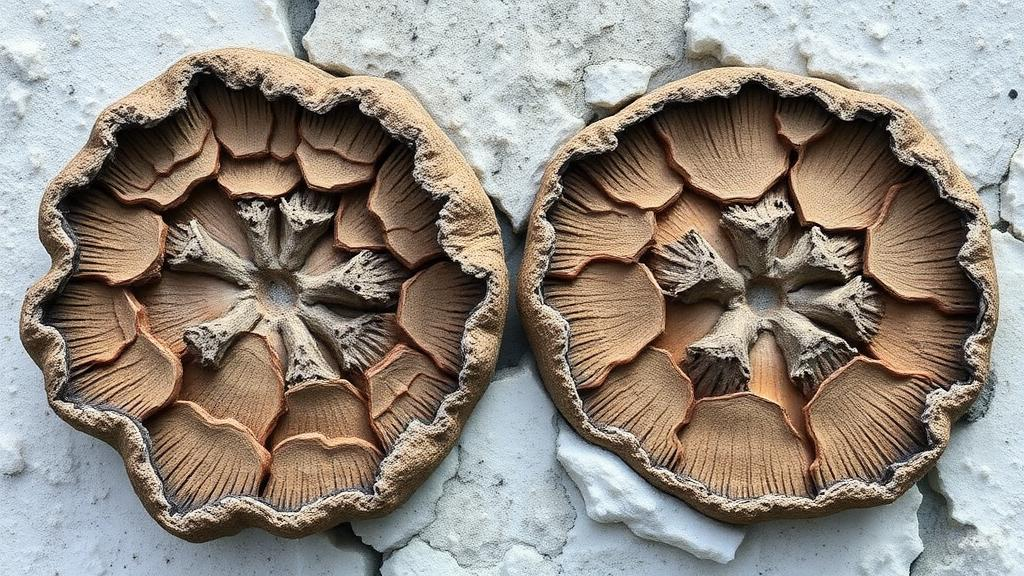
Silicified wood collected from Carapace Nunatak in South Victoria Land contains two distinct Early Jurassic conifer wood types, Agathoxylon and Brachyoxylon , according to a microscopic and statistical study of specimens collected in 2014–2015. The wood also preserves fungal hyphae, clamp connections and traces of degradation resembling the activity of soft-rot fungi. These are the first formal reports of Agathoxylon and Brachyoxylon from the Jurassic of Antarctica.
The research is based on ten putative specimens, of which four were preserved well enough to show all the anatomical characters needed for wood taxonomy. The fossils came from a moraine on the east-northeast side of Carapace Nunatak, a site at 76°53′S, 159°25′E and 2,150 metres above sea level in the Central Transantarctic Mountains. The specimens occurred with blocks of silicified chert containing plant material from lacustrine beds of the Kirkpatrick Basalt Formation.
Radiometric dating and palynological analyses indicate an early Toarcian age, approximately 180 million years ago, for the formation. Based on the surrounding matrix, the moraine location and the associated chert, the researchers concluded that the woods were derived from the Kirkpatrick Basalt Formation and assigned them a Toarcian age. Ten possible wood specimens were recovered, but their quality varied substantially.
Four specimens—numbered 270, 271, 272 and 274—were sufficiently preserved to observe the principal characters used in the analysis. Four others, 273, 275, 276 and probably 279, were more distorted and did not permit as many reliable measurements. Specimen 277 was too poorly preserved for anatomical description, while specimen 278 was a wood impression on sedimentary rock containing small fusains rather than anatomically preserved wood.
The investigators prepared thin sections in transverse, tangential and radial planes and examined them under reflected light with stereomicroscopes, compound microscopes and a digital microscope. All the analyzable samples consisted of tracheids and parenchymatous rays. Average tracheid diameter generally ranged from 25 to 30 micrometres, depending on the specimen.
Rays were predominantly uniseriate, although some were partly biseriate, and the tallest contained no more than about 10 cells. Their walls were thin, straight and unperforated, and the cells commonly contained dark brown to black material. The end walls of the ray cells were perpendicular or subperpendicular to the rays.
Axial parenchyma was present only rarely and showed no particular organization, while resin canals were absent. Specimen 271 was identified as a branch approximately 7 by 5 centimetres in diameter and preserved several growth-ring boundaries. The other pieces lacked enough continuous wood to establish their original positions within a plant.
The most useful distinction between the samples involved pitting on the radial walls of the tracheids. Specimens 270, 271, 272 and 274 had mixed pitting, combining araucarian and abietinean forms. Where pitting was visible, araucarian pits represented about 55–60 percent of the total, and their distribution was not homogeneous throughout specimen 270.
Specimens 273, 275, 276 and probably 279 showed araucarian pitting. In this group, pits were contiguous in about 90 percent of observed cases and often flattened; when multiple rows occurred, they were arranged alternately. These differences in radial pitting were considered taxonomically significant and more reliable for classification than ray height, partly because the fragments could represent different positions within separate trees.
Ray height provided an additional statistical signal but could not reliably separate the material at the genus level. Thirty ray heights were measured in tangential or radial sections for each specimen. Individual measurements ranged from 25.5 to 310.6 micrometres, while specimen averages ranged from 61.0 to 166.6 micrometres.
A Kruskal–Wallis test found significant differences among specimens, with a chi-squared value of 71.148, seven degrees of freedom and a p-value below 0.001. Nevertheless, substantial variation among specimens prevented ray height from distinguishing the two morphogenera reliably. Using the pitting patterns and other anatomical features, the araucarian-pitting specimens were assigned to Agathoxylon , while the mixed-pitting specimens were placed in Brachyoxylon .
The araucarian group had araucarian cross-fields with numerous contiguous, unordered cupressoid to taxodioid oculipores, no spiral thickening and ray end walls oriented perpendicular or subperpendicular to the rays. The mixed group had araucarian cross-fields and earlywood oculipores that were consistently cupressoid. The authors identified only the genera, not species, because the sample was small, preservation was poor and variable, and the anatomical differences could include normal variation within a plant.
Agathoxylon has been associated with several groups of gymnosperms, including conifers, cordaites and pteridosperms, whereas Brachyoxylon has most often been linked with the extinct conifer family Hirmeriellaceae but has also been associated with Araucariaceae and Cupressaceae. The specimens also contain direct evidence of fungi. Fragmented hyphae occur in greatest concentration in the rays and adjacent cells.
The narrow forms measure 2–5 micrometres in diameter, while wider forms are at least 6 micrometres across; some of the wider structures may represent a biomimetic form. The hyphae branch perpendicularly at uneven intervals, are sparsely septate and are occasionally joined by rare clamp connections. Their presence indicates that at least one fungal organism belonged to the basidiomycetes.
Small ellipsoidal or spherical propagules occur terminally or intercalary, although similar structures could be preservation artifacts or possible tyloses rather than fungal propagules. Because the fungal remains are degraded and may include more than one species, the authors could not confidently determine their systematic affinities beyond the basidiomycete indication. Mycelia occur in several orientations and can be traced through pits from one tracheid into an adjacent tracheid.
Elsewhere, large erosional cavities create a starburst-like appearance in tracheid lumina, while troughs extend through the walls of neighboring cells. This degradation pattern resembles that produced by some living soft-rot fungi, which can make wood soft and spongy and complicate the preservation of diagnostic anatomy. The researchers propose that the trees had begun to decay before silicification, based on the fungal remains and the extensive damage.
They also acknowledge that some deterioration could have occurred before burial or during the taphonomic process, so the relative timing of decay and mineral replacement is not established with certainty. Comparisons with other Jurassic woods show that the Carapace Nunatak material is anatomically distinct from some previously described specimens but similar to others. Early Jurassic trunks from the Mesa Range in North Victoria Land had been assigned to Protocupressinoxylon , a name treated as a nomenclatural synonym of Protobrachyoxylon .
Those trunks had rays reaching 40 cells, no axial parenchyma and cross-field pitting with three to six non-contiguous cupressoid pits, unlike the crowded pits in the new specimens. The conifer stump from nearby Coombs Hills shared uniseriate rays, thin unpitted ray-cell walls and araucarioid cross-fields with the Carapace Nunatak woods. However, the stump had smaller tracheids, rays reaching 15 cells and a mean ray height of 66 micrometres, and it lacked data on the frequency of the two radial pitting types.
The researchers therefore said that similarity with some of the new woods could not be ruled out rather than treating it as a definitive match. Taken together, the new material indicates that at least three named wood morphotypes occurred in Victoria Land during the Early Jurassic: Protobrachyoxylon , Agathoxylon and Brachyoxylon , with the poorly compared Coombs Hills stump potentially representing additional diversity. The identifications also fit other fossils from Carapace Nunatak.
The site contains abundant Classopollis pollen, often associated with Hirmeriellaceae, and the permineralized pollen cone Classostrobus elliotii , assigned to that family. The Brachyoxylon wood provides additional evidence for Hirmeriellaceae at the locality. Another pollen cone, Chimaerostrobus minutus , combines characters reminiscent of Voltziales and Araucariaceae, and the authors note that the Agathoxylon wood may be associated with one of those groups, although that relationship is not demonstrated.
The apparent scarcity of anatomically studied Jurassic wood in Antarctica may reflect environmental constraints, volcanic activity and limited sampling; it may also be influenced by the greater ease of collecting recognizable leaves, cones and pollen than wood requiring sectioning and microscopy. The findings provide anatomical evidence that multiple conifer groups were present in Antarctica during an interval in which several modern conifer lineages were diverging and diversifying.
Subject of Research: Anatomical diversity, conifer affinities and fungal decay in Early Jurassic silicified wood from Carapace Nunatak, Antarctica
Article Title: Early Jurassic silicified woods from Carapace Nunatak, South Victoria Land, Antarctica
Article References: Toumoulin, A., Decombeix, A.-L., Harper, C. J., & Serbet, R. (2023). Early Jurassic silicified woods from Carapace Nunatak, South Victoria Land, Antarctica. Fossil Record, 26(1), 103-115. https://doi.org/10.3897/fr.26.102570
Image Credits: AI Generated
DOI: 10.3897/fr.26.102570
Keywords: Antarctica, Early Jurassic, fossil wood, conifers, silicification, fungi, Toarcian, Victoria Land, paleobotany, Gondwana, Early, Jurassic
Cite Scienmag News
Roger Howard. (October 20, 2026). Antarctic fossil woods reveal two Jurassic conifer types and fungal decay. Scienmag. https://scienmag.com/antarctic-fossil-woods-reveal-two-jurassic-conifer-types-and-fungal-decay/
Roger Howard. "Antarctic fossil woods reveal two Jurassic conifer types and fungal decay." Scienmag, 20 October 2026, https://scienmag.com/antarctic-fossil-woods-reveal-two-jurassic-conifer-types-and-fungal-decay/. Accessed 20 October 2026.
Roger Howard. "Antarctic fossil woods reveal two Jurassic conifer types and fungal decay." Scienmag. October 20, 2026. https://scienmag.com/antarctic-fossil-woods-reveal-two-jurassic-conifer-types-and-fungal-decay/


