


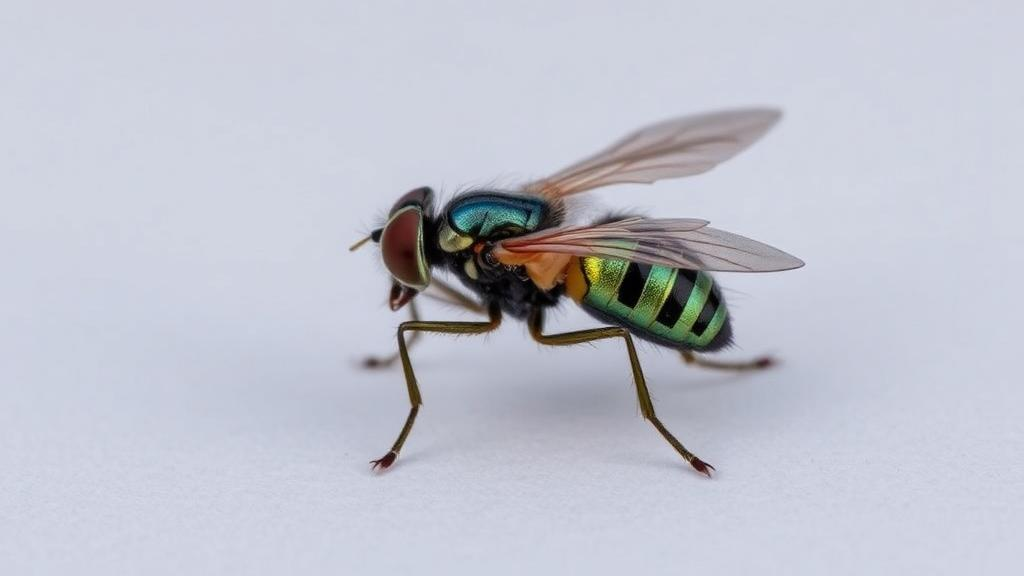
A minute fly collected in an oak-and-chestnut forest near Losone, in the Swiss canton of Ticino, has been identified as a species new to science: Periscelis (Myodris) haennii. The discovery emerged from a forest insect survey in which numerous specimens appeared to be Periscelis (M.) annulata under an existing identification key but showed different features in their male genitalia. Researchers examined the new material alongside the other two European species of the subgenus Myodris, redescribed the male terminalia of P. (M.) annulata, and tested the distinctions with DNA barcoding.
The study identifies P. (M.) haennii as a cryptic species whose close relatives cannot be separated reliably from external appearance alone. The investigation formed part of an entomological program conducted by the Natural History Museum of Canton Ticino in Lugano to document forest insect diversity around Locarno. Investigators surveyed three stations in a Querco-castagnetum forest over a full year, from July 2015 to July 2016, and used different kinds of traps.
Three slightly different attractant traps—transparent traps containing wine or beer and a yellow trap containing wine—captured 99.4% of the Periscelididae collected. A total of 305 males of the new species were trapped. The material was initially preserved in ethanol, after which 53 specimens designated as the type series were dried and mounted on pins for examination.
Under the most recent identification key available to the researchers at the time, many of the captured flies were treated as P. (M.) annulata, a species described by Fallén in 1813. However, the male terminalia of the specimens did not match the diagnostic features of that species. This discrepancy prompted taxonomic verification with international expertise from the late László Papp of Budapest and Miguel Carles-Tolrá of Barcelona.
To determine whether the unusual genital structure represented a distinct species, the team examined the male terminalia of all three European members of Myodris: P. (M.) haennii, P. (M.) annulata, and P. (M.) piricercus, described by Carles-Tolrá and Verdugo Páez in 2009. The male terminalia of P. (M.) annulata were redescribed and illustrated as part of that comparison. The holotype of the new species measures 1.31 mm in total body length and 1.01 mm in wing length.
Its general coloration is brown and grey, with dull, microtomentose surfaces and yellow to yellow-ochre areas on the head, mouthparts, and legs. The microtomentum of the scutum and scutellum is darker and browner than in P. (M.) annulata, so the brown acrostichal and dorsocentral stripes have less contrast against the background. The fly’s legs are yellow and brown, while small silvery-white spots occur along the lateral margins of abdominal tergites 3–6.
Although some of these external traits differ from P. (M.) annulata, the decisive features are found in the male genitalia, particularly the cerci, surstylus, postgonite, and ejacapodeme. In the new species, the cerci are longer and more slender than those of P. (M.) annulata and longer than the anal opening of the epandrium. Each cercus bears two short, robust anteroapical spines that arise close together, while its subapical posterior setae are scarcely longer than adjacent posterior setae.
The surstylus narrows more gradually and remains relatively straight distally. The postgonite is more elongate, with a slender distal portion that is longer and slightly bent. The ejacapodeme is also proportionally more elongate, measuring about 5.5 times as long as its maximum width, compared with about 4.5 times that length in P. (M.) annulata.
These distinctions form the basis of the authors’ identification key for European male Myodris flies. Molecular analysis supplied an additional line of evidence. The researchers amplified and sequenced the COI barcoding region from one specimen each of P. (M.) haennii, P. (M.) annulata, and P. (M.) piricercus, together with Periscelis (s. str.) winnertzii for comparison.
All analyzed flies came from Losone in Ticino and had been preserved in 80% ethanol. The COI sequences were 658 base pairs long, and genetic distances were calculated with the Kimura two-parameter model. P. (M.) haennii differed from P. (M.) annulata by 7.58% and from P. (M.) piricercus by 9.12%.
The distance between P. (M.) annulata and P. (M.) piricercus was 6.88%. Because only one specimen per species was barcoded, the analysis could not measure intraspecific variation. Long series of all three European Myodris species from the same locality and habitat also revealed previously unrecognized variation in thoracic micropubescence, color pattern, and clouding of the wing membrane and veins.
The wing clouding was particularly variable in P. (M.) annulata. As a result, the researchers concluded that the three species cannot be recognized safely using only external features and that identification should always be verified by examining the male genitalia. Females consequently cannot be assigned unambiguously to species from morphology at present, although the study reports that molecular barcoding can identify them.
The new key is therefore restricted to males and uses genital characters rather than the variable external coloration and wing pattern seen in the field material. Within the key, P. (M.) piricercus is separated from the other two species by its sparsely setose pregenital sternum, short pyriform cercus with an expanded proximal half, short and broadly based surstylus, and short, broad postgonite with a robust apex. P. (M.) haennii and P. (M.) annulata both have more densely setose pregenital sternites, slender elongate cerci, long and slender surstyli, and long, distally slender postgonites.
The new species differs from P. (M.) annulata in the relative length of its cercus, the close spacing of the two anteroapical cercus spines, the reduced prominence of the subapical posterior setae, the straighter distal surstylus, and the longer, slightly bent distal portion of the postgonite. These are the specific observations used to distinguish the two species under magnification. The type locality is the Forest Reserve of Parco Collina di Maia in Losone, at 46°09′53″ N, 8°44′54″ E and an elevation of 419 metres.
The holotype is a pinned male collected between 21 and 28 July 2015 in a chestnut-and-oak forest and is deposited in the Natural History Museum of Canton Ticino. Paratypes are held in Lugano and at the Silesian Museum in Opava, Czech Republic. Additional material was collected in 2016 and 2017.
At present, P. (M.) haennii is known only from southern Switzerland. The authors suggest that it may also occur elsewhere in Europe, particularly in more southern areas, because earlier records of P. (M.) annulata may have included the new species, but no confirmed distribution outside Ticino is reported. The biology of P. (M.) haennii remains unknown.
The authors consider it plausible that the species has habits similar to P. (M.) annulata, which has been associated with sap runs on wounded trees, especially oaks and elms, often in their crowns, and whose larvae reportedly develop in fermenting tree sap. That comparison is explicitly provisional and does not document the biology of the new species. What is known directly is that 305 specimens were collected in wine- and beer-baited traps in a lowland forest dominated by oaks and chestnuts.
The same traps also captured both other European Myodris species and two species of Periscelis in the strict sense. The authors describe P. (M.) haennii as another cryptic member of the Periscelididae and suggest that additional unnamed species may be found, particularly in less thoroughly explored eastern and southeastern parts of Europe, when long-term fieldwork and specialist taxonomic examination are available.
Subject of Research: Taxonomic identification of a new cryptic Periscelididae fly species using male genital morphology and COI DNA barcoding
Article Title: Periscelis ( Myodris ) haennii sp. nov., a new species of Periscelididae ( Diptera ) from Ticino, Switzerland, with a new key to European species of the subgenus
Article References: Pollini Paltrinieri, L., & Roháček, J. (2022). Periscelis (Myodris) haennii sp. nov., a new species of Periscelididae (Diptera) from Ticino, Switzerland, with a new key to European species of the subgenus. Alpine Entomology, 6, 39-49. https://doi.org/10.3897/alpento.6.85391
Image Credits: AI Generated
Keywords: new species, Periscelis haennii, Periscelididae, cryptic species, DNA barcoding, male genitalia, Myodris, Ticino, forest biodiversity, taxonomy, Periscelis, haennii
Cite Scienmag News
Drew Townsend. (October 20, 2026). Tiny Ticino fly identified as new cryptic species. Scienmag. https://scienmag.com/tiny-ticino-fly-identified-as-new-cryptic-species/
Drew Townsend. "Tiny Ticino fly identified as new cryptic species." Scienmag, 20 October 2026, https://scienmag.com/tiny-ticino-fly-identified-as-new-cryptic-species/. Accessed 20 October 2026.
Drew Townsend. "Tiny Ticino fly identified as new cryptic species." Scienmag. October 20, 2026. https://scienmag.com/tiny-ticino-fly-identified-as-new-cryptic-species/


