


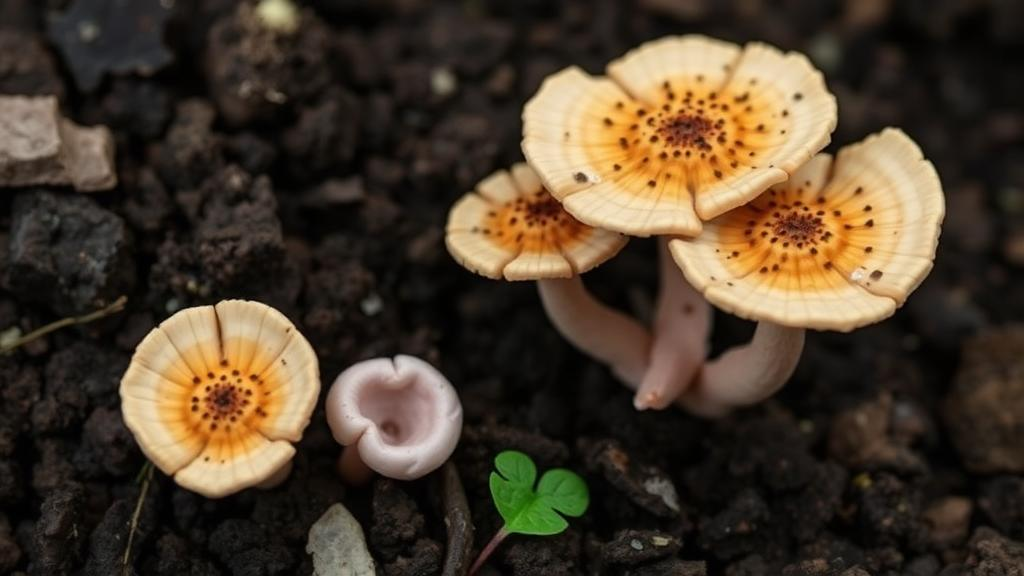
A study of soil fungi collected in southern China has identified three new species in the family Cunninghamellaceae: Absidia grisea, Absidia dendroidea and Cunninghamella dimorpha. The researchers described the taxa using colony morphology, microscopic structures and DNA sequence analyses, with each species forming a distinct, strongly supported lineage in phylogenetic trees. The work is the 15th installment of a series examining the diversity of early-diverging fungi in China.
The new species were isolated from soil samples collected in Guangdong and Yunnan provinces during 2025. Two Absidia species were recovered from Guangdong sites in and around Maoming, while C. dimorpha came from sites in Xishuangbanna Dai Autonomous Prefecture in Yunnan, including Jinghong and Mengla. The authors used a combination of soil-sprinkling and single-spore isolation methods. Soil was scattered on rose bengal chloramphenicol agar and incubated at 25 degrees Celsius in darkness for two to five days, after which target spores were picked under a stereomicroscope and transferred to potato dextrose agar.
Living cultures were preserved in sterile glycerol at 4 degrees Celsius, and type specimens and cultures were deposited in recognized fungal collections in China. Colonies were examined on potato dextrose agar, with their upper and lower surfaces photographed using a digital camera. Microscopic features were observed with an optical microscope and measured with Digimizer software; each indicator was measured at least 30 times. These procedures allowed the researchers to compare colony color, growth, branching, rhizoids, sporangiophores, sporangia, columellae, apophyses and spores among the isolates and closely related species.
For A. grisea, colonies on potato dextrose agar reached 60 millimeters in diameter after six days at 25 degrees Celsius. Hyphae were initially white and became gray with age, while young hyphae were aseptate and mature hyphae septate. The species had branched, septate stolons and well-developed, root-like rhizoids. Sporangiophores arose from the stolons and could be erect, curved, unbranched, monopodially branched or sympodially branched, occurring singly or in whorls of two to five. Its smooth-walled, deliquescent sporangia measured 14.3–38 micrometres long and 11–28 micrometres wide. Sporangiospores were globose or ovoid, hyaline and smooth-walled, measuring 2.6–4.9 micrometres long and 2.0–4.3 micrometres wide.
Two strains of A. grisea formed a single clade in the five-marker Absidia tree with maximum-likelihood bootstrap support of 100 and Bayesian posterior probability of 1.00. The species is closely related to A. purpurea, with 98.6% ITS sequence similarity, corresponding to nine nucleotide differences across 577 positions. The authors distinguished the new taxon through its gray mature colonies and gray hyphae, together with sympodial branching. By contrast, A. purpurea has pale quaker-drab mature colonies, violet-blue hyphae and no sympodial branching. The name grisea refers to the gray colonies.
Absidia dendroidea was also collected from Guangdong, including sites in Maoming and Yunfu. Its colonies reached 53 millimeters in diameter after six days on potato dextrose agar at 25 degrees Celsius. Hyphae began white and gradually became yellowish brown; young hyphae were aseptate and mature hyphae septate. The species lacked rhizoids, distinguishing it from A. grisea. Its sporangiophores could be unbranched or simply branched and occurred singly or in whorls of two to seven. The whorled structures arose at the same position on the stolons, producing the dendroid arrangement referenced by the species name.
The A. dendroidea strains formed a distinct clade with maximum-likelihood bootstrap support of 100 and Bayesian posterior probability of 1.00. They were closely related to A. stercoraria and A. pseudocylindrospora. The ITS sequence of A. dendroidea showed 98.6% similarity to A. stercoraria, while LSU and SSU similarities were each 97.0%; ACT sequences were 100% identical, and TEF1alpha similarity was 99.0%. Morphologically, A. dendroidea could produce as many as seven structures in a whorl at one stolon position, whereas A. stercoraria was described as producing no more than five. Its globose, smooth-walled sporangia measured 8.6–34.3 micrometres long and 8.6–35.3 micrometres wide, and its ellipsoid sporangiospores measured 3.6–5.3 micrometres long and 1.6–2.9 micrometres wide.
Cunninghamella dimorpha was isolated from soil in Yunnan’s Xishuangbanna Dai Autonomous Prefecture, where collections came from Jinghong and Mengla. Its colonies were initially white and became dark gray as incubation continued, with a floccose appearance. Young hyphae were aseptate, while mature hyphae were septate and branched. The species possessed rhizoids and sporangiophores that could be unbranched or simply branched, with simple verticils. Its vesicles were subglobose to globose, hyaline and rough-walled, measuring 12.4–31.4 micrometres long and 13.2–28.4 micrometres wide. The sporangiola borne on the vesicles were globose, ellipsoid or ovoid, brown and spinose, measuring 5.8–19.7 micrometres long and 5.6–15.3 micrometres wide.
The two C. dimorpha strains clustered together with maximum-likelihood bootstrap support of 97 and Bayesian posterior probability of 0.99. The lineage was sister to Cunninghamella blakesleeana. ITS similarity with C. blakesleeana was 98.0%, while LSU and TEF1alpha similarities were each 99.0%. The principal morphological distinction was the presence of two spore types in C. dimorpha, whereas C. blakesleeana was described as possessing only one spore type. The epithet dimorpha refers to these two sporangial forms.
The phylogenetic analyses used combined sequence matrices for both genera. The Absidia analysis included 114 strains representing 68 species and used ITS, LSU, SSU, ACT and TEF1alpha sequences, totaling 5,221 concatenated characters. Of these, 2,909 were constant, 536 variable but parsimony-uninformative and 1,776 parsimony-informative. The Cunninghamella analysis included 91 strains representing 48 species and used ITS, LSU and TEF1alpha sequences, totaling 4,245 characters: 1,836 constant, 539 variable but parsimony-uninformative and 1,870 parsimony-informative. Maximum-likelihood analyses and Bayesian inference produced congruent tree topologies, and the maximum-likelihood trees were used for presentation.
Sequences were extracted with a modified cetyltrimethylammonium bromide method and analyzed with MEGA 7.0, while Geneious Prime was used for alignment of the new and reference sequences. Maximum-likelihood reconstruction was performed with RAxML-NG version 1.1.2 using default parameters, and Bayesian inference was conducted with MrBayes version 3.2.7a. The four new Absidia strains and two new Cunninghamella strains formed three separate clades with full statistical support in the reported trees. The study therefore links the three new names to phylogenetic separation as well as to the observed colony and microscopic traits, expanding the documented species diversity of Cunninghamellaceae in China.
Subject of Research: Taxonomic discovery of three new Cunninghamellaceae species from soil in Guangdong and Yunnan, China
Article Title: Unveiling species diversity within early-diverging fungi from China XV: Three new species of Cunninghamellaceae ( Mucorales )
Article References: Liu, W.-X., Zhao, H., Yan, Q.-H., Li, F., Geng, S.-T., Zou, H.-Y., Lu, W.-L., Han, P.-J., Wang, S., & Liu, X.-Y. (2026). Unveiling species diversity within early-diverging fungi from China XV: Three new species of Cunninghamellaceae (Mucorales). MycoKeys, 136, 119-138. https://doi.org/10.3897/mycokeys.136.198771
Image Credits: AI Generated
DOI: 10.3897/mycokeys.136.198771
Keywords: fungal taxonomy, Cunninghamellaceae, Absidia, Cunninghamella, soil fungi, phylogenetics, DNA barcoding, species discovery, Mucorales, China, Unveiling, species
Cite Scienmag News
Roger Howard. (October 19, 2026). Three new soil fungi identified in China’s Cunninghamellaceae family. Scienmag. https://scienmag.com/three-new-soil-fungi-identified-in-chinas-cunninghamellaceae-family/
Roger Howard. "Three new soil fungi identified in China’s Cunninghamellaceae family." Scienmag, 19 October 2026, https://scienmag.com/three-new-soil-fungi-identified-in-chinas-cunninghamellaceae-family/. Accessed 19 October 2026.
Roger Howard. "Three new soil fungi identified in China’s Cunninghamellaceae family." Scienmag. October 19, 2026. https://scienmag.com/three-new-soil-fungi-identified-in-chinas-cunninghamellaceae-family/


