


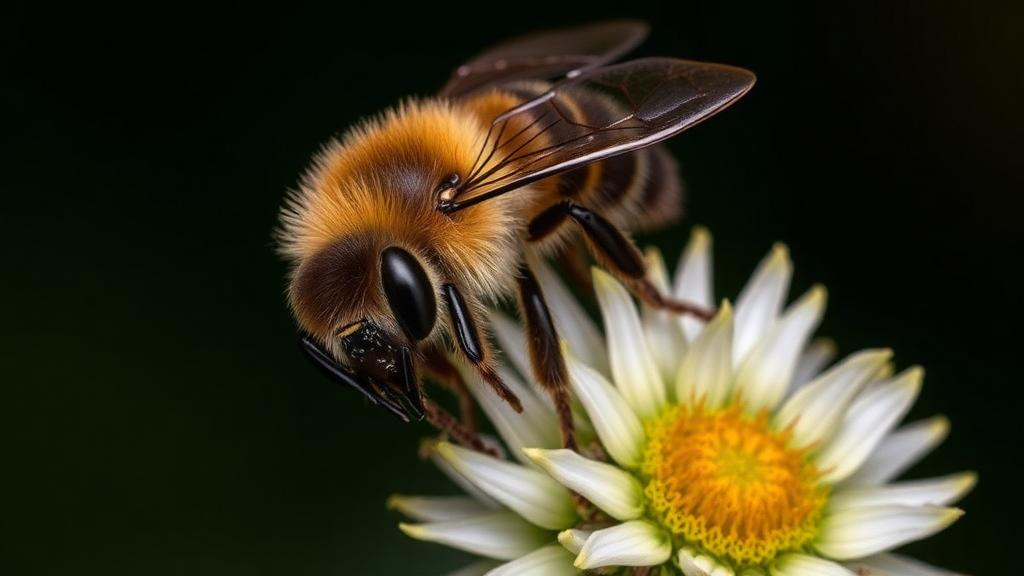
Europe’s masked bees appear far more selective about their pollen than their flower-visiting habits have led researchers to believe. A microscopic analysis of pollen stored inside 1,027 female bees reveals that 19 of 36 Central European species studied either depend almost entirely on one plant group or show a strong preference for it. The finding overturns the long-standing view that most bees in the genus Hylaeus are pollen generalists and suggests that conventional field observations can badly underestimate specialized diets hidden by bees’ unusual transport behavior.
Masked bees, also called yellow-faced bees, are small, dark and often nearly hairless members of the family Colletidae. Unlike most bees, which carry pollen externally on their hind legs or beneath the abdomen, Hylaeus females swallow pollen directly from flowers and carry it home inside a crop, an expandable chamber in the front of the abdomen. At the nest, the bee regurgitates the pollen into brood cells, where larvae develop with a diet of pollen and nectar. Because the pollen remains concealed inside the body, determining what these bees eat has required dissecting their metasomas. Researchers had never applied this method systematically to European Hylaeus, leaving the diets of most species to be inferred from flowers seen during field visits.
That inference is potentially misleading. A bee may visit a flower for nectar while taking little or no pollen from it, and identifying a tiny Hylaeus to species level in the field is notoriously difficult because many species share almost identical markings and proportions. The new study therefore treated flower records as a separate measure of activity rather than a direct map of diet. The researchers examined 30 pollen-containing crops from each of 36 species where possible, using specimens collected from museum and private collections across Switzerland, Germany and Austria. The sample included four species associated with higher elevations in the Alps.
Under the microscope, pollen grains were identified to plant family and, when possible, to subfamily, tribe or genus. Loads containing multiple pollen types were analyzed along transects, with at least 500 grains counted in especially dense samples, and the resulting numbers were adjusted for differences in pollen-grain volume. Crops were also weighted according to how full they were, so a full load contributed more than one filled to a quarter. Using two complementary criteria, the authors classified a bee as oligolectic when at least 95% of its pollen came from one plant taxon or when at least 90% of its females carried pure loads from that taxon.
Under those definitions, three of the 36 species were narrowly oligolectic: Hylaeus pilosulus and H. signatus specialized on Reseda, while H. punctulatissimus specialized on Allium. Seven more were broadly oligolectic. Six of those relied on the carrot family, Apiaceae, including H. clypearis, H. duckei, H. sinuatus, H. styriacus, H. taeniolatus and H. tyrolensis, and H. nigritus concentrated on two major Asteraceae lineages, Asteroideae and Carduoideae. Another nine species remained generalists but showed marked preferences. Five favored Apiaceae, three favored Rosaceae, especially Potentilla and Rubus, and H. leptocephalus strongly favored Melilotus, a genus of legumes.
Across all species, the bees collected pollen from 31 plant families, but the resources were far from evenly distributed. Apiaceae contributed 39.6% of the combined pollen spectrum, followed by Rosaceae at 18.7%, Resedaceae at 7.0%, Fabaceae at 6.1%, Asteraceae at 3.7%, Amaryllidaceae at 3.5% and Campanulaceae at 3.4%. Together, those seven families accounted for more than 80% of the pollen harvested. Almost all Rosaceae pollen came from Potentilla or Rubus, nearly all Fabaceae pollen came from Melilotus, and the Resedaceae and Amaryllidaceae pollen was attributable to Reseda and Allium, respectively.
Some Hylaeus species displayed almost fanatical fidelity to a single host. Every crop of H. tyrolensis and H. styriacus contained only Apiaceae pollen, as did all 30 crops of H. pilosulus and H. signatus, which carried exclusively Reseda pollen. H. punctulatissimus obtained 96% of its pollen from Allium. By contrast, H. paulus concentrated on Rosaceae, especially Rubus and Potentilla, while H. pfankuchi and H. rinki showed similarly strong Rosaceae preferences. The researchers also found that several apparently unrelated lineages favored Apiaceae, including members of six of the genus’s 10 Central European subgenera. That pattern may indicate an ancient association, or it may have arisen repeatedly as bees diversified.
The comparison with flower records exposed another major distortion. Among 29 species represented in the Wildbienen-Kataster Baden-Württemberg database, Apiaceae appeared in 39.6% of 3,175 flower records and 42.4% of the pollen found in their crops, a close match. Asteraceae produced a strikingly different signal. They accounted for 26.4% of flower visits, making them the second-most-recorded family, yet represented only 4.3% of the pollen. Once the Asteraceae specialist H. nigritus was excluded, flower visits to the family fell to 20.5%, while its pollen contribution dropped to just 1.1%. Most generalist Hylaeus therefore visited daisies and relatives for nectar, not as meaningful pollen sources.
This distinction fits what scientists call the Asteraceae paradox. Pollen from this family can be difficult or costly to digest because of unfavorable or protective chemical properties, and bees may require physiological adaptations before they can use it effectively. H. nigritus appears to have met that challenge: Carduoideae pollen made up 77.4% of its diet, while Asteroideae contributed another 18.9%. Most of its loads combined both groups, suggesting that visits to one group sometimes supplied pollen while visits to the other provided accessible nectar. H. dilatatus, the one generalist Central European species that collected a substantial amount of Asteraceae pollen, may retain an inherited capacity to exploit these plants efficiently.
Most Hylaeus pollen came from low-growing plants: herbs accounted for about 89% of the total, Rubus for 9.6%, tree species for only 0.2%, and an additional 0.4% could not be assigned. Nearly 93% of the pollen came from flowers whose nectar was accessible to the bees’ short tongues, either because it was exposed or because their small bodies allowed them to reach nectar at the base of the corolla. Some important pollen plants, however, offered no nectar or concealed it deep within narrow tubes. This means a female could specialize in gathering pollen from a plant while obtaining the energy needed for her flight and nest work elsewhere.
The findings have practical consequences for the steep declines of European bees. Targeted planting of summer-flowering Apiaceae, especially Daucus, together with Potentilla, Rubus, Reseda and Melilotus could support a large share of Central European Hylaeus and potentially other short-tongued pollinators. Protecting these resources may be especially important for threatened species, 13 of which are red-listed in Switzerland and six in Baden-Württemberg. More broadly, the study shows that a bee’s presence on a flower is not proof of pollen dependence. For masked bees, whose diets remain hidden inside their bodies, identifying the pollen itself is essential if conservation programs are to match the right flowers to the right insects.
Despite their unusual method of carrying pollen, Hylaeus bees are not feeding in an ecological world apart from other short-tongued bees. Their host plants overlap extensively with those used by Andrena, Colletes and Lasioglossum, and their range of associations runs from narrow specialization to broad generalism, as it does in other Palaearctic bee groups. What changes the picture is not an unfamiliar menu but a hidden one. By opening the crop and examining its microscopic cargo, the study reveals that familiar flower visits can conceal remarkably precise dietary choices—and that the masked bees of Central Europe are far more varied in their pollen use than their outward behavior suggests.
Subject of Research: Pollen-host specialization in Central European Hylaeus bees
Article Title: The hidden diet – examination of crop content reveals distinct patterns of pollen host use by Central European bees of the genus Hylaeus ( Hymenoptera , Colletidae )
Article References: Müller, A. (2023). The hidden diet – examination of crop content reveals distinct patterns of pollen host use by Central European bees of the genus Hylaeus (Hymenoptera, Colletidae). Alpine Entomology, 7, 21-35. https://doi.org/10.3897/alpento.7.102639
Image Credits: AI Generated
Keywords: Hylaeus bees, pollen analysis, bee diet, flower specialization, Apiaceae, Rosaceae, Reseda, pollination ecology, bee conservation, hidden, diet, examination
Cite Scienmag News
Daisy Hatcher. (October 19, 2026). Hidden diets reveal surprising specialization among Europe’s masked bees. Scienmag. https://scienmag.com/hidden-diets-reveal-surprising-specialization-among-europes-masked-bees/
Daisy Hatcher. "Hidden diets reveal surprising specialization among Europe’s masked bees." Scienmag, 19 October 2026, https://scienmag.com/hidden-diets-reveal-surprising-specialization-among-europes-masked-bees/. Accessed 19 October 2026.
Daisy Hatcher. "Hidden diets reveal surprising specialization among Europe’s masked bees." Scienmag. October 19, 2026. https://scienmag.com/hidden-diets-reveal-surprising-specialization-among-europes-masked-bees/


