


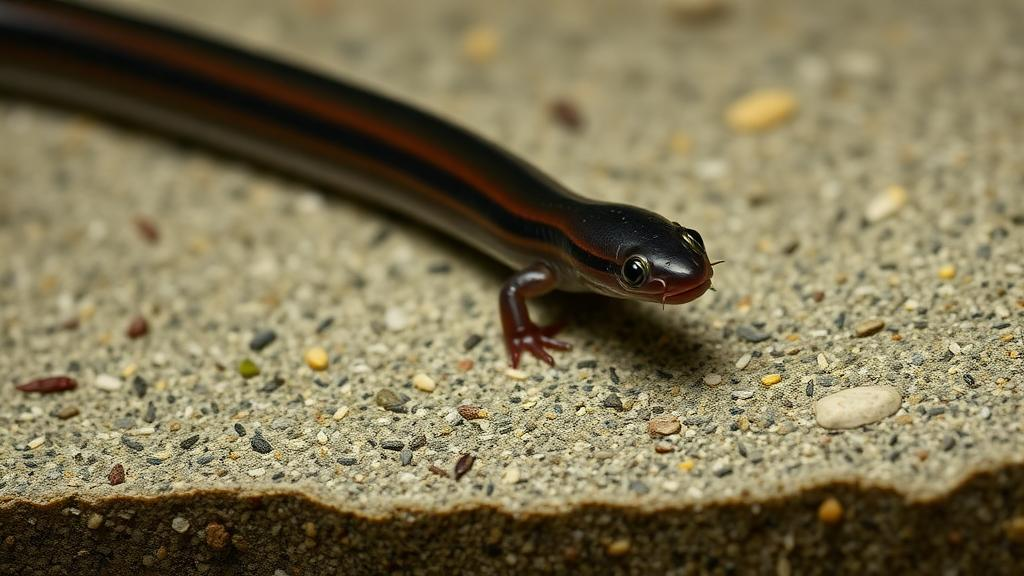
A small Triassic amphibian once appeared to offer an unusually clean answer to one of evolutionary biology’s most persistent puzzles: where did living caecilians, the limbless, burrowing amphibians, come from? The fossil named Chinlestegophis jenkinsi was described in 2017 as a stem caecilian closely related to the Permo-Triassic stereospondyl temnospondyls, suggesting that caecilians had evolved their specialized anatomy within a lineage quite different from the one that gave rise to frogs and salamanders. The discovery was quickly presented as a solution to the origin of caecilians, and it even entered widely used zoology textbooks. A new critical reanalysis, however, finds that the fossil’s placement is highly sensitive to long-standing problems with fossil sampling, anatomical coding and data-matrix construction. When the evidence is examined more carefully, Chinlestegophis is better regarded as a stereospondyl than as a direct ancestor or close relative of caecilians.
The confusion arose partly because the two main phylogenetic matrices used to position the fossil answered different questions. An unpublished matrix included a broad range of Paleozoic tetrapods and initially placed Chinlestegophis among temnospondyls, outside the amphibamiform group that includes many early relatives of modern amphibians. A second, published matrix then expanded the sample of temnospondyls but removed nearly all lepospondyls, a broad and historically important assemblage of small, often elongated early tetrapods. That second dataset placed Chinlestegophis, Rileymillerus and the caecilians together in a stereotyped lineage. Yet neither matrix could directly compare the competing origins of caecilians with adequate taxonomic and character coverage. The published version omitted the lepospondyl hypothesis by design, while its broader predecessor lacked stereospondyls and retained some scores that had already been criticized.
The most conspicuous problem was the method used to summarize the results of parsimony analysis. The published matrix generated 882 equally optimal trees, spread across five distinct sets, or islands, of equally parsimonious solutions. The original study emphasized a majority-rule consensus tree that depicted caecilians and Chinlestegophis as close relatives, but that tree represented only one dominant island and did not reveal the full range of possibilities. Other equally optimal trees placed the living amphibian groups within amphibamiform temnospondyls, placed Chinlestegophis inside the caecilian lineage, or positioned it outside a clade containing all modern amphibians. Because every most-parsimonious tree has equal evidential status under the analysis, presenting a majority consensus as the decisive result can make an unresolved evolutionary question appear settled.
Bootstrap tests of the original published matrix showed only moderate support for the extraordinary arrangement. Chinlestegophis appeared beside the three sampled caecilians in 52% of replicates, while a clade containing frogs, salamanders, karaurids and the dissorophoid Gerobatrachus appeared in 43%. No node separating caecilians from batrachians reached 50% support in the original results, and the most inclusive alternative grouping of living amphibians was even less secure. A Bayesian analysis produced a topology resembling the majority-rule tree, but Bayesian methods are particularly sensitive to the combination of missing data and conflicting character signals that is common in fossil matrices. In such datasets, characters scored for every taxon can exert disproportionate influence over incompletely sampled traits. The authors therefore emphasize that no analytical method can rescue a matrix containing miscoded anatomy, incorrect scores or redundant characters.
Several of the anatomical similarities once presented as evidence for a close relationship between Chinlestegophis and caecilians proved either more widely distributed, uncertain or incorrectly scored. The apparent double row of lower-jaw teeth was encoded as seven separate characters, artificially allowing the same evolutionary signal to be counted repeatedly. Re-examination showed that Chinlestegophis had only one dentary tooth row, while the additional lingual teeth in caecilians are borne on coronoids rather than the dentary or splenial. A purported pterygoquadrate in Chinlestegophis was not directly observed, and the structure considered analogous in Eocaecilia appears to involve fusion of the quadrate with the stapes, not the pterygoid. The supposed incipient tentacular sulcus was likewise absent: the maxilla does not reach the orbit, and the nasolacrimal duct opens far inside the skull, where it would be poorly positioned for the chemosensory function of a caecilian tentacle.
Other proposed links depended on anatomy that is either characteristic of many amphibians or absent from caecilians. Fusion of the opisthotic and exoccipital occurs broadly among modern amphibians and in several unrelated early tetrapods, rather than marking a caecilian–Chinlestegophis lineage. A broad, parallel-sided parasphenoid process is also widespread and cannot be diagnostic of the proposed group. The elongated occipital condyles of Chinlestegophis resemble those of stereospondyls but are not present in caecilians, whose differently constructed skull roofs leave the joints exposed. The fossil’s postcranial anatomy also points toward stereospondyl relationships: it has a large interclavicle, plate-like clavicles, well-developed posttemporal openings and unreduced ribs, none of which resembles the shoulder girdle or vertebral construction of modern amphibians. Body elongation is the principal feature linking Chinlestegophis to caecilians, yet elongated bodies arose repeatedly among early tetrapods.
Taxon choice and character ordering can transform the result. Adding Albanerpetidae, an extinct group consistently regarded as a close relative or possible member of the modern amphibian lineage, moves the living amphibians back into the amphibamiform temnospondyls and leaves Chinlestegophis and Rileymillerus among the stereospondyls. Ordering characters that represent continuous morphological sequences, such as changes in the relative width of a skull process, also changes the trees by recognizing that intermediate states are not arbitrary categories. In the most fully revised analysis, with Albanerpetidae included and 35 obvious morphological clines ordered, bootstrap support reached 77% for a clade of modern amphibians excluding Chinlestegophis. Chinlestegophis and Rileymillerus received limited support as close relatives of brachyopoid stereospondyls, while a grouping of Chinlestegophis with caecilians appeared in only 15% of replicates and an exclusive union of all modern amphibians with stereospondyls in just 10%.
Even so, the new work does not replace one simple certainty with another. The origin of caecilians remains unresolved, as does the wider evolutionary origin of modern amphibian groups. Some analyses still allow modern amphibians to sit near Chinlestegophis and Rileymillerus within Stereospondyli, but the relationship is weak and may reflect convergence rather than close ancestry. The fossil’s mixture of caecilian-like elongation and stereospondyl-like skull and shoulder anatomy may still provide useful evidence about Mesozoic tetrapod evolution. It cannot, however, be used to claim that caecilians arose from stereospondyls, that living amphibians are diphyletic or that the specialized head-first burrowing lifestyle evolved through a simple sequence of transitional fossil stages. Nor should its supposed position be used to calibrate molecular estimates of when caecilians and other modern amphibians diverged.
The broader lesson is that spectacular fossils do not automatically resolve deep evolutionary questions. A small animal can appear to complete a missing chapter, but its historical significance depends on whether the comparisons used to place it are anatomically accurate, whether competing fossil lineages have been sampled, and whether every apparent similarity has been counted independently. Chinlestegophis remains a fascinating Triassic temnospondyl with a surprising mixture of features. What it does not provide, according to the reanalysis, is a securely demonstrated link to the origin of caecilians. The fossil may yet illuminate the evolution of elongate, burrowing tetrapods, but the claim that it solved the origin of modern amphibians is more securely rooted in the analysis pipeline than in the anatomy itself.
Subject of Research: A reevaluation of the phylogenetic evidence linking Chinlestegophis to the evolutionary origin of caecilians
Article Title: The new problem of Chinlestegophis and the origin of caecilians ( Amphibia , Gymnophionomorpha ) is highly sensitive to old problems of sampling and character construction
Article References: Marjanović, D., Maddin, H. C., Olori, J. C., & Laurin, M. (2024). The new problem of Chinlestegophis and the origin of caecilians (Amphibia, Gymnophionomorpha) is highly sensitive to old problems of sampling and character construction. Fossil Record, 27(1), 55-94. https://doi.org/10.3897/fr.27.109555
Image Credits: AI Generated
DOI: 10.3897/fr.27.109555
Keywords: Chinlestegophis, caecilians, temnospondyls, Lissamphibia, phylogenetics, fossil matrix, taxonomic sampling, character coding, amphibian evolution, stereospondyls, problem, origin
Cite Scienmag News
Gavin Prescott. (October 19, 2026). Chinlestegophis does not settle the origins of caecilians. Scienmag. https://scienmag.com/chinlestegophis-does-not-settle-the-origins-of-caecilians/
Gavin Prescott. "Chinlestegophis does not settle the origins of caecilians." Scienmag, 19 October 2026, https://scienmag.com/chinlestegophis-does-not-settle-the-origins-of-caecilians/. Accessed 19 October 2026.
Gavin Prescott. "Chinlestegophis does not settle the origins of caecilians." Scienmag. October 19, 2026. https://scienmag.com/chinlestegophis-does-not-settle-the-origins-of-caecilians/


