


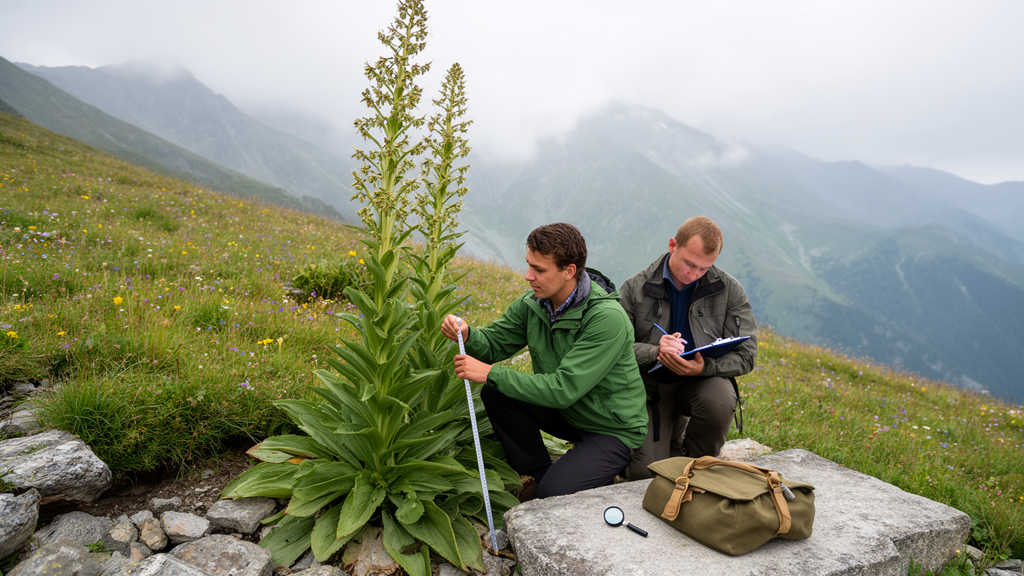
High in the mountains of Southern Siberia and the Caucasus, where snow lingers late and soils stay rich and moist, grows some of the most spectacular vegetation in Eurasia: meadows of towering monkshoods, giant hogweeds and globe flowers that can reach shoulder height. Ecologists call these tall-forb communities, and for decades they have carried a Latin name that quietly hid a tangle of contradictions. A new study in the journal Vegetation Classification and Survey has now untangled that knot, formally renaming, redefining and re-typing dozens of these plant communities in the largest nomenclatural overhaul the group has ever received.
The work comes out of the ongoing project Vegetation Classification of Russia, a national effort to bring order to the country’s immense botanical diversity. Its focus this time was the class Mulgedio-Aconitetea, the formal unit that unites nutrient-rich tall-herb vegetation found at high altitudes, fertilized by water percolating down slopes. The class stretches an extraordinary 3,000 kilometres east of the Ural Mountains, with a major centre of diversity in the Altai-Sayan mountain system, where more than forty distinct associations have been described. Yet many of the names attached to these communities were published invalidly, ambiguously, or with types that do not actually match the vegetation they were meant to represent.
The problem is more than academic pedantry. In plant sociology, the science of classifying vegetation, every named community must be anchored to a physical type: a specific plot of vegetation, a relevé, recorded with a species list. If the type plot turns out to be something else entirely, or if a name was never properly anchored at all, the name becomes a source of cascading errors. Ecologists mapping habitats, conservationists designating protected areas, and researchers comparing meadows across continents all rely on these names meaning the same thing to everyone. When they do not, decades of field data can be silently misinterpreted.
The most dramatic case concerns a community described in the late 1970s by the French botanist Marcel Guinochet during an expedition to the Lake Baikal region of Eastern Siberia. His association Rubo-Cardaminetum macrophyllae was based on a single plot of just thirteen species, recorded at a forest edge near a road. The authors of the new study dissected that species list and found it was essentially a botanical accident: seven of the thirteen species are typical forest plants, the dominant horsetail is a species of moist woods, and only one species shows real fidelity to tall-forb meadows. In other words, Guinochet’s type plot was not a tall-forb community at all, but a synanthropic mixture at a disturbed roadside. The name has been repeatedly misapplied ever since, and the team formally proposes rejecting it as an ambiguous name.
That rejection triggers a chain reaction. Guinochet’s association served as the type for an entire alliance and order of Siberian tall-herb vegetation, names that are otherwise well established and consistently applied to genuine tall-forb meadows across Southern Siberia, northern Mongolia and Kazakhstan. Rather than discard these widely used names, the authors invoke a formal mechanism of the International Code of Phytosociological Nomenclature: conservation with a new type. They propose a well-documented association from the Kuznetsk Alatau Mountains, one whose type plot actually contains both of the alliance’s name-giving species, as the new anchor. A similar rescue operation is proposed for the largest tall-forb alliance in Southern Siberia, whose older rival name has been used only once in the literature, while the familiar name appears in at least sixteen subsequent publications.
The study also corrects names that were never validly published in the first place. Under the code, names published after 2001 must explicitly designate a type using the Latin word typus; an asterisk in a table no longer suffices. Several alliances and associations described by Russian ecologists in the 2000s failed this test, sometimes because their diagnoses contained multiple plots without a designated type, sometimes because the name-giving species was ambiguous. The new paper validates eight such names, including an alliance of forest-edge tall herbs in Siberia and an alliance of subalpine meadows in the Southern Urals that has been elevated from suballiance rank.
Rank changes form another major component of the revision. Two suballiances of the Urals, each confined to regional vegetation found nowhere near their Central European relatives, are raised to full alliance rank, reflecting a 2,500-kilometre geographic gap that makes comparison at equal rank meaningful. Four subassociations are likewise promoted to associations, including tall-forb meadows in the Polar Urals that had been tucked inside a shrub association belonging to an entirely different vegetation class, and birch and larch open woodlands of the Altai whose herb layers are dominated by tall-forb species but which belong to woodland and forest classes rather than meadows.
Five genuinely new associations are described, and several of them carry a conservation message. One, from the Caucasus Nature Reserve, characterizes undisturbed communities of the giant hogweed Heracleum mantegazzianum, a species infamous as an invasive neophyte in Western Europe but native to the Caucasus, where pristine stands had never been formally classified. Because earlier researchers explicitly noted they had never encountered stands unaffected by human activity, this reserve material has particular reference value: it documents what the species’ natural communities actually look like before invasion biology borrowed the species for its cautionary tales. Other new associations include avalanche-track tall herbs near the upper forest limit of the Northern Caucasus and brookside communities on the Barguzin Ridge east of Lake Baikal, which turn out to be unrelated to Guinochet’s problematic type.
Even the name of the class itself changes. The original name, published in 1944, used Mulgedium alpinum as a name-giving species, but that name is now considered disused; the plant is properly called Cicerbita alpina. Following the rules, the class is mutated to Cicerbito alpinae-Aconitetea firmi. Parallel mutations affect an order and alliance of Siberian alder scrub, and the paper clarifies that the widely cited class name for green alder krummholz in the EuroVegChecklist rests on a fictitious name, since the correct species epithet has priority. A separate class for Siberian tall-herb meadows, long debated as an alternative to the Mulgedio-Aconitetea concept, is incidentally validated with corrected name-giving taxa.
What looks like an exercise in Latin grammar is in fact infrastructure for ecology. With the names stabilized, the team can proceed to the next phase: compiling a comprehensive database of vegetation plots from across Eastern Europe and Northern Asia to critically revise the tall-forb vegetation of the entire region on empirical grounds. The mountains of Southern Siberia, with their more than forty associations, are revealed as an Asian centre of diversity for this spectacular vegetation, deserving the same classificatory rigor that Central European meadows received generations ago. Every corrected name means that a plot recorded near Lake Baikal in 1979, a meadow surveyed in the Kuznetsk Alatau in 1995, and a hogweed stand photographed in the Caucasus Nature Reserve can now be compared, mapped and conserved as what they truly are.
Subject of Research: Nomenclatural revision of tall-forb vegetation classes in Russia
Article Title: Proposals (48–51) and nomenclatural novelties for the class Mulgedio-Aconitetea and related vegetation in Russia
Article References: Chepinoga, V. V., Theurillat, J.-P., & Tsepkova, N. L. (2026). Proposals (48–51) and nomenclatural novelties for the class Mulgedio-Aconitetea and related vegetation in Russia. Vegetation Classification and Survey, 7, 163-181. https://doi.org/10.3897/vcs.191954
Image Credits: AI Generated
DOI: 10.3897/VCS.191954
Keywords: plant sociology, phytosociology, Mulgedio-Aconitetea, vegetation classification, Siberia, Caucasus, nomenclature, tall-forb meadows, biodiversity, ecology, Lake Baikal, Heracleum mantegazzianum
Cite Scienmag News
Gavin Prescott. (October 19, 2026). Botanists Rewrite the Rulebook for Russia’s Giant Mountain Herbs. Scienmag. https://scienmag.com/botanists-rewrite-the-rulebook-for-russias-giant-mountain-herbs/
Gavin Prescott. "Botanists Rewrite the Rulebook for Russia’s Giant Mountain Herbs." Scienmag, 19 October 2026, https://scienmag.com/botanists-rewrite-the-rulebook-for-russias-giant-mountain-herbs/. Accessed 19 October 2026.
Gavin Prescott. "Botanists Rewrite the Rulebook for Russia’s Giant Mountain Herbs." Scienmag. October 19, 2026. https://scienmag.com/botanists-rewrite-the-rulebook-for-russias-giant-mountain-herbs/


