


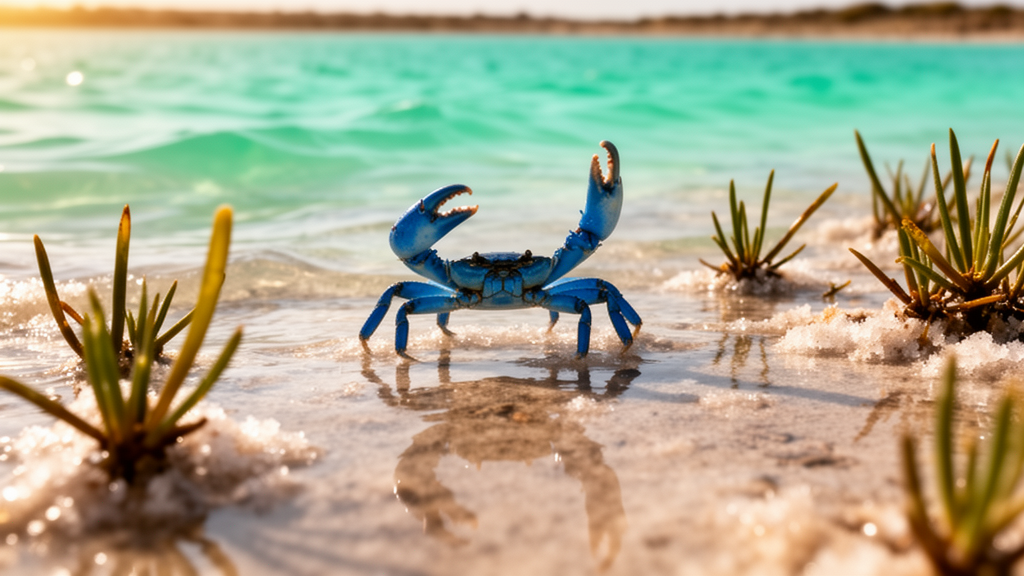
The invasive blue crab Callinectes sapidus has established a fully functioning population in the Stagnone di Marsala, a shallow hypersaline basin on the northwestern coast of Sicily, according to a study published in the journal NeoBiota. Researchers monitored the species from June 2021 to September 2023 and documented crabs of both sexes across a wide range of developmental stages, evidence that the animals are not merely visiting the basin but completing their entire life cycle within it. The finding demonstrates an underappreciated degree of ecological plasticity in one of the Mediterranean’s 100 most invasive species and signals that hypersaline coastal ecosystems, long considered marginal habitats for the crab, may now be firmly on its expansion map.
The blue crab is native to the western Atlantic, ranging from the Gulf of Maine to Argentina, where it plays a keystone role in coastal food webs as both a voracious predator and a coupler of benthic and pelagic ecosystems. Its arrival in Europe dates to 1901, when it was recorded along the Atlantic coasts of France, most likely introduced in ships’ ballast water. It first appeared in the Mediterranean in 1947 in the Aegean Sea and subsequently spread through brackish lagoons and estuaries along the northern shores of the basin, from Spain to Greece. Over the past decade its distribution has expanded almost ubiquitously, with recent records from south-Mediterranean environments in Algeria, Malta, and Libya—regions characterized by limited freshwater input and generally high salinities. Those records hinted that the crab might be adapting to hypersaline conditions, but the structure and dynamics of such populations remained virtually unexplored until now.
The Stagnone di Marsala offered an ideal natural laboratory for testing that hypothesis. The semi-enclosed basin covers roughly 21 square kilometers with an average depth of just 1.5 meters. Separated from the open sea by a calcarenite platform and lacking any freshwater inflows, the lagoon is hypersaline, with salinities ranging seasonally between 32.8 and 47.1 PSU and temperatures between 11.2 and 29.1 degrees Celsius. Two sub-basins differ sharply in their connection to the sea: the northern one exchanges water through a narrow, shallow opening called Bocca San Teodoro, while the southern sub-basin connects through the much larger Bocca Grande. As a result, the central and northern parts of the lagoon experience limited water exchange, making them more thermally and chemically stable—and more extreme—than the southern sectors.
The research team sampled nine sites grouped into four zones spanning the basin from north to south. Two fishing methods were deployed: baited traps measuring 60 by 30 centimeters with a 15-millimeter nylon mesh, baited with sardines and chicken discards and left overnight, and, from April 2022 onward, 50-meter gillnets with a 30-millimeter mesh at four additional sites. Water temperature and salinity were measured with a multiparameter probe at every site and sampling occasion. Captured crabs were transported to the laboratory in refrigerated cool boxes, where they were identified, weighed, measured for carapace length and width, and sexed by abdominal shape. The relative abundance of the crab was estimated as catch per unit effort, calculated separately for each gear type, and analyzed with permutational analysis of variance to test for differences across years, seasons, zones, and sexes.
In total, 495 blue crabs were captured, of which 327 were males and 168 were females, yielding an overall sex ratio of 1.94 males per female. Distribution maps revealed a clear and continuous increase in abundance over time across all sampling zones. Catches peaked during the final sampling period in summer 2023, when trap CPUE reached 3.3 at a Center–North site and gillnet CPUE averaged 10, plus or minus 2.8, at another site in the same zone. Statistical analysis confirmed that abundance in 2023 was significantly higher than in 2021, and that growth continued between 2022 and 2023. Male catches by net rose significantly in spring and summer compared with winter, and males outnumbered females in summer catches, consistent with the more active and aggressive behavior that makes males more vulnerable to passive fishing gear.
The choice of sampling method mattered as much as the choice of site. Gillnets consistently yielded larger specimens than traps, capturing crabs with carapace widths ranging from 78 to 186 millimeters for males and 79 to 154 millimeters for females, whereas traps caught a broader size spectrum, from 34 to 166 millimeters for males and 49 to 153 millimeters for females. The nets effectively targeted larger, more mobile males, while traps proved more efficient for sampling the full range of life stages, including more females. This contrast runs counter to much of the published literature, which cites traps as the most effective gear for blue crab capture, and it carries practical implications: fishermen in the region report that crabs frequently damage nets and that untangling them substantially increases the time and labor required during fishing operations.
Population structure varied markedly across the basin. Carapace width ranged from 22 to 186 millimeters overall, with larger individuals recorded in the Center–North zone and during the warmer seasons. The Center–North sector, the most remote from the open sea, hosted the highest crab abundance and the largest body sizes, likely because of its dense seagrass meadows dominated by Cymodocea nodosa, which provide shelter, feeding grounds, and breeding sites, and because its limited water exchange creates a stable, protected environment. Four ovigerous females—females carrying eggs—were found in this zone during the summer months at high salinity levels, corroborating its suitability as a reproductive habitat. This aligns with observations from the species’ native range, where gravid females migrate from low-salinity estuarine regions toward high-salinity waters near the ocean to release their larvae.
Environmental data added a crucial layer to the interpretation. Water temperature ranged from 9.1 degrees Celsius in winter 2023 in the Center–South zone to 35.5 degrees Celsius in summer 2022 in the Center–North zone, while salinity was more variable among zones, spanning from 29.3 PSU in the South zone in winter 2022 to 52.2 PSU in the Center–North zone in summer 2021. Crab abundance correlated slightly with both temperature and salinity, but the relationship was statistically significant only for trap CPUE and salinity. Although no significant temperature correlation emerged, catch peaks occurred in summer for both methods, when temperatures were highest. In its native Chesapeake Bay, the blue crab shows a strong affinity for warmer waters, where elevated temperatures increase metabolic activity, accelerate growth, and enhance reproductive output—traits that appear to serve it equally well in the Mediterranean.
The crab’s tolerance of extreme salinity is the study’s most striking technical finding. In Florida, the species mainly occupies low-salinity estuaries and brackish waters, but in the Gulf of Mexico it has been documented in two hypersaline lagoons, Laguna Madre and Corpus Christi Bay, where salinities can exceed 40 PSU—comparable to those recorded in the Stagnone di Marsala. Hypersaline basins are often unsuitable for many native species that cannot tolerate such conditions, which reduces competition and opens ecological niches for the blue crab. Elevated salinity also promotes key biological functions in the species, including growth, molting, and reproduction, and experimental work in Corsican lagoons has demonstrated that the crab tolerates a salinity range of 29 to 50 PSU, with salinity exerting a significant positive effect on female body size. The combination of reduced biotic pressure and improved physiological performance helps explain the species’ invasive success in hypersaline habitats.
The rapid expansion of the blue crab within the Stagnone di Marsala raises urgent ecological and management considerations. The species holds substantial economic value as a fishery resource in several Mediterranean regions and in the eastern Atlantic, where established populations support local fisheries in Portugal and Morocco, but its aggressive predatory behavior threatens native species and could alter the composition of biological communities in the lagoon. The authors recommend adaptive management strategies, including selective harvesting focused on peak reproductive months in summer, when larger individuals and gravid females are most abundant, combined with regular monitoring of salinity and temperature. Because the Stagnone di Marsala is a protected area, conservation objectives may complicate active interventions, requiring context-specific governance that balances ecological priorities with conservation mandates. As salinity and temperature are recognized drivers of the crab’s distribution, future management plans must also account for the effects of climate change on the ecosystem. An integrated framework that weaves together ecological data, stakeholder engagement, and sustainable fishing will be critical to protecting native biodiversity while managing one of the Mediterranean’s most adaptable invaders.
Subject of Research: Establishment and population dynamics of the invasive blue crab Callinectes sapidus in a Mediterranean hypersaline coastal basin
Article Title: Establishment of the blue crab Callinectes sapidus (Rathbun, 1896) in a Mediterranean hypersaline basin: evidence of ecological plasticity and range expansion
Article References: Cicala, D., Andolina, C., Bardelli, R., Cilluffo, G., Ciriminna, L., Mancinelli, G., & Vizzini, S. (2025). Establishment of the blue crab Callinectes sapidus (Rathbun, 1896) in a Mediterranean hypersaline basin: evidence of ecological plasticity and range expansion. NeoBiota, 104, 281-300. https://doi.org/10.3897/neobiota.104.160696
Image Credits: AI Generated
DOI: 10.3897/neobiota.104.160696
Keywords: blue crab, Callinectes sapidus, invasive species, Mediterranean Sea, hypersaline lagoon, Stagnone di Marsala, population dynamics, ecological plasticity, salinity tolerance, range expansion, NeoBiota, Sicily
Cite Scienmag News
Gavin Prescott. (October 19, 2026). Blue crab colonizes hypersaline Sicilian lagoon, confirming its Mediterranean range expansion. Scienmag. https://scienmag.com/blue-crab-colonizes-hypersaline-sicilian-lagoon-confirming-its-mediterranean-range-expansion/
Gavin Prescott. "Blue crab colonizes hypersaline Sicilian lagoon, confirming its Mediterranean range expansion." Scienmag, 19 October 2026, https://scienmag.com/blue-crab-colonizes-hypersaline-sicilian-lagoon-confirming-its-mediterranean-range-expansion/. Accessed 19 October 2026.
Gavin Prescott. "Blue crab colonizes hypersaline Sicilian lagoon, confirming its Mediterranean range expansion." Scienmag. October 19, 2026. https://scienmag.com/blue-crab-colonizes-hypersaline-sicilian-lagoon-confirming-its-mediterranean-range-expansion/


