


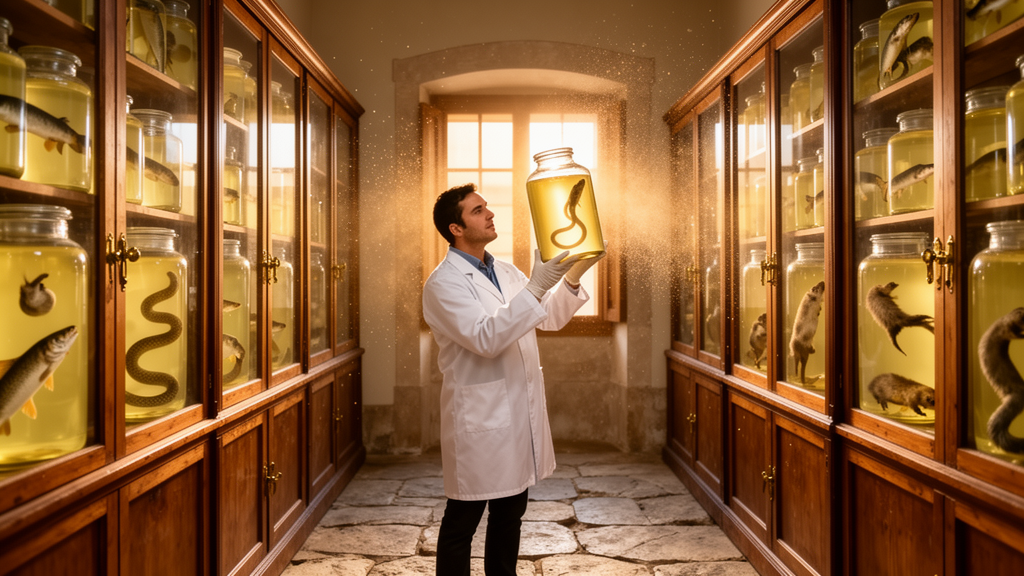
Millions of zoological specimens around the world float in jars of alcohol and formalin, forming the backbone of taxonomy, comparative anatomy and, increasingly, genomics. A new study published in Natural History Collections and Museomics traces, for the first time, how those techniques evolved in Portugal from the mid-eighteenth century to the 1970s, and what that history means for the specimens still sitting on museum shelves today. Drawing on 36 publications issued between 1779 and 1972, together with direct inspection of the country’s major collections, the researchers reconstruct the fixatives, preservatives and sealing methods that Portuguese naturalists prescribed for collectors at home and across the empire.
The story begins with Domenico Vandelli, the Paduan naturalist hired by the Portuguese crown in the 1760s to direct the Royal Botanical Garden and Royal Cabinet of Natural History at Ajuda in Lisbon. His unpublished 1779 instructions described gutting small mammals through an incision near the anus, replacing the viscera with camphor, and immersing the animal in diluted wine spirit with dissolved burnt alum. Birds were wrapped in cloth and bathed in spirit mixed with mercuric chloride, the toxic compound known as corrosive sublimate. Fishes, which ‘corrupt faster’, demanded stronger spirit and generous alum. Similar instructions issued in 1781 by the Royal Cabinet and the Academy of Sciences, largely the work of Vandelli and his student Alexandre Rodrigues Ferreira, refined these recipes and even specified how jars should be sealed with wax and resin.
These eighteenth-century prescriptions were not merely theoretical. A 1794 catalogue records that the Ajuda cabinet then held more than 1,100 fluid-preserved specimens, including human foetuses, ‘monstrous pigs’, hundreds of birds, snakes and fishes, many collected during Ferreira’s celebrated Philosophical Voyage to Brazil. Almost none survive. The rare exceptions are striking: the conjoined twins born in Évora in 1788 and preserved in wine spirit still exist in Lisbon’s Museu da Medicina, and a handful of ‘monsters’ described in Vandelli’s 1776 Dissertatio de monstris, along with several Brazilian reptiles collected by Ferreira, remain in the University of Coimbra’s collections.
The nineteenth century brought new manuals and new chemistry. In 1800, friar José Mariano da Conceição Velloso published a Portuguese adaptation of Abbé Manesse’s treatise, reporting experiments with solutions of alum, ammonia salt, nitre and sea salt, including a mixture that preserved a human foetus for over a year behind a simple cork stopper. In 1836, Francisco Assis de Carvalho, director of the newly reorganised National Museum in Lisbon, issued detailed taxon-by-taxon instructions specifying alcohol concentrations on the Baumé scale: skins at 14 to 18 degrees, whole reptiles at 20, venomous snakes at 20 to 24, fishes at 20 to 22. Notably, he recommended preserving venomous snakes intact precisely so that curators would not stab themselves on their fangs.
The most influential nineteenth-century text came from José Vicente Barbosa du Bocage, who took charge of the zoological section of the Lisbon Museum in 1858. His 1862 practical instructions circulated widely through the Portuguese empire and prescribed wine spirit at 20 to 22 degrees Baumé for fishes, reptiles, birds and small mammals, alongside alternative formulas combining salt, alum and corrosive sublimate, and a creosote solution of two grams per litre of water that, Bocage noted, avoided attacking colour or contracting soft tissues. Collectors such as José de Anchieta and Francisco Newton applied these methods across Angola, the Gulf of Guinea and Cape Verde, generating thousands of specimens. Many were lost in the catastrophic 1978 fire that destroyed the Museu Bocage, but duplicates distributed to other museums survive, including type specimens of Angolan mammals now in Porto and a rare specimen of the extinct Cape Verde giant-skink.
The 1890s marked a chemical revolution. In 1895, Adriano Xavier Lopes Vieira, director of the Zoology Museum at the University of Coimbra, argued that alcohol deformed and discoloured soft animals, was expensive and constantly evaporated, and proposed instead a four percent solution of formaldehyde. His colleague Manuel Paulino de Oliveira tested the new fixative that same year on anemones, crustaceans and salps, reporting that specimens died without retracting their appendages, retained their natural positions and colours, and hardened enough for histological study. Oliveira also documented the ’emzéd cement’, a hot mixture of paraffin and natural rubber applied to jar mouths with warmed glass lids, which he praised for sealing perfectly while still allowing jars to be reopened with a knife or hot water. That sealant, the study notes, appears to have worked remarkably well: many Coimbra jars from the period remain stable more than a century later.
King Carlos I of Portugal brought royal enthusiasm to the field. An active oceanographer who organised expeditions off the Portuguese coast in the late 1890s, he published a 1902 report detailing his own preservation protocols. Fishes were fixed in four percent formalin for about an hour, washed, and transferred to a ‘glycérine formolée’ mixture of glycerine, distilled water and formaldehyde that he credited with preserving colours indefinitely. Marine invertebrates were fixed in strong formalin and preserved in weak alcohol or the same glycerine solution. Many of the resulting specimens, including vividly coloured deep-sea crustaceans, are still extant at the Aquário Vasco da Gama in Cascais.
The twentieth century saw formalin and ethanol standardised. Instructions from the Sociedade de Geografia de Lisboa in 1912, Fernando Pedrosa Mendes’s 1942 museum manual with its tabulated anaesthetics, fixatives and preservatives for every invertebrate group, António de Barros Machado’s 1945 cave-biology formulas, and the detailed protocols of Fernando Frade’s colonial zoological missions all converged on seventy percent alcohol and five to ten percent formalin as the workhorses of preservation. The most comprehensive treatment came from marine biologist Luiz Saldanha, whose 1959, 1965 and 1972 publications laid out anaesthesia, fixation and preservation methods for taxa from sponges to fishes, complete with formula lists for Bouin’s fluid, Perenyi liquor, buffered formalin and colour-preserving alcohol-salt mixtures. Saldanha’s specimens were largely consumed by the 1978 fire, which the study describes as the single greatest loss to Portuguese fluid collections.
Why does this archival archaeology matter now? The authors emphasise that fixation history directly determines what modern science can do with a specimen. The quantity and quality of extractable DNA depend on the original fluids: formalin-fixed material, especially historical formalin, poses severe molecular challenges, while alcohol-preserved specimens are far more amenable. As museomics, the extraction of genomic data from historical collections, matures, knowing whether a jar’s contents were fixed in mercuric chloride-laced spirit, Goadby liquor or buffered formalin informs both the feasibility of sampling and the interpretation of results. The study also flags safety concerns, since corrosive sublimate, mercury and other toxic compounds lurk in legacy jars.
The paper closes with an account of recent recovery efforts at the Museu Nacional de História Natural e da Ciência in Lisbon, the Museu de História Natural e da Ciência in Porto and the Museu da Ciência in Coimbra: topping up evaporated fluids, transferring specimens to seventy percent ethanol, replacing cracked jars, printing resistant internal labels and digitising records for online databases. Yet the authors stress that understaffing remains the dominant threat, that no Portuguese degree programme teaches fluid preservation, and that curators must still decide whether these jars are scientific vouchers for the biodiversity crisis, historical relics of past science, or both. Mapping 250 years of recipes, they argue, is the essential first step toward answering that question.
Subject of Research: Historical fluid-preservation techniques used in Portuguese natural history collections from the eighteenth century to the 1970s and their implications for specimen management and research
Article Title: Fluid-preserved zoological specimens in Portuguese Natural History collections: a historical overview and implications to collection management and research
Article References: Ceríaco, L. M. P., & Marques, M. P. (2025). Fluid-preserved zoological specimens in Portuguese Natural History collections: a historical overview and implications to collection management and research. Natural History Collections and Museomics, 2, 1-69. https://doi.org/10.3897/nhcm.2.142114
Image Credits: AI Generated
Keywords: fluid preservation, natural history collections, museomics, formalin, ethanol, specimen fixation, Portugal, zoological collections, collection management, DNA extraction, museum conservation, history of science
Cite Scienmag News
Gavin Prescott. (October 19, 2026). Two Centuries of Spirits and Formalin: How Portugal Built Its Fluid-Preserved Zoological Collections. Scienmag. https://scienmag.com/two-centuries-of-spirits-and-formalin-how-portugal-built-its-fluid-preserved-zoological-collections/
Gavin Prescott. "Two Centuries of Spirits and Formalin: How Portugal Built Its Fluid-Preserved Zoological Collections." Scienmag, 19 October 2026, https://scienmag.com/two-centuries-of-spirits-and-formalin-how-portugal-built-its-fluid-preserved-zoological-collections/. Accessed 19 October 2026.
Gavin Prescott. "Two Centuries of Spirits and Formalin: How Portugal Built Its Fluid-Preserved Zoological Collections." Scienmag. October 19, 2026. https://scienmag.com/two-centuries-of-spirits-and-formalin-how-portugal-built-its-fluid-preserved-zoological-collections/


