


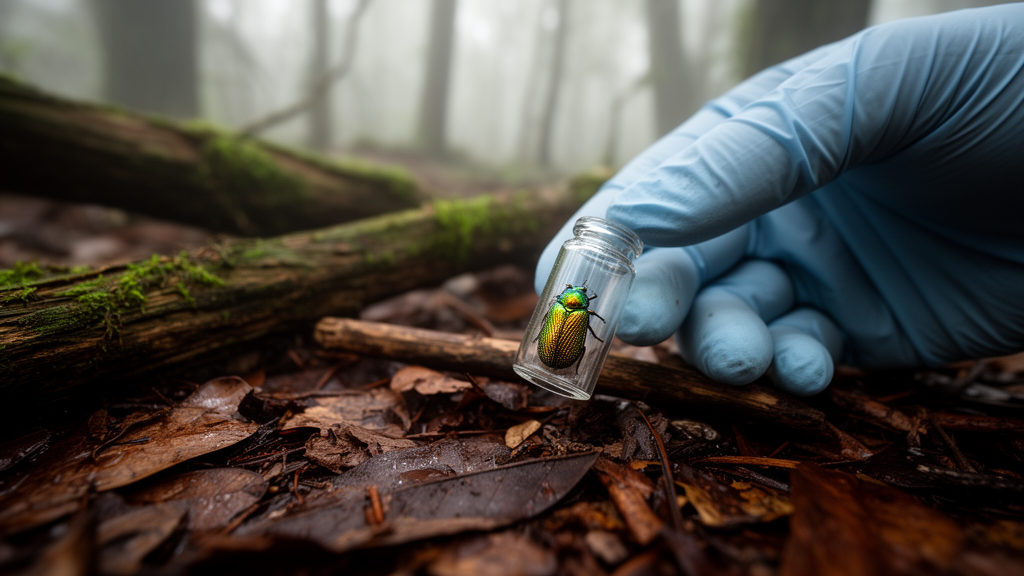
Deep within the leaf litter of Taiwan’s subtropical forests lies a world so densely packed with beetle species that scientists compare it to coral reefs in its biological richness. Now, an international team of researchers has published the first large-scale DNA barcoding dataset of the island’s forest floor beetles, revealing hundreds of species in a single reserve and delivering a wave of first records, a newly described species, and the first-ever photographs of numerous beetle larvae. The findings, published in the Deutsche Entomologische Zeitschrift, mark the launch of the Taiwanese Leaf Litter Beetles Barcoding project, an ambitious effort to build an expert-identified DNA barcode library for one of the least studied corners of the beetle world.
Forest leaf litter is recognized as one of the most species-rich habitats on Earth, particularly in tropical and subtropical regions. Beetles dominate this hidden ecosystem, where they play crucial roles in decomposition and nutrient cycling. Yet studying them has long been what scientists call a ‘toxic mix’ of challenges: enormous numbers of species, tiny body sizes, and high local endemism caused by limited dispersal abilities. Several authors of the new study have spent their entire careers processing leaf litter samples from around the world, but only a tiny fraction of the collected material has ever been formally described. Even scarcer is knowledge of the immature stages: for most leaf litter beetle genera, nobody knows what the larvae look like, which obscures both their ecology and their evolution, since larval characters are often highly informative for reconstructing family trees.
DNA barcoding, the identification of organisms using short mitochondrial fragments, has been advocated as a way to overcome this so-called taxonomic impediment. But quick identification methods require a reference set of barcodes based on specimens identified by experts. Such libraries have already been completed for some insect groups and launched as country-wide initiatives in Canada, Germany, Finland and Costa Rica. The Taiwanese project aims to build the same kind of resource for the island’s leaf litter beetles. Taiwan lies at the intersection of the Oriental and Palaearctic biogeographical regions, home to more than 119 beetle families and 7,711 recorded species, yet its leaf litter fauna has been studied only sporadically, largely through collections made by Aleš Smetana in the 1990s and Stanislav Vít in the 2010s.
The first dataset now published is based on 4,629 beetle specimens collected between 2019 and 2021 at five sites in the Huisun Forest Reserve in Nantou County, central Taiwan, at altitudes of 700 to 1,100 meters. Samples were gathered by sifting leaf litter through a 5-millimeter grid and extracting beetles with portable Winkler extractors over three days. Adults and larvae were sorted into morphospecies, and one or two specimens of each were selected for DNA extraction. Using the HotSHOT protocol and standard extraction kits, the team amplified the 5′ part of the mitochondrial cytochrome oxidase I gene, the standard 658-base-pair barcode fragment, and sequenced the samples with Oxford Nanopore Flongle flow cells, a third-generation approach that allows hundreds of uniquely tagged samples to be pooled and demultiplexed with the ONTbarcoder software.
The results are striking. Good-quality, non-contaminated barcodes were obtained for 947 specimens, 84 percent of all extractions, representing 328 species candidates across 36 beetle families. Rove beetles, the Staphylinidae, proved the most diverse with 152 species, followed by weevils with 30 and darkling beetles with 23. In most cases the DNA-based species delimitation matched morphology, but a few cases revealed cryptic species hidden within what appeared to be single morphological species, including in the scolytine Coccotrypes papuanus. Larvae made up nearly 20 percent of all specimens, and DNA barcodes allowed the team to associate larvae with adults for 42 species, an achievement that would be impossible using morphology alone. Sixty-one species were collected only in the larval stage, mostly from lineages with free-living adults such as soldier beetles, fireflies and net-winged beetles.
Even this single-reserve dataset produced a remarkable list of first records for Taiwan. The family Sphindidae, represented by the genus Aspidiphorus, had never been reported from the island, nor had the pselaphine rove beetle tribes Trichonychini, Ctenistini and Bythinoplectini. Genera newly recorded include Gyrelon, Thyroderus and Cautomus among the Cerylonidae, Dermatohomoeus among the Leiodidae, Thinocharis and Paraploderus among the rove beetles, Cephennodes and Napoconnus among the ant-like stone beetles, Bicava among the minute brown scavenger beetles, and Otibazo, Seleuca and Acallinus among the weevils. The ground beetle Oodes japonicus, widespread from the Russian Far East through China and Japan to Laos and Vietnam, was recorded from Taiwan for the first time, as was the widespread rove beetle Drusilla obliqua and the seed-boring scolytine Coccotrypes advena, whose Taiwanese sequences cluster closely with a specimen from Japan.
The taxonomic results include the description of Gyrelon jenpani, a new species of Cerylonidae named in honor of Dr. Jen-Pan Huang of Academia Sinica for his support of the project. The species, 2.8 to 3.2 millimeters long and dark reddish brown to black, is so far known only from its type locality in central Taiwan and was distinguished from relatives in southern China, Sarawak, Sumatra and Singapore by a detailed comparison of pronotal and elytral punctation, the shape of the prosternal process, and the punctation of the metaventrite and abdominal ventrites. The team also described the previously unknown male of Sivacrypticus taiwanicus, an endemic species of the family Archeocrypticidae first described in 1964 from southern Taiwan. Its male genitalia, with a strongly bent median lobe and a large bottle-like sperm pump, are very distinct from most described species of the genus but closely resemble those of S. philippinus from Luzon, from which it differs in the apical expansion of the median lobe. Sequenced specimens from lowland forests in central Taiwan suggest the species is likely widespread across the island’s lowland and lower montane forests.
The barcodes also captured unexpected biology. Sequencing occasionally returned DNA of other organisms, including bacteria and prey. The team reported the first cases of Rickettsia infections in the Scydmaeninae and Pselaphinae rove beetle subfamilies, and revealed Wolbachia in hister beetles and two rove beetle lineages. Contaminations by nematodes, oomycetes and Amoebozoa in nitidulid beetles may relate to these beetles’ preference for decaying fruits. Most intriguingly, sequences of Burmoniscus isopods appeared repeatedly in specimens of the rove beetle Tolmerinus, both adults and larvae, suggesting that isopods may be a preferred food for these predatory beetles, a hypothesis never documented before.
The newly illustrated larvae are among the most visually compelling outcomes of the study. The team published detailed photographs of larvae associated with adults by DNA for species including the ground beetles Oodes japonicus and Perigona cf. nigriceps, the soldier beetle Maltypus ryukyuanus, the rove beetles Drusilla obliqua, Myrmecocephalus brevisulcus, Diochus sp. and Mimopinophilus sp., the sap beetles Stelidota multiguttata and Lasiodites inaequalis, and the darkling beetles Lagria scutellaris and Anaedus spinicornis. The larva of Ptilodactyla revealed a proventriculus armored with numerous spines, a structure never before documented for larval Ptilodactylidae, suggesting these larvae may feed on decaying wood and detritus rather than only on plant roots as previously stated. The larva of the Taiwan-endemic Lagria scutellaris, often a dominant morphotype in Taiwanese leaf litter samples, was illustrated for the first time and compared with its European and African relatives.
All data, including sequences, metadata and 428 voucher photographs, are publicly available in the Barcode of Life Database under the project acronym TWHUI and in a Zenodo archive, and voucher specimens are kept at the Insect Diversity Lab of National Sun Yat-sen University in Kaohsiung, where they are available to taxonomists on request. The authors emphasize that their aim is not to support DNA-only systematics: the Taiwanese fauna overlaps with that of southern Japan, southern China and the northern Philippines, where traditional taxonomic work has long been underway, and DNA barcodes should serve as a tool for more efficient study, not a replacement of previous effort. Sampling continues across Taiwan, with 85 additional samples accumulated since 2021 and 27 already in the pipeline of barcoding. The team’s data also show that sampling design matters: five nearby sites sampled on a single day covered roughly 40 percent of the estimated local species richness, whereas a single six-liter sample covered only about 10 percent, prompting a shift to smaller three-liter samples that allow quicker processing and more sites per visit. New findings will be published continuously, keeping the barcode library an up-to-date resource for ecologists, conservation biologists and anyone curious about the hidden life beneath the forest floor.
Subject of Research: Biodiversity
Article Title: Forest leaf litter beetles of Taiwan: first DNA barcodes and first insight into the fauna
Article References: Hu, F.-S., Arriaga-Varela, E., Biffi, G., Bocák, L., Bulirsch, P., Damaška, A. F., Frisch, J., Hájek, J., Hlaváč, P., Ho, B.-H., Ho, Y.-H., Hsiao, Y., Jelínek, J., Klimaszewski, J., Kundrata, R., Löbl, I., Makranczy, G., Matsumoto, K., Phang, G.-J., … Fikáček, M. (2024). Forest leaf litter beetles of Taiwan: first DNA barcodes and first insight into the fauna. Deutsche Entomologische Zeitschrift, 71(1), 17-47. https://doi.org/10.3897/dez.71.112278
Image Credits: AI Generated
Keywords: DNA barcoding, beetles, Taiwan, leaf litter, biodiversity, entomology, Forest, leaf, litter, first, barcodes, insight
Cite Scienmag News
Gavin Prescott. (October 19, 2026). DNA Barcodes Reveal Hidden Beetle Diversity in Taiwan’s Forest Floors. Scienmag. https://scienmag.com/dna-barcodes-reveal-hidden-beetle-diversity-in-taiwans-forest-floors/
Gavin Prescott. "DNA Barcodes Reveal Hidden Beetle Diversity in Taiwan’s Forest Floors." Scienmag, 19 October 2026, https://scienmag.com/dna-barcodes-reveal-hidden-beetle-diversity-in-taiwans-forest-floors/. Accessed 19 October 2026.
Gavin Prescott. "DNA Barcodes Reveal Hidden Beetle Diversity in Taiwan’s Forest Floors." Scienmag. October 19, 2026. https://scienmag.com/dna-barcodes-reveal-hidden-beetle-diversity-in-taiwans-forest-floors/


