


Nitrous oxide rarely makes headlines, yet the gas is quietly reshaping the planet’s future. Better known as laughing gas, N2O is the third most important human-driven greenhouse gas after carbon dioxide and methane, and it is now the single dominant precursor of the ozone-destroying substances rising into the stratosphere. Once released, it lingers for more than a century, and its atmospheric concentration has climbed from roughly 270 parts per billion before the industrial era to about 338 ppb today, growing at nearly 1 ppb per year. Agriculture supplies the biggest share of these emissions through microbial processes in fertilized soils, which makes understanding exactly where and when the gas escapes a central problem for climate policy. Meeting the Paris Agreement’s targets, according to recent scenario studies, will require cutting N2O emissions by 11 percent by 2050 for a 2-degree pathway and by 22 percent for 1.5 degrees, yet even the most pessimistic standard emission scenarios underestimate what the atmosphere actually contains.
The trouble is that measuring N2O from the air is brutally difficult. The natural variability of the gas in the lower atmosphere is often smaller than 1 ppb against a huge background of around 338 ppb, so even tiny instrumental wobbles swamp the real signal. Many existing airborne spectrometers are sensitive to environmental and flight-related parameters that change within seconds: cabin pressure, the roll and pitch angles of the aircraft, and above all ambient water vapor. Fast-moving planes also demand faster data than most instruments can deliver. Conventional gas chromatographs and Fourier transform infrared spectrometers, once the workhorses of the field, resolve only about one measurement per minute, and even modern laser instruments typically manage 1 Hz, too slow for eddy covariance flux measurements on an aircraft racing across farmland at hundreds of kilometers per hour.
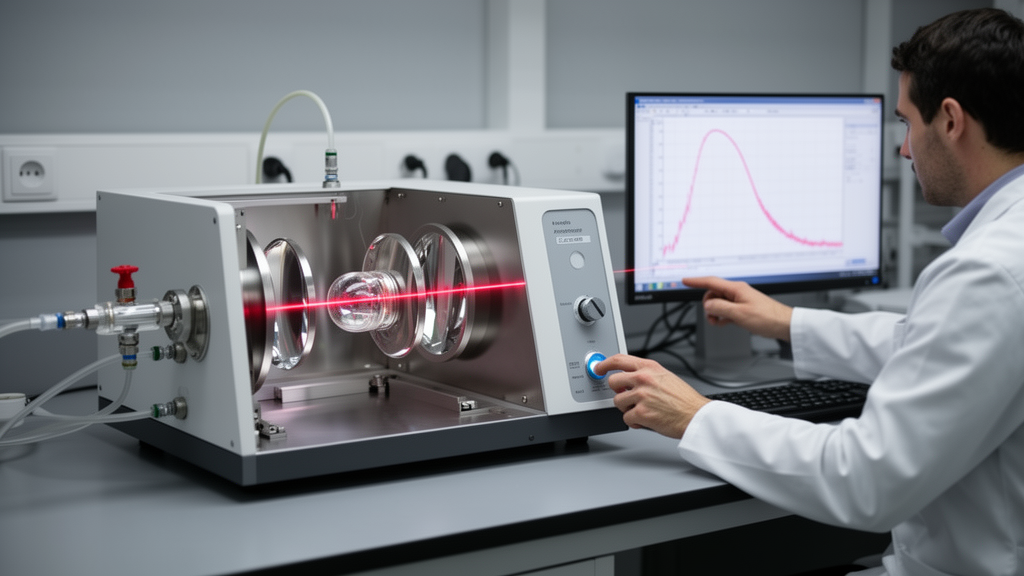
A team led by Leon Knez of the German Aerospace Center (DLR) has now shown that a commercial quantum cascade laser spectrometer, carefully engineered and rigorously tested, can deliver what the field has been missing. In a study published in Atmospheric Measurement Techniques, the researchers present the airborne performance of a MIRO MGA3 Multicompound Gas Analyzer configured for N2O sampling at 10 Hz with an in-flight precision of roughly 0.18 ppb, precise enough for airborne eddy covariance. The instrument exploits two continuous-wave quantum cascade lasers operating at room temperature, sweeping wavenumbers around 2190 and 1282 inverse centimeters through a Herriot measurement cell just 0.44 liters in volume but folded into a 76-meter optical path. Laser light absorbed by the sample air paints an absorption spectrum, and a fitting routine based on the Beer-Lambert law with a Voigt line profile retrieves the mole fractions of N2O, methane, carbon monoxide, and water simultaneously.
Turning this laboratory-grade instrument into an airborne system required a full engineering ecosystem. A scroll pump draws outside air through a rear-facing inlet on the aircraft hull, along meters of PTFE tubing, through a 2-micron particle filter, and past a mass flow meter into the cell at about 13 standard liters per minute. Because air cannot rush through the tubing instantly, the team measured a response time of 0.1 to 0.2 seconds, confirming an effective sampling frequency near 7 Hz despite the nominal 10 Hz retrieval rate. Every ten minutes an internal valve switches the instrument to a two-point calibration, drawing a low and a high standard gas traceable to the NOAA reference scale, each for twenty seconds. The gas pairs were deliberately chosen to bracket the atmospheric background with differences of ten to twenty ppb so the calibration can capture the small excursions caused by agricultural emissions, a lesson learned after earlier campaigns showed that overly similar standards caused calibration errors.
Water vapor emerged as the central enemy. In the tropical boundary layer, humidity can reach 30,000 ppm, four to five orders of magnitude more abundant than N2O itself. Water molecules both dilute the sample and, through quantum-mechanical line broadening, distort the very shape of the spectral lines being fitted; for the specific N2O absorption line used here, HITRAN database values show water vapor broadens the line more strongly than dry air or N2O itself. The instrument’s original fitting software ignored these effects entirely, and laboratory humidification experiments revealed raw N2O readings drifting by more than 10 to 18 ppb between dry and saturated conditions, an error roughly thirty times larger than the target precision. Knez’s team therefore derived an empirical correction from dedicated laboratory experiments, fitting a quadratic function of measured humidity and normalizing it so the correction scales proportionally with the N2O mole fraction, then validated it against NASA’s established instruments.
The validation came aboard NASA’s DC-8 during the ASIA-AQ campaign in early 2024, which surveyed the Philippines, South Korea, Taiwan, and Thailand. Comparing the corrected MGA3 data with NASA’s DACOM spectrometer, a tunable diode laser instrument that dries its sample air through a Nafion tube, the team found agreement within combined measurement uncertainties for all tested correction approaches, with up to about 82 percent of data points overlapping when the instrument’s own humidity measurements were calibrated against NASA’s Diode Laser Hygrometer. A newly released software version that applies the water vapor correction directly during spectral fitting matched DACOM well up to about 15,000 ppm of water but drifted at higher humidities, a quirk traced to a pressure regulator sensitive to moisture. Deactivating a fitting parameter that freezes the spectral line width, meanwhile, reduced measurement noise by roughly 42 percent, pushing the best in-flight precision to approximately 0.17 ppb.
Just as important was what did not appear in the data. Earlier airborne studies had reported N2O deviations of several ppb tied to cabin pressure changes and aircraft roll angles exceeding ten degrees, forcing researchers into data-destroying quality flags. The DLR team ran dedicated experiments: they asked the DC-8 crew to actively vary cabin pressure from 840 to 760 hPa over eight minutes and flew descents in the unpressurized DLR Cessna spanning 820 to 880 hPa, sampling calibration gas throughout. No significant pressure dependency emerged. Similarly, calibration measurements taken during steep turns with roll angles up to 36 degrees and climbs with pitch up to 15 degrees showed no dependency larger than the instrument’s own noise, meaning the spectrometer holds steady even in the turbulent boundary layer where the scientifically interesting fluxes live.
The campaign data itself offers a preview of what the technique can reveal. Over the Yellow Sea, the instrument recorded the clean background of about 338 ppb, unmoved even when descending through a sharp humidity gradient into the boundary layer. Approaching Seoul, enhancements of about 3 ppb appeared, and a vertical profile near Osan Airbase captured plumes reaching 16 ppb above background. Aggregated vertical profiles showed Thailand’s agricultural heartland, where post-rain emissions pushed enhancements up to 14 ppb, running several ppb higher than winter-bound South Korea in the 90th percentile. Surprisingly, overflights of a Tainan technology park hosting semiconductor plants in Taiwan revealed N2O enhancements up to 15 ppb around 1,500 meters altitude, a reminder that industrial sources can rival farmland. When the team applied the same water corrections to eddy covariance fluxes from the earlier GHGMon campaign in the Netherlands, the two approaches differed by less than a tenth of the typical flux uncertainty.
There are honest caveats. The MGA3’s humidity measurements, zeroed only against dry calibration gas, read about 16 percent lower than the hygrometer and drifted from flight to flight, which is why the DLH cross-calibration improved the correction. A hard landing or highway transport once misaligned the optics, temporarily worsening precision by 50 to 100 percent, although the instrument held alignment over roughly 90 flight hours during ASIA-AQ. The unpressurized Cessna produced slightly less stable measurements, likely from vibration and turbulence rather than pressure itself. The team recommends realigning mirrors before every campaign and mounting the instrument where its mirrors remain accessible, and suggests that shorter calibration windows could push the duty cycle above the current 94 percent.
The payoff extends well beyond instrument engineering. Tropical regions with intense agriculture and crushing humidity have long been observational blind spots precisely because water vapor corrupts the measurements that would map their emissions. A fast, precise, humidity-immune spectrometer validated against NASA’s best reference instruments changes that calculus, enabling eddy covariance flux quantification from moving aircraft over the very landscapes where fertilizer-driven emissions are growing fastest. As food and energy demand pushes N2O concentrations ever higher and climate models already trail reality by two to three ppb, closing that observational gap with instruments that can finally see through the humid air may prove one of the quiet, essential victories in the effort to protect both the climate and the ozone layer.
Subject of Research: Airborne quantum cascade laser spectrometer performance for fast, precise atmospheric nitrous oxide measurements
Article Title: Airborne performance assessment of the DLR MIRO MGA3 quantum cascade laser spectrometer for fast N2O measurements
Article References: Knez, L., Eckl, M., Waldmann, P., Fiehn, A., Pühl, M., Aseev, O., Diskin, G. S., DiGangi, J. P., Choi, Y., Miech, J. A., Bennett, R., Gatebe, C. K., Dean-Day, J. M., Poudyal, R., Lee, G., Kim, J., & Roiger, A. (2026). Airborne performance assessment of the DLR MIRO MGA 3 quantum cascade laser spectrometer for fast N 2 O measurements. Atmospheric Measurement Techniques, 19(20), 6583-6605. https://doi.org/10.5194/amt-19-6583-2026
Image Credits: AI Generated
Keywords: nitrous oxide, N2O, quantum cascade laser, spectrometer, greenhouse gas, water vapor correction, eddy covariance, DLR, NASA DC-8, ASIA-AQ, atmospheric measurement, agricultural emissions
Cite Scienmag News
Russell Cooper. (October 19, 2026). Laser Spectrometer Tames Humid Air to Track the Ozone-Hole Culprit Nitrous Oxide. Scienmag. https://scienmag.com/laser-spectrometer-tames-humid-air-to-track-the-ozone-hole-culprit-nitrous-oxide/
Russell Cooper. "Laser Spectrometer Tames Humid Air to Track the Ozone-Hole Culprit Nitrous Oxide." Scienmag, 19 October 2026, https://scienmag.com/laser-spectrometer-tames-humid-air-to-track-the-ozone-hole-culprit-nitrous-oxide/. Accessed 19 October 2026.
Russell Cooper. "Laser Spectrometer Tames Humid Air to Track the Ozone-Hole Culprit Nitrous Oxide." Scienmag. October 19, 2026. https://scienmag.com/laser-spectrometer-tames-humid-air-to-track-the-ozone-hole-culprit-nitrous-oxide/


