


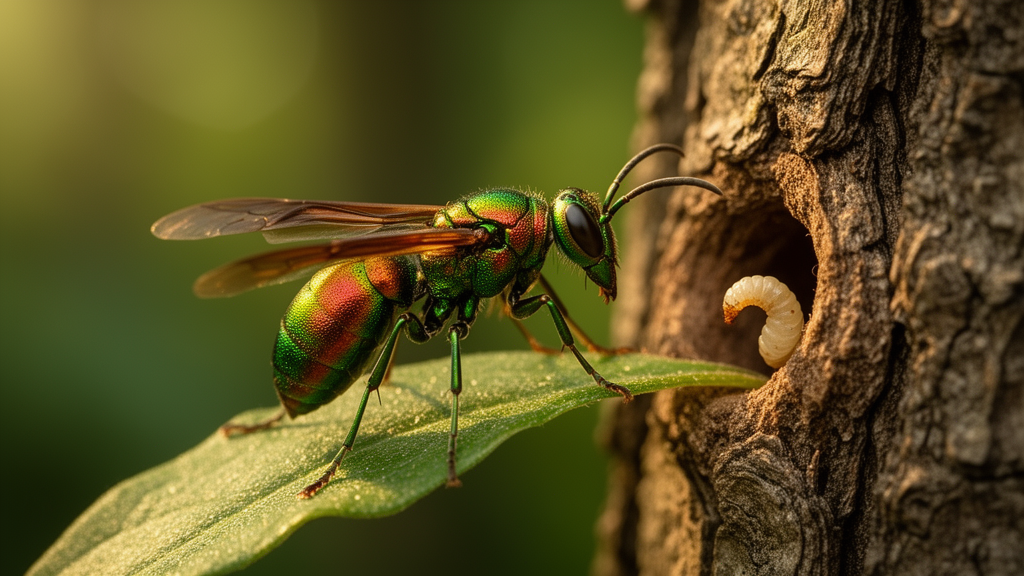
Deep in the pine forests of Dinghu Mountain in China’s Guangdong Province, a Malaise trap quietly collected an insect that would turn out to be entirely new to science. The wasp, now named Balcha fulgida by researchers documenting China’s eupelmid wasp fauna, glitters with brilliant reddish and golden metallic luster across its mid-back, a feature so distinctive that it immediately separates the species from every other member of its genus. Its description, published in the open-access journal ZooKeys, is far more than a routine taxonomic addition. The study raises the number of Balcha species known from China to eight, making the country the richest documented hotspot for this poorly understood genus, and it delivers a surprising twist in the story of one of North America’s most watched biological invasions.
Balcha wasps are parasitoids, meaning their larvae develop by feeding on other insects, and members of the genus are known to attack wood-boring jewel beetles in the family Buprestidae. The genus is native to the Old World, distributed across the Afrotropical, Australasian, Oriental and Palaearctic regions, with one notable exception: Balcha indica was accidentally introduced to North America. That species gained international attention because it parasitizes the emerald ash borer, Agrilus planipennis, the devastating beetle responsible for the deaths of hundreds of millions of ash trees across the United States and Canada. When Gibson revised the world species of Balcha in 2005, he identified the North American parasitoid as B. indica and speculated that it had originated in Vietnam or elsewhere in Southeast Asia, perhaps carried there by military transport.
The new research, led by Wang and Peng, upends that assumption. By combining fresh specimens from Jiangsu Province with DNA sequencing, the team found that Chinese B. indica matches North American material in every diagnostic character examined. Both share dark femora, a mesoscutum that is dorsally quite uniformly alveolate with a few white lanceolate setae posteromedially, a scutellum with conspicuous anterior rugae, and an entirely alutaceous postalar region of the acropleuron. More compelling still, the mitochondrial cytochrome c oxidase subunit I, or COI, gene sequence from the Chinese specimen differs by only 0.2 percent from sequences of North American specimens deposited in the Barcode of Life Data Systems. Taken together with the fact that both the emerald ash borer and its ash tree hosts are naturally distributed in China, the evidence points firmly to China as the likely source of the Nearctic population, most probably shipped via commercial commodities rather than military channels.
The molecular work underpinning this conclusion required painstaking laboratory technique. Wasps collected between 2015 and 2025 were preserved in 95 percent ethanol and stored at minus 20 degrees Celsius before their DNA was extracted using a commercial kit with several modifications designed to coax usable genetic material from tiny specimens. Incubation was extended to at least 12 hours at 56 degrees Celsius in a thermo-shaker, and the adsorption columns were carefully air-dried to eliminate residual ethanol that could degrade subsequent amplification. The team then used the classic Folmer primers LCO1490 and HCO2198 to amplify a COI fragment, running 35 amplification cycles before sending the products for sequencing. The resulting sequences were verified by translating them into amino acids to confirm the absence of premature stop codons, then aligned with the MUSCLE algorithm so that pairwise Kimura 2-parameter genetic distances could be calculated.
Those distance calculations revealed another puzzle. Among the three Balcha species sequenced, interspecific COI distances ranged from 9.4 to 14.5 percent, comfortably separating the taxa. Yet within B. dictyota, two conspecific specimens from Jiangsu and Jiangxi Provinces differed from each other by a striking 6.5 percent, an unusually deep mitochondrial split for a single species. Both specimens had been unambiguously identified through morphology, matching the original description and the extensive variation documented in earlier studies. The authors note that such divergence, while remarkable, is not unprecedented in the family Eupelmidae: a comparable 6.2 percent intraspecific COI distance has been reported in Zaischnopsis lii, another eupelmid with stable diagnostic morphology despite high mitochondrial divergence.
B. dictyota itself has become something of a case study in how variable a species can be. The original description rested on a single female from Beijing, characterized by longitudinal parapsidal bands extending over roughly half the mesoscutal length and a green scutellum. Specimens now examined from Anhui, Jiangsu and Jiangxi Provinces show mesothoracic coloration that departs from that template, and one individual from Chuzhou displays a transitional state bridging the holotype’s morphology with that of other specimens. Body length varies even more dramatically, from 7.5 to 16.8 millimeters, forming two largely discrete size classes rather than a smooth gradient. The researchers suggest this disparity likely reflects differences in host resources during larval development, perhaps tied to different host species or developmental stages of the wood-boring beetles the larvae consume.
The newly described B. fulgida, known only from a single female caught in Dinghu Mountain National Nature Reserve between late February and late March 2024, belongs to the elegans species group, distinguished by a thick dorsellum and a setose paraspiracular region on the propodeum. At about nine millimeters long, the holotype bears a mesoscutum entirely ablaze with reddish and golden metallic luster, and the species name derives from the Latin fulgidus, meaning shining or glittering. The authors caution that because the species is described from one specimen, and because close relatives such as B. dictyota and B. indica show substantial intraspecific variation, identifications should rest on an integrated evaluation of multiple characters rather than any single feature. Male and biology remain unknown, leaving plenty of work for future collectors.
Three of the eight Chinese species are recorded for the first time from the country, and the study adds valuable biological details for two of them. Three B. indica females were found on trunks of paper mulberry, Broussonetia papyrifera, in Nanjing, where the collector observed oviposition behavior and recorded an abundance of wood-boring beetles, including jewel beetles, longhorn beetles and weevils. Based on the known host preferences of the genus, jewel beetles are the most likely targets, although parasitism of other borers cannot be ruled out. Separately, two females of B. reticulata emerged in the laboratory from a section of dahurian larch trunk collected in Benxi, Liaoning Province, suggesting a wood-boring beetle host associated with that tree, which also grows in the Russian Far East and may therefore support the species there as well.
Perhaps the most tantalizing hint of what remains undiscovered comes from outside China. In compiling a global synthesis of Balcha distribution using citizen-science observations from iNaturalist alongside published records, the researchers encountered reports from Poland and from Moscow in European Russia. These localities lie far north of the previously known northern limit of roughly 43 degrees latitude in the easternmost Russian Far East, and no Balcha species had ever been formally documented from the European biogeographic realm. Whether these records represent natural range expansions, misidentifications or previously overlooked populations, they underline how incomplete our picture of this glittering genus remains, even as China cements its status as its global diversity stronghold.
Subject of Research: Taxonomy, DNA barcoding and biogeography of the parasitoid wasp genus Balcha in China, including the description of a new species and new host records.
Article Title: Contribution to the genus Balcha Walker ( Hymenoptera , Chalcidoidea , Eupelmidae ) of China, with description of a new species and DNA data
Article References: Wang, Q., Liao, H., Li, Z., Zhang, Y., & Peng, L. (2026). Contribution to the genus Balcha Walker (Hymenoptera, Chalcidoidea, Eupelmidae) of China, with description of a new species and DNA data. ZooKeys, 1289, 215-236. https://doi.org/10.3897/zookeys.1289.199128
Image Credits: AI Generated
DOI: 10.3897/zookeys.1289.199128
Keywords: Balcha, Eupelmidae, Chalcidoidea, taxonomy, new species, DNA barcoding, COI gene, parasitoid wasps, emerald ash borer, China, biogeography, ZooKeys
Cite Scienmag News
Gavin Prescott. (October 19, 2026). New Jewel of Chinese Insect Life Sheds Light on a Beetle-Killing Parasitoid’s Journey. Scienmag. https://scienmag.com/new-jewel-of-chinese-insect-life-sheds-light-on-a-beetle-killing-parasitoids-journey/
Gavin Prescott. "New Jewel of Chinese Insect Life Sheds Light on a Beetle-Killing Parasitoid’s Journey." Scienmag, 19 October 2026, https://scienmag.com/new-jewel-of-chinese-insect-life-sheds-light-on-a-beetle-killing-parasitoids-journey/. Accessed 19 October 2026.
Gavin Prescott. "New Jewel of Chinese Insect Life Sheds Light on a Beetle-Killing Parasitoid’s Journey." Scienmag. October 19, 2026. https://scienmag.com/new-jewel-of-chinese-insect-life-sheds-light-on-a-beetle-killing-parasitoids-journey/


