


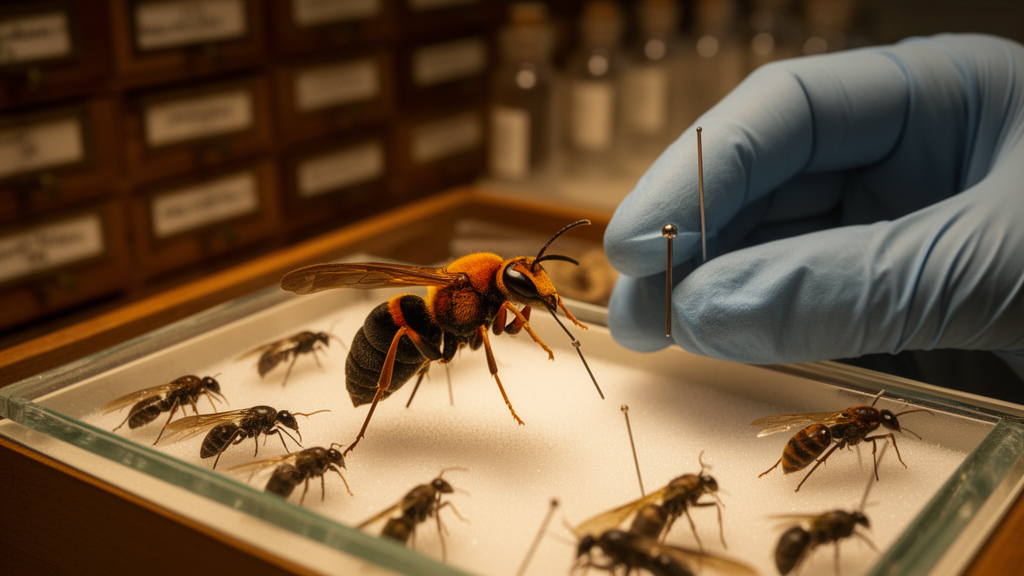
Deep inside the drawers and glass-topped cases of Sweden’s natural history museums lies a quiet archive of one of Europe’s most striking insects: the large velvet ant Mutilla europaea, a wasp whose wingless females scuttle across the ground in red and black armor while their winged males patrol the summer air. A new survey published in Natural History Collections and Museomics has now catalogued every known specimen of this species held in the country’s major museum collections, recording 216 individuals that together span roughly 150 years of collecting, from the 1870s to the 2020s. The result is more than a curatorial exercise. It is a consolidated dataset, now flowing into the Global Biodiversity Information Facility, that turns scattered drawers into a coherent record of where and when this species has occurred in southern Sweden.
The project was born of a practical problem that plagues biodiversity research everywhere: specimens exist, but nobody knows exactly where. Sweden has an entomological tradition stretching back nearly 300 years, and its museums hold vast quantities of insects gathered by generations of collectors. Yet despite accelerating digitization, many institutions still lack complete lists of what they hold, making it difficult for researchers to locate material for studies of rare species or long-term ecological change. The survey therefore targeted the institutions with the largest insect collections in the country: the National Museum of Natural History in Stockholm, the National Museum of Natural History in Gothenburg, the Biological Museum in Lund, and the Museum of Evolution in Uppsala, along with smaller but significant holdings at Helsingborgs Museum, Malmö Museum, Vänersborgs Museum, and the Swedish University of Agricultural Sciences, whose Veterinary Museum collection is housed at the Ecology Center in Uppsala.
The counting itself was straightforward but meticulous. Because Mutilla europaea is the only species of its genus in Sweden, the author could trust the identification labels on the specimens without fear of confusion with close relatives. Records were filtered through GBIF using dataset keys for the Lund University Biological Museum insect collections and the Gothenburg entomological collection, with the taxon key pinned to Mutilla europaea Linnaeus, 1758. From the resulting pool, frequency and distribution maps were constructed using the grid statistics of Artdatabanken, the Swedish Agricultural University’s analysis portal, yielding an alpha-level picture of the species’ confirmed occurrences across the country.
The numbers tell a story of both abundance and fragility. Of the 216 Swedish specimens, 189 are pinned and 27 are glued, and the collections are described as being in good condition, offering a solid reference base for future research. Crucially, 138 specimens carry complete data with both year and locality, which is the minimum needed to confirm distribution and frequency. The Biological Museum in Lund holds the largest share, with 70 specimens, of which 46 are females and 24 are males. Gothenburg follows with 59, Stockholm with 49, Uppsala with 19, the SLU Ecology Center with 11, Vänersborg with 5, Helsingborg with 2, and Malmö with just 1. The sex ratios vary strikingly between institutions, a reminder that collecting methods and historical fashion shape what ends up in a drawer.
What elevates this catalogue beyond a simple tally is the age and provenance of some of the material. The Biological Museum in Lund traces its origins to the early eighteenth century and preserves the entomological collection of Johan Leche, who lived from 1704 to 1764, as well as the collection of Kilian Stobaeus, donated to the museum in 1735. Stobaeus is best remembered as the teacher of Carl Linnaeus during the year the great taxonomist spent in Lund, from 1727 to 1728. This collection is considered the second oldest insect collection in the world. Meanwhile, the Museum of Evolution in Uppsala holds historical material gathered by Carl Peter Thunberg, a former disciple of Linnaeus himself, although the curator notes it is not certain that the Mutilla europaea specimens in that collection actually originate from Sweden.
Not every record resolves cleanly. One specimen in Gothenburg is labelled Kullabo, but Sweden contains three places of that name, and it is now impossible to determine which one produced the insect. Three specimens in Stockholm carry the label Karup, with no indication of whether they came from the South or the North Karup. Two specimens from Östergötland county are particularly tantalizing: they are the only known individuals recorded in that county apart from a single literature reference from 1985, yet their labels are so difficult to interpret that only the abbreviation for Östergötland can be deciphered. These ambiguities are not mere annoyances; they are the raw material of biogeography, and the catalogue makes them visible rather than burying them in drawer labels.
Among the standouts is a single black male of Mutilla europaea, collected in Steneby in Dalsland, Västra Götaland County, and held in Lund. Black males are common in Eastern and Central Europe, but this is the only one known from Sweden in the surveyed collections, making it a biogeographic outlier worth its own line in the appendix. Another specimen, captured in Odensjö in 1896 by an unknown collector and held in Stockholm, likely corresponds to a record mentioned in the old insect inventory compiled by Henning Nordenström, partly during the 1870s and partly between 1896 and 1899. Connecting a physical pin to a century-old literature citation is exactly the kind of link that digitized catalogues are designed to surface.
The survey also recovered specimens identified by Stellan Erlandsson, whose 1964 paper listed all documented finds of the species known to him at the time. Four additional specimens he identified in 1971 turned up in the SLU Ecology Center during this survey. In Helsingborg, the two specimens were collected by Cecilia Andersson, a diligent collector of butterflies and beetles who can be counted as the first woman in Sweden to work as an active insect collector. Her specimens lack collection dates, but because she lived in Båstad between 1906 and 1917, the curator considers it probable that the insects were gathered during that window. Such inferences, drawn from biography as much as from labels, illustrate how museum science blends entomology with history.
Perhaps the most biologically revealing specimens are those recovered directly from bumblebee nests, a window into the parasitic lifestyle that defines this species. Three females in Lund were found in nests of what was then called Bombus agrorum, now known as Bombus pascorum, and one female from the same museum came from a nest of Bombus terrestris, with a note that it hatched on September 1, 1925. In Stockholm, 13 males and 3 females were captured in a nest of Bombus muscorum, a record documented in Erlandsson’s 1964 paper. Erlandsson also recorded that a collector named Wieslander found many males and females on August 3, 1930, and it is likely that the specimens labelled August 20, 1930 in Stockholm are the ones he meant. Together, these records confirm the intimate association between Mutilla europaea and its bumblebee hosts in Scandinavia, where mated females infiltrate Bombus nests to lay their eggs.
The species itself remains relatively rare in Sweden, and the new database, now accessible through the Swedish node of GBIF, gives researchers a tool for studies of conservation, systematics, biogeography, ecology, and biology. By uniting specimens from eight institutions into a single queryable resource, the catalogue transforms what was once a diffuse, drawer-by-drawer puzzle into a national dataset that scientists anywhere can interrogate. For a species whose females spend their lives on the ground and whose males vanish into the summer air, that kind of visibility is no small thing. The velvet ant’s Swedish history, once scattered across centuries and counties, now has a map.
Subject of Research: Museum specimen catalogue and GBIF digitization of the velvet ant Mutilla europaea in Swedish natural history collections
Article Title: Catalogue of Mutilla europaea Linnaeus,1758 ( Insecta , Hymenoptera , Mutillidae ) deposited in the collections of the major Natural History Museums of Sweden
Article References: Gunnarsson, K. (2025). Catalogue of Mutilla europaea Linnaeus,1758 (Insecta, Hymenoptera, Mutillidae) deposited in the collections of the major Natural History Museums of Sweden. Natural History Collections and Museomics, 2, 1-14. https://doi.org/10.3897/nhcm.2.147202
Image Credits: AI Generated
Keywords: Mutilla europaea, velvet ant, Mutillidae, natural history museums, Sweden, GBIF, biodiversity informatics, bumblebee parasitism, entomology collections, Linnaeus, specimen digitization, biogeography
Cite Scienmag News
Margaret Porter. (October 19, 2026). Sweden’s Velvet Ant Vaults: 216 Museum Specimens Map a Rare Wasp’s Hidden History. Scienmag. https://scienmag.com/swedens-velvet-ant-vaults-216-museum-specimens-map-a-rare-wasps-hidden-history/
Margaret Porter. "Sweden’s Velvet Ant Vaults: 216 Museum Specimens Map a Rare Wasp’s Hidden History." Scienmag, 19 October 2026, https://scienmag.com/swedens-velvet-ant-vaults-216-museum-specimens-map-a-rare-wasps-hidden-history/. Accessed 19 October 2026.
Margaret Porter. "Sweden’s Velvet Ant Vaults: 216 Museum Specimens Map a Rare Wasp’s Hidden History." Scienmag. October 19, 2026. https://scienmag.com/swedens-velvet-ant-vaults-216-museum-specimens-map-a-rare-wasps-hidden-history/


