


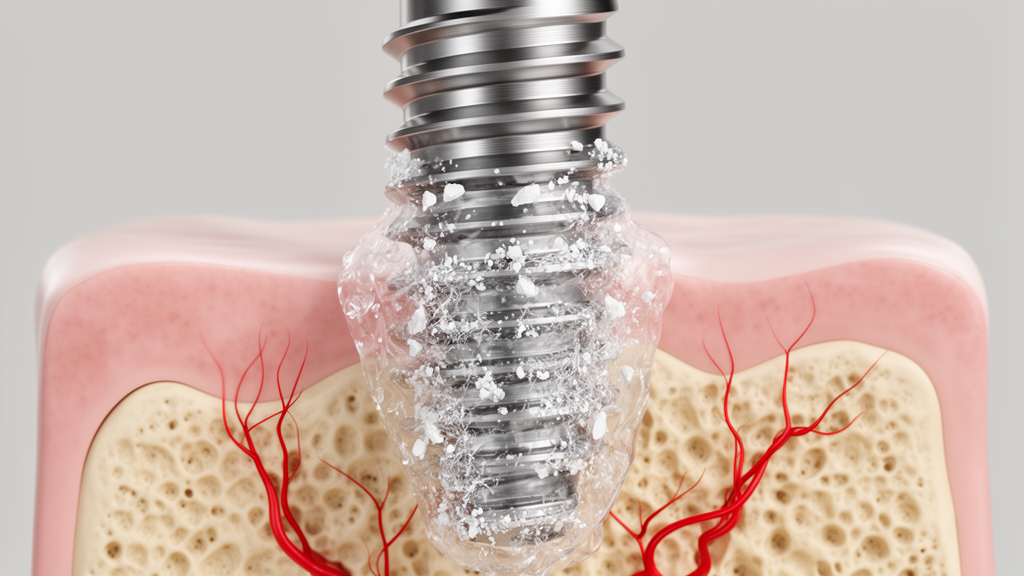
Titanium has long been the gold standard for dental and orthopedic implants, prized for its biocompatibility and its ability to fuse with living bone through a process called osseointegration. Yet titanium, for all its virtues, is biologically inert. It lacks osteoconductivity and osteoinductivity, the properties that actively recruit and guide bone-forming cells to the implant surface. When osseointegration is incomplete, implants can loosen and fail, a risk that is especially high in patients with systemic conditions such as osteoporosis and diabetes. Now, a research team from Fujian Medical University and Wenzhou Medical University has reported a surface modification strategy that could change that, coating titanium with a combination of sodium alginate, collagen, and the plant-derived polyphenol troxerutin to simultaneously stimulate bone formation and blood vessel growth around implants.
The study, published in Frontiers in Bioengineering and Biotechnology, addresses one of the central challenges in implantology: after an implant is inserted, the surrounding bone undergoes remodeling, a cascade of events that includes osteogenesis, angiogenesis, and stem cell homing. Blood vessels are not passive spectators in this process. They promote hematoma organization, callus formation, and bone tissue reconstruction by delivering oxygen, nutrition, and cellular support to the healing site. A material that stimulates only bone cells, without supporting vascularization, may therefore fall short of the full biological demands of bone formation. The researchers argue that relying on a single functional material is rarely enough, which is why they turned to a multi-component coating designed to act on both fronts at once.
The coating itself was built using a layer-by-layer approach, a reliable technique for assembling biomaterials on metal surfaces. Titanium discs measuring 10 millimeters in diameter and 1 millimeter in thickness were first cleaned with acetone, ethanol, and distilled water, then treated with a sodium hydroxide solution for 24 hours at 80 degrees Celsius to activate the surface. The discs were immersed in a mixture of collagen and sodium alginate for 30 minutes, and finally soaked in a troxerutin solution for 24 hours at 37 degrees Celsius before being dried and disinfected under ultraviolet light for 12 hours. Sodium alginate, a natural polysaccharide with hydrophilicity and excellent biocompatibility, serves as an encapsulating carrier, while collagen provides a familiar structural scaffold for cells. Troxerutin, a flavonoid polyphenol already used clinically to treat cardiovascular and cerebrovascular diseases, is the active ingredient that the researchers hoped would deliver osteogenic and angiogenic effects.
Surface characterization confirmed that the coating had formed as intended. Scanning electron microscopy revealed a porous structure in the alginate-collagen layer, an ideal environment for loading troxerutin particles, which were successfully embedded in the final coating. Atomic force microscopy showed surface heterogeneity after modification, and X-ray diffraction detected an additional peak in the troxerutin-loaded group, consistent with successful drug incorporation. Perhaps most importantly for biological performance, water contact angle measurements demonstrated that the surface became significantly more hydrophilic after modification, a property known to benefit osseointegration and primary stability. In vitro release experiments simulating body conditions showed that troxerutin underwent an initial burst release during the first 10 days, followed by a slower, sustained release, a profile that could match the early biological demands of implant healing.
Biocompatibility testing using mouse embryonic osteoblast cells, known as MC3T3-E1 cells, and human umbilical vein endothelial cells, or HUVECs, showed that the coating supported cell viability without toxicity. Cell proliferation, measured with a cell counting kit after 4 and 7 days, was greatest in the troxerutin-loaded group compared with unmodified titanium and the alginate-collagen coating alone. The researchers note that this simple drug delivery system avoided the biocompatibility problems that can plague more complex delivery platforms, an important consideration for any material intended for clinical use.
The osteogenic results were striking. After 7 days in culture, alkaline phosphatase activity, an early marker of osteoblast differentiation, was highest in the troxerutin-loaded group. After 21 days, alizarin red staining revealed significantly more mineralized nodule formation, indicating that troxerutin enhanced the late-stage mineralization of MC3T3-E1 cells. Real-time polymerase chain reaction confirmed that the coating upregulated the expression of key osteogenic genes, including RUNX2, ALPL, BGLAP, and COL1A1, compared with the other groups. These findings align with previous reports that troxerutin can stimulate osteoblast differentiation of mesenchymal stem cells, activate Wnt/beta-catenin signaling to facilitate fracture healing, and increase the expression of Osterix and RUNX2 to improve mineralization.
The angiogenic side of the story proved equally compelling. In tube formation assays, HUVECs cultured for 6 hours on Matrigel formed the longest tube structures in the troxerutin-loaded group, measured quantitatively by node number and tube length. Transwell migration assays showed that the coating promoted the chemotactic migration of HUVECs, with crystal violet staining after 24 hours revealing more migrated cells on the basal side of the insert membrane. The coating also increased the expression of vascular endothelial growth factor, or VEGF, a master regulator of angiogenesis. These results suggest that troxerutin produces vasculotropic and vasculoregulatory effects that could enhance the vascularization needed for bone remodeling around implants, consistent with its established clinical role in treating chronic venous insufficiency.
To test whether these in vitro effects translated into actual bone formation, the researchers implanted the coated titanium discs into the femurs of rats. Eighteen animals were randomly divided into three groups receiving unmodified titanium, titanium with the alginate-collagen coating, or titanium with the full alginate-collagen-troxerutin coating. After 4 weeks, micro-computed tomography scanning of the region of interest, defined as the 0.5-millimeter area around each implant, showed that the troxerutin-loaded group had the highest bone volume fraction and trabecular thickness. Histological examination using hematoxylin and eosin and Masson trichrome staining revealed greater amounts of newly formed bone tissue around the troxerutin-coated implants, and immunofluorescence staining detected more positive signal for collagen type I, osteocalcin, and osteopontin, markers of active bone formation.
The researchers are careful to note that the coating remains far from clinical application. Troxerutin has relatively low bioavailability, and maintaining its stability within the body is difficult. Sterilization poses another challenge, since many standard methods could destroy the delicate coating, and a suitable sterilization process must be developed before the material can be brought to market. Controlling the loading and release of polyphenolic compounds is also essential, because high doses can have negative effects. Still, the study demonstrates that a simple, biocompatible coating combining a natural polysaccharide carrier, a structural protein, and a clinically proven flavonoid can simultaneously enhance mineralization and vascularization around titanium implants, offering a promising direction for surface modification strategies that could improve implant outcomes, particularly for patients whose healing capacity is compromised by osteoporosis, diabetes, or other systemic diseases.
Subject of Research: Biomaterials
Article Title: Sodium alginate and collagen-loaded troxerutin improve mineralization and vascularization around implants
Article References: Lin, Z.-Z., Ou, Y.-J., Ding, X., & Chen, J. (2026). Sodium alginate and collagen-loaded troxerutin improve mineralization and vascularization around implants. Frontiers in Bioengineering and Biotechnology, 14, Article 1935336. https://doi.org/10.3389/fbioe.2026.1935336
Image Credits: AI Generated
DOI: 10.3389/fbioe.2026.1935336
Keywords: titanium implants, osseointegration, troxerutin, sodium alginate, collagen, biomaterials, surface modification, osteogenesis, angiogenesis, Sodium, alginate, collagen-loaded
Cite Scienmag News
Denise Maddox. (October 19, 2026). Sodium alginate and collagen-loaded troxerutin improve mineralization and vascularization around implants. Scienmag. https://scienmag.com/sodium-alginate-and-collagen-loaded-troxerutin-improve-mineralization-and-vascularization-around-implants/
Denise Maddox. "Sodium alginate and collagen-loaded troxerutin improve mineralization and vascularization around implants." Scienmag, 19 October 2026, https://scienmag.com/sodium-alginate-and-collagen-loaded-troxerutin-improve-mineralization-and-vascularization-around-implants/. Accessed 19 October 2026.
Denise Maddox. "Sodium alginate and collagen-loaded troxerutin improve mineralization and vascularization around implants." Scienmag. October 19, 2026. https://scienmag.com/sodium-alginate-and-collagen-loaded-troxerutin-improve-mineralization-and-vascularization-around-implants/


