


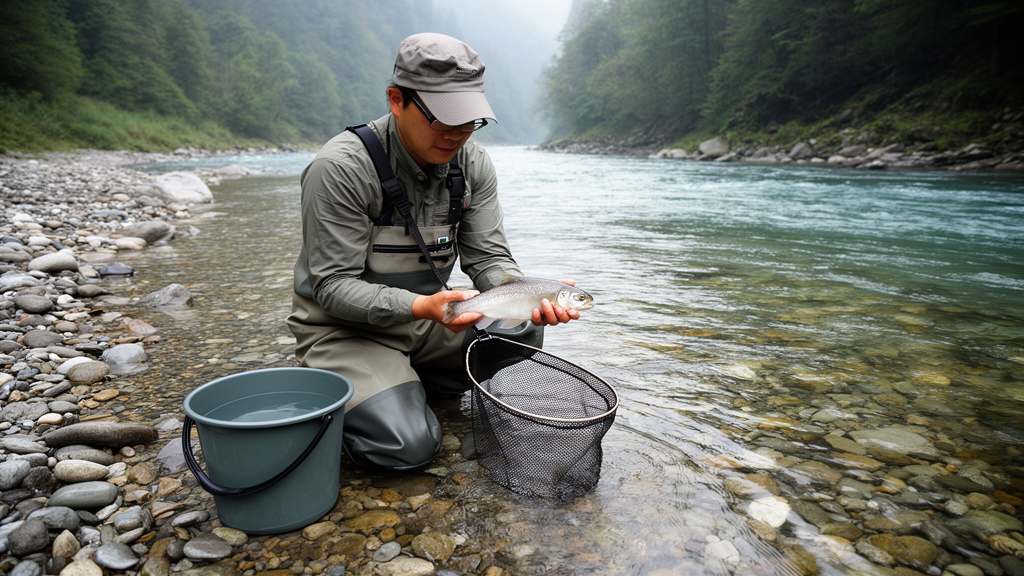
Deep in the mountain valleys of Yunnan Province, China, a river born on the eastern slopes of the Ailao Mountains winds southward into Vietnam, where the world knows it as the Red River. On its Chinese stretch, the Yuanjiang, an international research effort has now produced something deceptively simple yet extraordinarily valuable: a set of equations describing how twenty-three native freshwater fish species convert length into weight. Published in April 2025 in the journal Acta Ichthyologica et Piscatoria, the study delivers the first-ever growth data for seventeen of these species, information that has never before appeared in FishBase, the world’s largest online repository of fish biology. For species that live in remote, fast-flowing subtropical waters and are barely studied, these equations are the mathematical foundation on which all future conservation and fisheries management will be built.
The power of the approach lies in a formula that fisheries scientists have relied on for decades: W = aL^b, where W is body weight in grams, L is length in centimeters, and a and b are parameters fitted statistically to field measurements. The exponent b is the star of the show. When b equals exactly 3, a fish grows isometrically, meaning its shape stays constant as it gets longer, with length, width, and depth all increasing proportionally. When b deviates from 3, growth is allometric: the fish becomes more slender or more rotund as it ages, reflecting differences in how tissue is deposited across the body. Those deviations are not mere biological trivia. Decades of empirical work have tied systematic shifts in b-values to environmental quality, food availability, and the intensity of human pressure on aquatic habitats, making this single number a compact bioindicator of ecosystem health.
Between June 2023 and October 2024, the research team systematically sampled the Yuanjiang River basin, working through both flood and dry seasons to capture the full range of conditions the river experiences. Their toolkit was deliberately low-tech but rigorously standardized: multipanel nylon gillnets 20 to 40 meters long and 1 to 3 meters high with mesh sizes between 3 and 8 centimeters, alongside long, low cage nets measuring 40 meters in length with a fine 5-millimeter mesh capable of holding the smallest fish. Every fishing operation took place in the early morning hours, between 05:00 and 07:00, to keep conditions consistent across the sampling campaign. Each captured specimen was identified to species using established morphological keys, and total length, standard length, and body weight were recorded on-site to the nearest 0.1 centimeter and 0.1 gram.
The catch list reads like a biological census of one of Asia’s most distinctive river systems. It spans six families and three orders, dominated by the cyprinids, the vast carp and minnow family that includes the ornamental ancestor of the modern koi, Cyprinus rubrofuscus, alongside grazing species such as Onychostoma gerlachi and Poropuntius krempfi. There are loaches of the family Nemacheilidae, including Schistura fasciolata, represented by a robust sample of 452 individuals, and the cliff-hugging balitorids of the genera Vanmanenia, Beaufortia, and Sinogastromyzon, whose flattened bodies allow them to cling to rocks in torrential currents. The catfish diversity is equally striking, with sisorids of the genus Glyptothorax, the endangered Bagarius rutilus represented by juveniles, and several bagrid species, capped by the snakehead Channa gachua, a prowling ambush predator of the family Channidae.
The statistical outcomes were unambiguous. Every single length–weight and length–length regression across the 23 species proved highly significant, with probability values below 0.001. Coefficients of determination for the length–weight relations ranged from 0.911 to 0.996, meaning the fitted power functions explain more than ninety percent of the variation in body weight in every case. The allometric exponent b ranged from 2.492 in the rock-dwelling Beaufortia leveretti to 3.367 in Onychostoma gerlachi, spanning both markedly negative and strongly positive allometry. Where regressions showed coefficient values below 0.95, the team removed outliers and recalculated, a quality-control step that ensured only robust equations entered the final dataset. For length–length conversions between total and standard length, the fitted linear equations similarly achieved strong fits, giving researchers interchangeable metrics for comparison with studies recorded in different conventions.
The database implications are the study’s most dramatic headline. Seventeen of the twenty-three species had no length–weight record whatsoever in FishBase before this work, meaning that anyone attempting to estimate the biomass of these fish, model their populations, or assess the effects of fishing had essentially no quantitative starting point. The study also contributed a new distribution record for the region, documenting the rasborine cyprinid Rasbora atridorsalis in the Red River drainage for the first time in FishBase. In data-poor fisheries science, Bayesian models that borrow parameters from related species are often the only option for estimating growth, and the authors emphasize that their first-time values will help validate the accuracy and predictability of such models. Real measurements, in other words, are what keep the statistical guesswork honest.
Reading the allometric patterns across the assemblage reveals a river under visible stress. Nine species, or 39.1 percent of the sample, exhibited negative allometric growth, meaning they became proportionally lighter and more slender for their length, while fourteen species, 60.9 percent, showed positive allometry. The authors point to overfishing as a likely driver of the negative component: relentless extraction skews populations toward younger, smaller individuals, a phenomenon known as miniaturization that is common in exploited fisheries worldwide. Miniaturization is not just an aesthetic shift. It reduces fishery productivity, reshuffles the composition of aquatic communities, and ultimately alters the structure and function of entire ecosystems, from the algae grazed by cyprinids to the prey fish regulated by predatory catfish.
Environment and biology both leave their fingerprints on the exponent b. The Yuanjiang basin descends dramatically from 2,625 meters above sea level to just 115 meters, creating steep gradients in temperature, flow, and productivity along its course. Where food is abundant and productivity high, fish tend toward positive allometry, packing on bulk as they grow; in less productive reaches such as deeper waters, negative allometry tends to prevail. Sex, growth stage, and season further modulate the parameters. The dominance in the catches of species such as Cyprinus rubrofuscus, Onychostoma gerlachi, Opsariichthys bidens, Schistura fasciolata, Vanmanenia tetraloba, and Abbottina rivularis suggests that substantial portions of the river remain productive enough to support robust growth, a cautiously hopeful signal embedded within the data.
The wider context makes the work urgent. The Yuanjiang sustains more than 120 native freshwater fish species, many of them endemic, including the endangered catfish Bagarius rutilus sampled here in its juvenile stage. Human pressures are compounding: dams and water conservancy projects fragment habitats and drown spawning grounds, pollution degrades water quality, overfishing removes the largest and most fecund individuals, and shifting monsoon patterns under climate change are altering the water temperatures and flow regimes on which fish life cycles depend. Keystone roles amplify the stakes, because cyprinids regulate algal biomass through grazing while predatory silurid catfish hold prey populations in check, so the erosion of these fish communities would propagate through the entire food web.
What this study ultimately offers is a baseline, and baselines are precious in a changing river. With species-specific equations now in hand, managers can convert routine length measurements from future surveys into biomass estimates, model population dynamics, and calculate sustainable yields without relying on borrowed parameters from unrelated fish elsewhere in Asia. The authors recommend long-term monitoring of fish resources, systematic analysis of community and population dynamics, and comprehensive evaluation of how the river’s ecological condition and its fisheries interact. In the Yuanjiang’s case, twenty-three sets of two simple numbers, an intercept and a slope, now stand between data scarcity and evidence-based stewardship of one of the biologically richest river systems in China, a reminder that in conservation, some of the most consequential discoveries come from the humblest of measurements.
Subject of Research: Length–weight and length–length relationships of freshwater fishes in the Yuanjiang River, China
Article Title: Length–weight and length–length relations of twenty-three freshwater fish species ( Actinopterygii ) from the Yuanjiang River, Yunnan Province, China
Article References: Liu, Y., He, C., Liu, M., Chen, W., Xia, Y., Li, Y., Zhu, S., Li, J., & Li, X. (2025). Length–weight and length–length relations of twenty-three freshwater fish species (Actinopterygii) from the Yuanjiang River, Yunnan Province, China. Acta Ichthyologica et Piscatoria, 55, 83-87. https://doi.org/10.3897/aiep.55.145362
Image Credits: AI Generated
Keywords: length-weight relationship, freshwater fish, Yuanjiang River, Yunnan, allometry, FishBase, fisheries stock assessment, cyprinids, Red River, biomass estimation, conservation, Yunnan Province
Cite Scienmag News
Bianca Avery. (October 19, 2026). Hidden equations of a wild Chinese river reveal the growth secrets of 23 little-known fish. Scienmag. https://scienmag.com/hidden-equations-of-a-wild-chinese-river-reveal-the-growth-secrets-of-23-little-known-fish/
Bianca Avery. "Hidden equations of a wild Chinese river reveal the growth secrets of 23 little-known fish." Scienmag, 19 October 2026, https://scienmag.com/hidden-equations-of-a-wild-chinese-river-reveal-the-growth-secrets-of-23-little-known-fish/. Accessed 19 October 2026.
Bianca Avery. "Hidden equations of a wild Chinese river reveal the growth secrets of 23 little-known fish." Scienmag. October 19, 2026. https://scienmag.com/hidden-equations-of-a-wild-chinese-river-reveal-the-growth-secrets-of-23-little-known-fish/


