


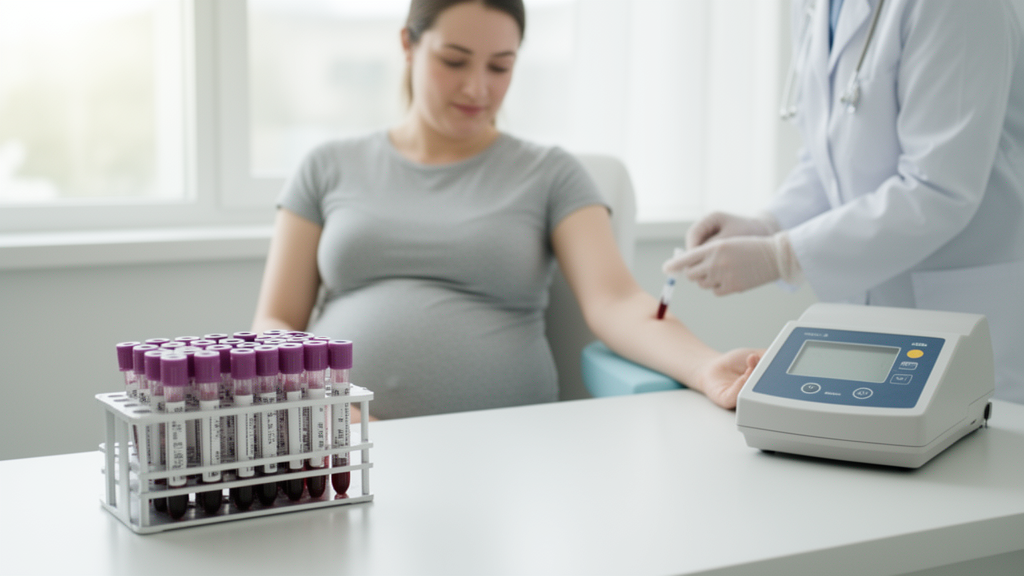
A routine blood test drawn in the first trimester of pregnancy may reveal, months before symptoms appear, which women are heading toward gestational diabetes mellitus (GDM), one of the most common metabolic complications of pregnancy. Researchers at Hainan Women and Children’s Medical Centre in Haikou, China, report in Frontiers in Nutrition that a composite metabolic index called TyHGB — built from triglycerides, high-density lipoprotein cholesterol, fasting plasma glucose, and pre-pregnancy body mass index — was strongly and independently associated with the risk of developing GDM later in gestation. Because the index relies on measurements that most prenatal clinics already collect, the finding points toward a cheap, practical way to identify high-risk pregnancies weeks earlier than the current diagnostic standard allows.
The study, a retrospective cohort analysis of 1,063 singleton pregnancies delivered between January and December 2024, set out to test whether TyHGB could serve as an early-warning biomarker for GDM. The index is an extension of the well-known triglyceride-glucose (TyG) index, a widely used surrogate for insulin resistance. TyHGB adds two more ingredients to the TyG formula: HDL cholesterol, the anti-inflammatory lipoprotein fraction involved in lipid regulation, and pre-pregnancy body mass index, a measure of systemic adiposity. Specifically, TyHGB is calculated as the ratio of triglycerides to HDL cholesterol, plus 0.7 times fasting plasma glucose in millimoles per liter, plus 0.1 times pre-pregnancy BMI in kilograms per square meter. Each component captures a different facet of the metabolic dysfunction that underlies GDM, which shares its core pathology — pancreatic beta-cell dysfunction and increased insulin resistance — with type 2 diabetes.
All participants underwent first-trimester blood testing before 14 weeks of gestation, with fasting venous samples analyzed for liver enzymes, total cholesterol, triglycerides, LDL and HDL cholesterol, fasting plasma glucose, and glycated hemoglobin. The women were then screened for GDM at 24 to 28 weeks using the standard 75-gram oral glucose tolerance test (OGTT), with diagnosis based on the International Association of the Diabetes in Pregnancy Study Groups criteria: fasting glucose of 92 mg/dL or higher, one-hour post-load glucose of 180 mg/dL or higher, or two-hour post-load glucose of 153 mg/dL or higher. Women with pre-existing type 1 or type 2 diabetes, multiple pregnancies, endocrine disorders, chronic hypertension, and other major complications were excluded to isolate the effect of the index in a broadly healthy obstetric population.
Of the 1,063 women enrolled, 190 — or 17.87 percent — were newly diagnosed with GDM. The median maternal age was 31 years, and the median pre-pregnancy BMI was 26.17 kg/m². When the researchers divided the cohort into tertiles based on TyHGB values, a striking gradient emerged: GDM prevalence rose from 6.59 percent in the lowest tertile to 18.72 percent in the middle tertile and 28.09 percent in the highest tertile. Women in the top tertile also carried higher triglycerides, LDL cholesterol, liver enzymes, fasting glucose, and pre-pregnancy BMI, along with lower HDL cholesterol, consistent with a broader pattern of metabolic dysregulation.
To determine whether TyHGB was an independent predictor rather than a proxy for other risk factors, the team built a series of multivariable logistic regression models with increasing levels of adjustment. In the fully adjusted model — controlling for maternal age, assisted reproductive conception, gravidity, total cholesterol, LDL cholesterol, alanine aminotransferase, aspartate aminotransferase, and glycated hemoglobin — each one-unit increase in TyHGB was associated with a 1.62-fold increase in the odds of GDM (95 percent confidence interval: 1.29 to 2.03). Compared with women in the lowest tertile, those in the highest tertile had nearly four times the odds of developing GDM (odds ratio 3.97, 95 percent CI: 2.19 to 7.21), and the dose-response relationship across tertiles was statistically significant, indicating a steady rise in risk with rising index values.
The diagnostic performance of TyHGB was then benchmarked against conventional markers using receiver operating characteristic (ROC) analysis. The area under the ROC curve (AUC) for TyHGB was 0.675 (95 percent CI: 0.646 to 0.703), with an optimal cut-off value of 5.995 determined by Youden’s index. At this threshold, the index achieved a sensitivity of 66.32 percent — correctly flagging about two-thirds of women who went on to develop GDM — and a specificity of 63.12 percent. Crucially, TyHGB outperformed maternal age (AUC 0.596), pre-pregnancy BMI (AUC 0.610), fasting plasma glucose (AUC 0.618), and the TyG index alone (AUC 0.615), suggesting that the composite formula extracts more predictive signal from the same routine blood draw than any single component could.
Subgroup analyses revealed an important nuance about who benefits most from this early signal. The association between TyHGB and GDM remained robust among women under 35 years of age, those with pre-pregnancy BMI below 25, and women who conceived spontaneously. However, in women with pre-pregnancy BMI of 25 or higher, the association was attenuated and no longer statistically significant, with a statistically significant interaction between BMI and the index. The researchers interpret this pattern as evidence that in low-risk populations — where obesity and advanced maternal age do not dominate the risk picture — subtle early glycemic and lipid disturbances are often missed by traditional screening tools, and TyHGB may fill that gap. In women already carrying strong conventional risk factors, those factors may mask the incremental value of the new index.
The biological rationale for TyHGB rests on the central role of insulin resistance in GDM. The TyG component reflects the interplay between blood glucose and triglyceride metabolism, both of which are disrupted when cells become less responsive to insulin. HDL cholesterol participates in anti-inflammatory and lipid regulatory processes, and impaired HDL function can aggravate lipotoxicity and worsen insulin resistance, further destabilizing glucose homeostasis. Pre-pregnancy BMI captures systemic adiposity, which a large-scale meta-analysis of more than 960,000 pregnant women linked to a 4 percent increase in GDM incidence per unit of BMI. By combining these parameters into a single number, TyHGB compensates for the limited accuracy of any one marker alone, and previous validation studies in Chinese and Korean populations have reported similar associations, with odds ratios ranging from 1.88 to 2.09.
The authors acknowledge several limitations. As a single-center retrospective study, the findings require external validation in larger prospective cohorts before broad clinical implementation. The study lacked data on lifestyle and socioeconomic factors such as diet, physical activity, sleep quality, and psychological status, which could influence glucose metabolism. TyHGB was measured only once, in early pregnancy, so dynamic metabolic changes across gestation were not captured. The cohort included only singleton pregnancies, and information on glucose-interfering medications was not systematically recorded. Moreover, with a moderate AUC of 0.675, TyHGB cannot serve as a standalone diagnostic test; its role is as an auxiliary tool for early risk stratification rather than a replacement for the OGTT.
Even with those caveats, the implications are significant. The current standard for GDM diagnosis — the OGTT performed at 24 to 28 weeks — arrives late in pregnancy, leaving little window for preventive intervention before complications can develop, and imposes considerable time and economic burdens on pregnant women. A simple index calculable from blood work already obtained in the first trimester could allow clinicians to flag high-risk patients months earlier, enabling targeted surveillance, individualized risk stratification, and proactive lifestyle or pharmacological measures at a stage when they may still alter the disease trajectory. Given that GDM now affects roughly 15 percent of pregnancies worldwide, with prevalence in China around 14.8 percent and regional rates ranging from 10.5 percent in Changsha to 19.7 percent in Beijing, a low-cost early screening tool could have substantial public health impact. The TyHGB index, the authors conclude, represents a promising, cost-effective, and widely applicable addition to routine antenatal screening protocols — one that could help lower GDM incidence and ultimately improve outcomes for both mothers and their babies.
Subject of Research: A composite metabolic index for predicting gestational diabetes risk in early pregnancy
Article Title: TyG indicator–TyHGB and the risk of gestational diabetes mellitus: a retrospective cohort study
Article References: Li, X., Bu, W., Liang, W., Ji, Z., Chen, Y., Xuan, Y., & Hu, X. (2026). TyG indicator–TyHGB and the risk of gestational diabetes mellitus: a retrospective cohort study. Frontiers in Nutrition, 13, Article 1967930. https://doi.org/10.3389/fnut.2026.1967930
Image Credits: AI Generated
DOI: 10.3389/fnut.2026.1967930
Keywords: gestational diabetes, TyHGB index, insulin resistance, pregnancy, first trimester screening, triglycerides, HDL cholesterol, fasting glucose, body mass index, biomarker, oral glucose tolerance test, maternal health
Cite Scienmag News
Harold Sullivan. (October 19, 2026). Simple Blood Formula in Early Pregnancy Flags Gestational Diabetes Risk, Study Finds. Scienmag. https://scienmag.com/simple-blood-formula-in-early-pregnancy-flags-gestational-diabetes-risk-study-finds/
Harold Sullivan. "Simple Blood Formula in Early Pregnancy Flags Gestational Diabetes Risk, Study Finds." Scienmag, 19 October 2026, https://scienmag.com/simple-blood-formula-in-early-pregnancy-flags-gestational-diabetes-risk-study-finds/. Accessed 19 October 2026.
Harold Sullivan. "Simple Blood Formula in Early Pregnancy Flags Gestational Diabetes Risk, Study Finds." Scienmag. October 19, 2026. https://scienmag.com/simple-blood-formula-in-early-pregnancy-flags-gestational-diabetes-risk-study-finds/


