


Bovine respiratory disease, or BRD, remains one of the most damaging health problems facing young cattle worldwide, striking an estimated 30 to 40 percent of calves in the United Kingdom and roughly 30 percent in the United States. Now, a research team led by Johanna M. C. Brans of Scotland’s Rural College has shown that combining data from several farm technologies with machine learning can detect the disease in pre-weaned dairy-bred calves with accuracy approaching 70 percent, without requiring the labor-intensive daily health checks that farmers currently rely on. The study, published in Frontiers in Animal Science, offers a glimpse of how precision livestock farming could transform calf health management.
The economic stakes are considerable. In the UK, BRD costs an estimated £30 to £80 per affected animal, and sustained lung damage in a dairy heifer can lead to losses of up to £722 per case. American researchers have calculated short-term costs of around $41.54 to $42.15 per calf, while Australian studies have reported losses ranging from AUD$67.10 to AUD$384.97. Beyond the immediate financial toll, the disease leaves lasting marks on animal performance, compromising feed efficiency, growth rate, reproduction, carcass quality, and even future milk yield.
Diagnosing BRD is notoriously difficult because the condition can arise from multiple pathogens and produces variable symptoms, and there is no single standardized test. The most common on-farm tool is the Wisconsin score, which assigns points for rectal temperature, nasal and ocular discharge, coughing, and ear droop. But scoring every calf every day is time-consuming and impractical in large herds, and the method offers only an instant snapshot of health. Research suggests it achieves only about 30 percent sensitivity despite high specificity of roughly 90 percent. Lung ultrasound scanning is more accurate but requires trained personnel and repeated assessments, adding cost and complexity.
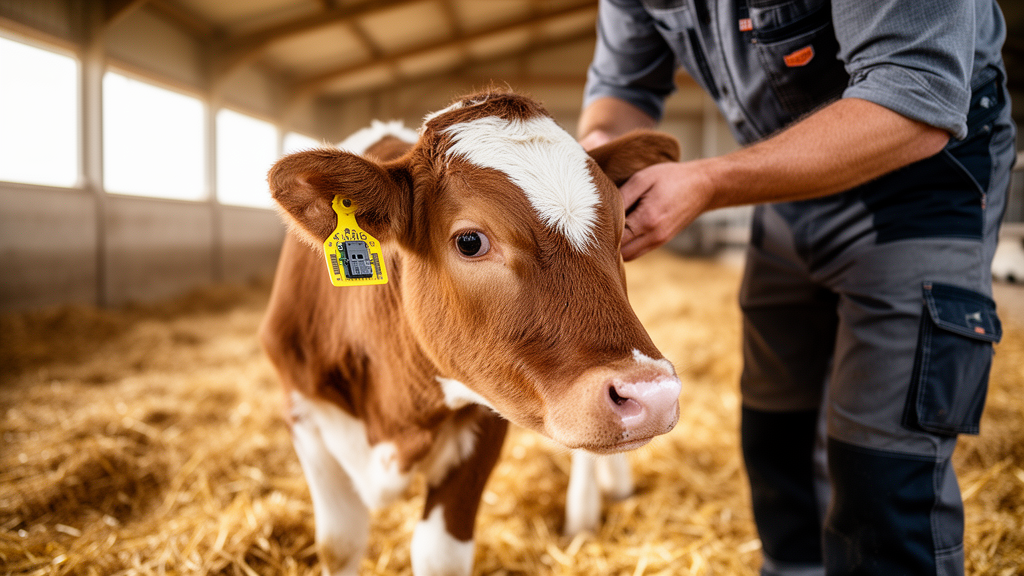
To overcome these limitations, the Scottish team monitored 118 mixed-breed calves at SRUC’s Crichton Royal Farm between August 2020 and March 2021, with 100 calves ultimately included in the analysis. The calves entered the trial at around nine days of age and were weaned at about 54 days. Each animal wore a newly developed calf-specific management ear tag called the WellCalf, produced by Smartbell, which combined a three-axis accelerometer, a three-axis gyroscope, and an infrared temperature sensor to generate 86 variables. The calves also wore IceQube pedometers on their rear left legs, capturing five daily locomotor metrics including standing and lying times, step counts, and motion index.
The researchers added two more data streams to the mix. An automatic milk feeding system from BioControl recorded the timing, duration, and volume of every milk and water visit, yielding 28 feeding variables such as intake and drinking speed. Meanwhile, daily environmental measurements from a weather station provided 24 additional variables covering temperature, humidity, and related factors. After cleaning and removing highly correlated variables, the complete dataset contained 152 variables, which the team trimmed to 100 for modeling. In total, the analysis covered 223 disease events and 223 healthy events across 98 calves, with two animals remaining healthy throughout.
Using the random forest algorithm, a supervised machine learning technique that aggregates the results of many decision trees, the team built 40 different models by combining different blocks of variables. The simplest models used only animal details such as sex, breed, and birth weight, while the most comprehensive layered together daily data from all four technologies, reaching 29 variables. The researchers also created retrospective models that averaged values across one, two, or three previous days, testing whether a longer behavioral window would improve prediction. Hyperparameters were tuned through random search, and each model was validated with five-fold cross-validation before being tested on unbalanced data.
All models were evaluated against the daily Wisconsin scores recorded by trained farm technicians, whose inter-observer reliability was confirmed with a Fleiss’ kappa of 0.78. A calf was classified as diseased with an overall score of at least 5 and a temperature above 39.4 degrees Celsius. Because the models were trained on balanced data using a SMOTEENN procedure, which oversamples the minority disease class and removes noisy data points, the researchers also assessed performance through two practical metrics: the accuracy of alerts generated by the model, and the accuracy of correctly identifying complete disease events.
The results revealed some instructive trade-offs. The best overall balance came from a model based solely on automatic feeder data averaged across the previous day, known as model Bm1, which achieved 56.0 percent accuracy of alerts and 69.1 percent accuracy of disease detection while producing some of the highest numbers of true positive and true negative results. The highest alert accuracy, 67.5 percent, came from the model integrating all daily data from every technology, model FTIEB. Meanwhile, the highest disease detection accuracy, 69.9 percent, was achieved by averaging feeder data across the two previous days, model Bm2. Notably, layering multiple technologies did not always improve disease detection compared with single-source models, but it consistently boosted alert accuracy.
The findings align with a growing body of evidence that sick calves change their behavior before clinical signs become obvious. Previous studies have shown that calves with BRD exhibit reduced activity, increased lying time, and decreased milk intake in the days surrounding diagnosis, and some machine learning approaches have predicted illness up to six days before a formal diagnosis. The Scottish team observed that models using retrospective data were not necessarily the best performers on standard testing metrics, yet they ranked among the best when applied through the alert system, suggesting that averaging behavioral data over several days adds practical value for farmers.
The authors caution that the study has limitations, including a relatively small sample size, missing data, and the fact that the Wisconsin score is less specific than diagnostic tools such as lung ultrasound. The calves were also housed in a single environment and the dataset skewed toward Holstein animals, which may limit generalizability. Still, the researchers argue that their approach demonstrates that early BRD detection is viable without daily manual scoring, reducing labor demands and improving objectivity. They recommend further investigation using independent commercial farm data, noting that reliable early warning systems could support more targeted veterinary treatment, limit the spread of disease, and help curb antimicrobial resistance by reducing unnecessary treatments.
Subject of Research: Machine learning detection of bovine respiratory disease in pre-weaned dairy calves using integrated sensor data
Article Title: Integrated data from different technologies coupled with machine learning can detect bovine respiratory disease in pre-weaned dairy-bred calves
Article References: Brans, J. M. C., Miller, G. A., Chitty, J., Mason, C., Adityan, V., Haskell, M. J., & Duthie, C.-A. (2026). Integrated data from different technologies coupled with machine learning can detect bovine respiratory disease in pre-weaned dairy-bred calves. Frontiers in Animal Science, 7, Article 1957311. https://doi.org/10.3389/fanim.2026.1957311
Image Credits: AI Generated
DOI: 10.3389/fanim.2026.1957311
Keywords: bovine respiratory disease, dairy calves, machine learning, random forest, precision livestock farming, ear tag sensors, automatic milk feeder, pedometer, Wisconsin health score, early disease detection, animal welfare, livestock technology
Cite Scienmag News
Teresa Odom. (October 19, 2026). Smart Ear Tags and Machine Learning Catch Calf Pneumonia Early, New Study Shows. Scienmag. https://scienmag.com/smart-ear-tags-and-machine-learning-catch-calf-pneumonia-early-new-study-shows/
Teresa Odom. "Smart Ear Tags and Machine Learning Catch Calf Pneumonia Early, New Study Shows." Scienmag, 19 October 2026, https://scienmag.com/smart-ear-tags-and-machine-learning-catch-calf-pneumonia-early-new-study-shows/. Accessed 19 October 2026.
Teresa Odom. "Smart Ear Tags and Machine Learning Catch Calf Pneumonia Early, New Study Shows." Scienmag. October 19, 2026. https://scienmag.com/smart-ear-tags-and-machine-learning-catch-calf-pneumonia-early-new-study-shows/


