


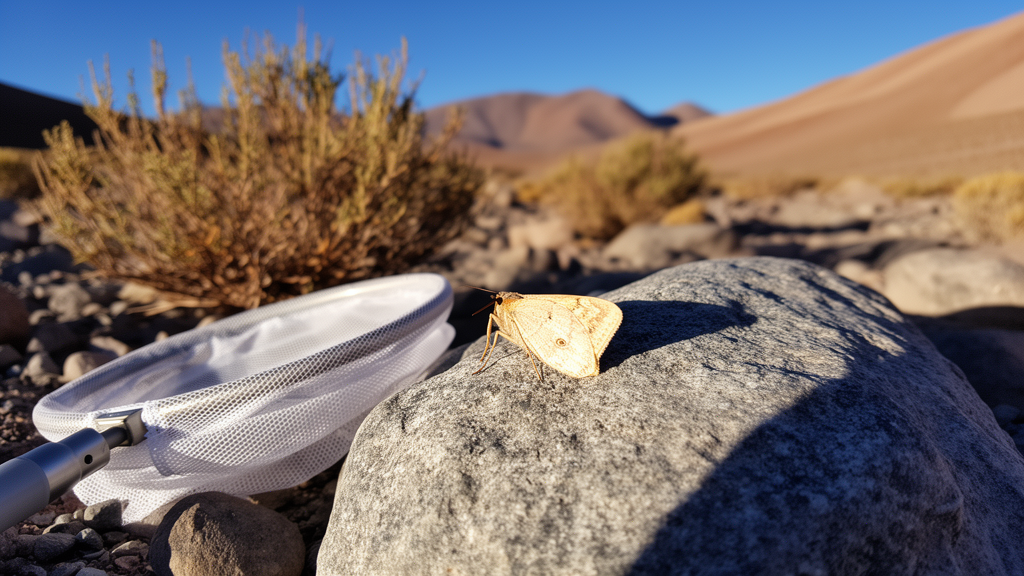
High on the arid western slopes of the Andes in northern Chile, where rainfall is scarce and vegetation is sparse, a small moth has been quietly flying under the radar of science. Researchers working in the Copaquilla ravine, at roughly 2,800 meters above sea level, set out a light trap in December 2020 and pulled in a series of slender geometrid moths whose anatomy did not match any described species. Detailed examination has now confirmed that the insects represent a species new to science, formally named Eupithecia copaquillaensis in a paper published in the journal Nota Lepidopterologica.
The genus Eupithecia is nothing short of enormous. With more than 1,300 species listed in the most recent world catalogue, it is the most species-rich genus in the entire family Geometridae, the moths whose caterpillars are famous for the looping inchworm gait created by their reduced abdominal legs. Yet even a genus this thoroughly catalogued keeps yielding surprises, with new species still being described from Europe, Asia and the Americas. The genus is readily recognized by a distinctive suite of male genital traits: an uncus that is broadest at its base and hook-like toward the tip, an hourglass-shaped juxta with a bilobed calcar, and curved labides bearing a setose, finger-like papilla. Molecular phylogenetic studies of Old World representatives further support the genus as a coherent, monophyletic lineage.
About a quarter of all known Eupithecia species live in the Neotropical Region, and the moist Andean forests have been suggested to be the richest places on Earth for the genus; intensive surveys in Ecuador’s humid Andes have revealed striking diversity. The dry side of South America tells a very different story. Chile, for all its length, had only 61 Eupithecia species with type localities in the country listed in the world catalogue, with a handful of additions since. Most Chilean species cluster in the center and south, and only five species had ever been recorded in the far north around 18 to 19 degrees south latitude. Just one of those was known to live in the Andean highlands, making any high-elevation find in this sector genuinely notable.
The specimens that led to the new species were collected in a single night of light trapping in the Copaquilla ravine, at coordinates 18°23’55″S, 69°37’49″W. To prepare them for study, the researchers removed the abdomens and cleared them in hot 10 percent potassium hydroxide, a standard technique that dissolves soft tissue and reveals the delicate sclerotized structures of the genitalia. The organs were then stained with Eosin Y and Chlorazol black and slide-mounted in Euparal for microscopic examination. Photography was carried out with digital cameras mounted on Leica and Olympus microscopes, and the type series, comprising one male holotype and six paratypes of both sexes, will be deposited in the Entomological Collection of the University of Tarapacá in Arica.
Because male and female moths of many small geometrid species are difficult to match by appearance alone, the team turned to DNA barcoding. Genomic DNA was extracted from the legs of one female and one male, and the standard 658-base-pair barcode region of the mitochondrial cytochrome c oxidase I gene was amplified and sequenced. The two sequences came back identical, providing molecular confirmation that the male and female specimens belong to the same species. In the Barcode of Life Data System, the closest match, at 98.6 percent similarity, was a privately held Eupithecia sequence from Antofagasta, Chile, several hundred kilometers to the south, hinting that the new species may range far beyond its type locality. The next nearest match, at 93.9 percent, was an unidentified lepidopteran from Ecuador.
The physical description of Eupithecia copaquillaensis fits the subtle, understated aesthetic typical of its genus. The forewings measure just under ten millimeters in males and are mainly creamy white, scattered with brownish gray and a few yellowish brown scales, with poorly defined transverse stripes that are broader and darker near the costal margin. Females are slightly lighter, with fewer gray and more yellow-brown scales. The abdominal segment VIII of the male bears a square-like tergum and a sternum split into two separate longitudinal rods, features that immediately place the species within Rindge’s Section 1 of Chilean Eupithecia, a group that includes its closest described relative, E. atacama.
Genitalia provide the decisive diagnostic characters. Both E. copaquillaensis and E. atacama carry two cornuti, or spine-like structures, on the vesica of the phallus, the larger being a narrow horseshoe-shaped piece with asymmetrical arms. The smaller cornutus, however, differs clearly between the two: in the new species it is sub-cylindrical and curved along its distal half, while in E. atacama it is depressed, squat and concave. The females are similarly separable. Both have a mainly membranous corpus bursae armed with small teeth-like signa, but in E. copaquillaensis the signa are grouped into a dense semicircular patch, whereas in E. atacama they are arranged in longitudinal stripes. These differences, though small enough to require slide preparation and a microscope, are exactly the kind of structural detail that lepidopterists rely on to distinguish cryptic geometrid species.
The new moth is only the second Eupithecia known from the arid highlands of Chile’s far northern Andes. The other, E. tarapaca, described in 1987, has larvae that feed on the flower buds of Balbisia microphylla, a shrub in the family Vivianiaceae, but it is easily told apart from the newcomer: its male sternum VIII is a narrow piece with two short apical arms, and its cornuti are shaped entirely differently. The species name copaquillaensis honors the ravine where the moths were captured, and the biology of the new species remains almost entirely unknown, since its host plants have not yet been identified and adults have so far been recorded only from the December light-trap catch.
Perhaps discouraged by the extreme aridity, entomologists have rarely surveyed the geometrid moths of the western slopes of the central Andes. Until a few years ago, the single holotype of E. tarapaca stood as the only specimen of Eupithecia ever reported in the scientific literature from above 3,000 meters in the northernmost part of Chile. The description of E. copaquillaensis follows a string of recent additions to other geometrid genera from the same region, reinforcing a growing message: the high-elevation environments of the central Andes harbor a geometrid fauna that has been substantially overlooked. Light traps, modern imaging and DNA barcoding are proving to be a powerful combination for uncovering it.
The authors note that the classification of Chilean Eupithecia, largely built on a framework proposed by Frederick Rindge in the 1980s and 1990s using genital morphology, now needs updating with modern phylogenetic methods. The monophyly of the Section 1 group to which the new species belongs, and indeed the evolutionary relationships of the entire Neotropical Eupithecia fauna, remain to be tested with molecular data across a broader sampling. For now, the discovery stands as a reminder that even one of the best-known moth genera on the planet still has species hiding in some of the driest, most inhospitable mountain landscapes on Earth, waiting for a light trap and a determined researcher to bring them into the light.
Subject of Research: Description of a new Eupithecia moth species from the arid Andes of northern Chile, distinguished by genital morphology and DNA barcodes
Article Title: A new species of Eupithecia Curtis ( Lepidoptera , Geometridae ) from the Andes of northern Chile
Article References: Vargas, H. A. (2021). A new species of Eupithecia Curtis (Lepidoptera, Geometridae) from the Andes of northern Chile. Nota Lepidopterologica, 44, 239-247. https://doi.org/10.3897/nl.44.73247
Image Credits: AI Generated
DOI: 10.3897/nl.44.73247
Keywords: Eupithecia, Geometridae, Lepidoptera, new species, Andes, Chile, DNA barcoding, genitalia morphology, Copaquilla ravine, taxonomie, species, Curtis
Cite Scienmag News
Gavin Prescott. (October 19, 2026). Tiny New Moth Species Discovered at 2,800 Meters in Chile’s Atacama Andes. Scienmag. https://scienmag.com/tiny-new-moth-species-discovered-at-2800-meters-in-chiles-atacama-andes/
Gavin Prescott. "Tiny New Moth Species Discovered at 2,800 Meters in Chile’s Atacama Andes." Scienmag, 19 October 2026, https://scienmag.com/tiny-new-moth-species-discovered-at-2800-meters-in-chiles-atacama-andes/. Accessed 19 October 2026.
Gavin Prescott. "Tiny New Moth Species Discovered at 2,800 Meters in Chile’s Atacama Andes." Scienmag. October 19, 2026. https://scienmag.com/tiny-new-moth-species-discovered-at-2800-meters-in-chiles-atacama-andes/


