


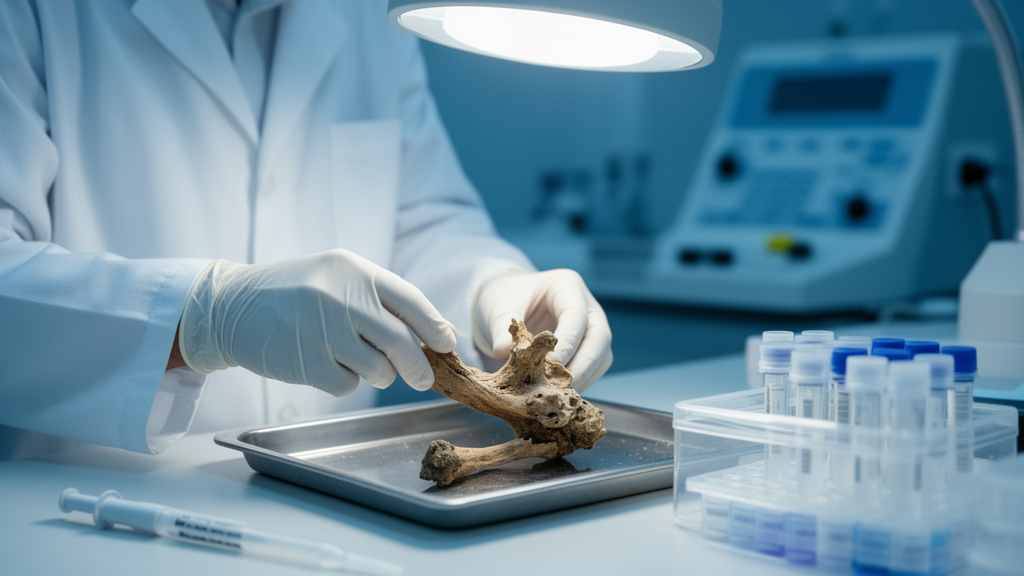
For most of the twentieth century, what we knew about disease in ancient populations came from bones: lesions on ribs, cavities in skulls, the telltale collapse of vertebrae. That picture was always incomplete, because many infections leave no distinctive trace on the skeleton. A new review published in Frontiers in Ecology and Evolution by Hantong Xie and Bowen Yuan of Taishan University argues that the field has now entered a fundamentally different era, one in which ancient pathogen genomics and palaeoproteomics together allow researchers to reconstruct not just which microbes infected past people, but whether those people actually experienced disease, which tissues were affected, and how illness fit into the broader ecology of diet, sanitation, care and social conditions.
The power of ancient pathogen genomics is best illustrated by its headline achievements. Draft genomes of Yersinia pestis recovered from victims of the Black Death and the earlier Justinianic plague tied historically documented mortality crises directly to a specific bacterium rather than relying on texts and burial patterns alone. Ancient genomes of Mycobacterium leprae confirmed leprosy in archaeological individuals and supplied strain-level detail beyond what skeletal lesions could offer. Viral infections, which almost never leave osteological evidence, have proven especially tractable: partial or complete genomes of hepatitis B virus, parvovirus B19, variola virus and influenza have all been recovered from archaeological and historical remains, revealing infections that would otherwise have remained invisible.
Genome-scale data have also rewritten evolutionary narratives. Neolithic and Bronze Age plague genomes revealed deeply divergent lineages and allowed researchers to pinpoint when genetic features associated with flea-mediated transmission emerged, while Bronze Age plague in Britain linked pathogen dispersal to prehistoric mobility. Ancient hepatitis B genomes demonstrated repeated lineage turnover over ten millennia, and genomes of the Treponema pallidum complex have complicated simple models of syphilis origins by showing considerable diversity in early modern Europe and the pre-Columbian Americas. Zoonotic histories have been reconstructed too, with Brucella melitensis tied to pastoralism and human-adapted Salmonella enterica linked to Neolithisation, settlement and intensified animal contact. Medieval English red squirrels, meanwhile, have been identified as an animal reservoir of leprosy.
Yet the review is emphatic that pathogen DNA alone is not sufficient for disease reconstruction. DNA may show that a pathogen was present in a tissue or individual, but it does not always show whether infection was active, which tissues were affected, what host responses were involved, or how disease related to diet, oral health, co-infection, labor, care or living conditions. A molecular identification becomes diagnostically informative only through its anatomical setting: pathogen material in dental pulp, a focal bone lesion or preserved lung tissue addresses a different question from the same material in oral calculus or surrounding sediment. Genomes establish lineage and genetic potential, but not tissue injury or host response.
This is where palaeoproteomics enters. Using liquid chromatography–tandem mass spectrometry, researchers can identify ancient proteins and peptides, surveying many proteins at once through shotgun approaches or examining mixtures from multiple organisms through metaproteomics. Proteins survive through mechanisms that differ from those affecting DNA: some are stabilised by mineral binding, cross-linking, tissue architecture or protected microenvironments. Collagen dominates bone proteomes, while dental calculus entombs proteins and other biomolecules within a calcified plaque matrix. Crucially, a pathogen protein, a host-response protein and an ingested dietary protein support different inferences even when recovered from the same sample, so the biological source of each molecule matters as much as its identity.
Dental calculus has emerged as the richest single archive. Because it is mineralised plaque formed during life, it records the oral cavity as a dynamic interface among host tissues, microbial biofilms, diet, behaviour and environment. Metagenomic studies showed long-term shifts in oral microbiota associated with major dietary transitions, and proteomic work demonstrated that calculus preserves not only bacterial DNA but also salivary, epithelial, serum-associated and innate immune proteins. Quantitative metaproteomics of medieval calculus has even revealed individual oral health status, and studies pairing calculus proteomes with dental examination have linked host and microbial proteins to the condition of teeth and supporting tissues. Milk proteins in calculus have provided direct individual-level evidence of dairy consumption from Neolithic Europe to eastern Africa.
Calculus can occasionally reach beyond the mouth. In one substantive example, researchers recovered a Mycobacterium leprae genome and mycobacterial proteins from the calculus of a sixteenth-century individual from Trondheim; some peptides supported species-specific attribution while others were shared among mycobacteria, and the agreement between genomic and proteomic findings strengthened pathogen identification without making every peptide independently diagnostic. Elsewhere, host-protein profiles from Andean mummies have been interpreted as consistent with pulmonary bacterial infection, and proteins associated with innate immunity and inflammation have been recovered from roughly 4,200-year-old Egyptian mummified skin and muscle. These findings document compatible tissue processes, but the authors caution that inflammatory proteins alone do not identify a unique cause.
The review also stresses that contested and negative findings are part of the evidence base. Early claims of mycobacterial protein evidence from archaeological remains were later questioned on specificity grounds, with only limited mycobacterial peptides found in mummified tissues. Immunological assays detecting antigens of Giardia and Entamoeba in coprolites and Iron Age Jerusalem latrines have documented intestinal infection at a population level, but a communal deposit cannot identify which individual was infected or estimate prevalence. Antibody-based antigen detection, the authors note, must be clearly distinguished from sequence-based proteomics, since immunoreactivity provides different identification evidence from peptide sequencing and can suffer from cross-reactivity.
Methodological challenges remain formidable. Ancient pathogen studies analyse degraded, low-biomass material exposed to environmental microbes, handling and laboratory reagents, and contamination can persist even in dental enamel. Reference-database bias means missing taxa may be assigned to the nearest available match, and a large proportion of spectra in ancient proteomic datasets remain unidentified. A diagnosis supported by one or two peptides is inherently fragile. The authors argue that retrospective diagnosis is strongest when molecular findings are consistent with anatomical, archaeological and historical evidence and help discriminate among plausible alternatives, and that conclusions should be phrased at the level the evidence supports: pathogen identification, local disease, systemic involvement and cause of death are separate claims.
Looking forward, the review calls for comparative samples with and without independently supported pathological evidence, archaeological validation of diagnostic markers, expanded reference databases covering underrepresented pathogens and dietary taxa, transparent reporting of negative results, and far broader geographic coverage beyond the European collections that currently dominate the field. It also emphasises ethical sampling of finite human remains, collaborative research design and open data. Read within anatomical and historical context, the authors conclude, protein evidence connects individual illness with diet, sanitation, animal contact and care, making ancient disease ecology far more informative than pathogen genomes alone ever could.
Subject of Research: Reconstruction of ancient disease ecology using pathogen genomics and palaeoproteomics
Article Title: Reconstructing ancient disease ecology through pathogen genomics and palaeoproteomics
Article References: Xie, H., & Yuan, B. (2026). Reconstructing ancient disease ecology through pathogen genomics and palaeoproteomics. Frontiers in Ecology and Evolution, 14, Article 1944061. https://doi.org/10.3389/fevo.2026.1944061
Image Credits: AI Generated
DOI: 10.3389/fevo.2026.1944061
Keywords: ancient DNA, palaeoproteomics, pathogen genomics, dental calculus, palaeopathology, retrospective diagnosis, Yersinia pestis, Mycobacterium leprae, oral microbiome, host immune response, zoonosis, archaeological science
Cite Scienmag News
Kristina Jarvis. (October 19, 2026). Ancient Proteins and Pathogen DNA Are Rewriting the History of Human Disease. Scienmag. https://scienmag.com/ancient-proteins-and-pathogen-dna-are-rewriting-the-history-of-human-disease/
Kristina Jarvis. "Ancient Proteins and Pathogen DNA Are Rewriting the History of Human Disease." Scienmag, 19 October 2026, https://scienmag.com/ancient-proteins-and-pathogen-dna-are-rewriting-the-history-of-human-disease/. Accessed 19 October 2026.
Kristina Jarvis. "Ancient Proteins and Pathogen DNA Are Rewriting the History of Human Disease." Scienmag. October 19, 2026. https://scienmag.com/ancient-proteins-and-pathogen-dna-are-rewriting-the-history-of-human-disease/


