


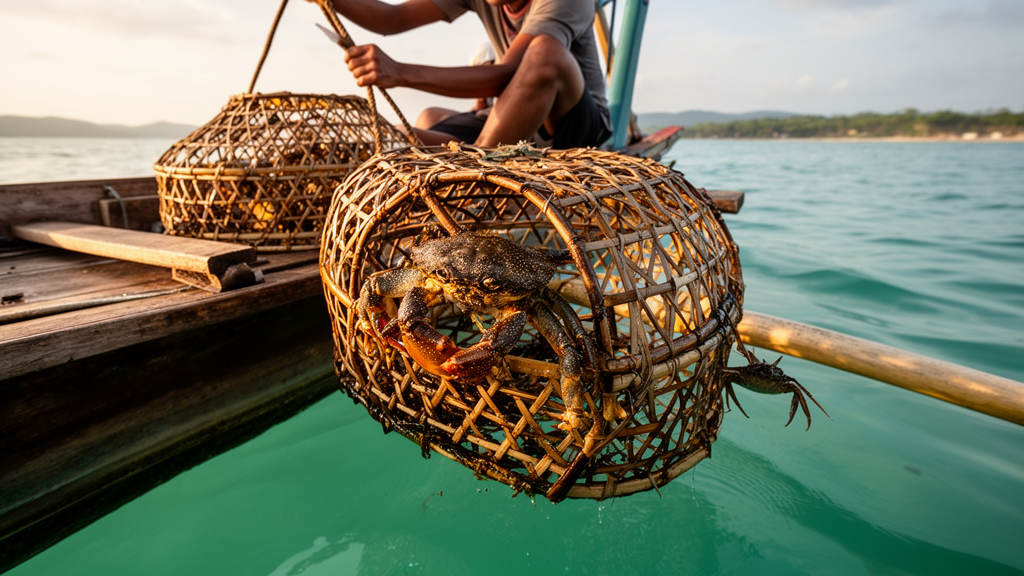
On the fishing grounds of Cancabato Bay in the Philippines, a pair of rectangular openings cut from galvanized iron wire and covered with a thin transparent plastic flap may be one of the cheapest fixes ever tested for a struggling tropical fishery. Researchers from Eastern Visayas deployed dome-type and box-type crab pots, half of them fitted with laboratory-tested escape gaps measuring 48 by 25 millimeters, across twelve actual fishing trials between August and October 2021. The results, published in Acta Ichthyologica et Piscatoria, show that this simple modification dramatically reduced the capture of juvenile blue swimming crabs Portunus pelagicus and unwanted bycatch, without reducing the catch of legal-sized crabs that fishers actually sell.
The blue swimming crab is a heavyweight in Philippine fisheries. Between 2019 and 2023, national production averaged roughly 28,090 tonnes per year, valued at about 4.65 billion Philippine pesos, with around 90 percent of that coming from small-scale municipal fishers. Crab pots are one of the two dominant gears these fishers use. Pots are considered relatively low-impact and fuel-efficient compared with active gears like trawls and dredges, and they deliver premium catch quality because crabs generally arrive alive at retrieval. But pots have a persistent flaw: they catch whatever swims or crawls in, including juveniles below the 102-millimeter minimum legal carapace width set by Philippine regulation and a long list of non-target species.
That flaw matters biologically and economically. Juvenile mortality undermines future recruitment and the reproductive potential of the stock, creating socio-economic problems for the fishery down the line. Previous studies reported that immature crabs made up 8 to 27 percent of crab pot catches in some Philippine areas, and as much as 62 percent in the Western Visayan Sea. Bycatch compounds the problem. In San Miguel Bay, one study found that blue swimming crab comprised only about 32 percent of crab pot catch, with other portunid crabs and assorted species making up the rest. High bycatch rates can erode biodiversity, slow the recovery of overexploited stocks, and alter the ecological profile of species in the region.
Escape gaps are a selectivity tool already proven in pot fisheries elsewhere, including Australia’s blue swimming crab fishery and the Dungeness crab fishery in Washington State, where escape rings cut sub-legal catch by more than half. The Philippine study aimed to test whether the same principle works in locally used pot designs. The researchers installed paired rectangular gaps, each covered from the outside with a 0.20-millimeter transparent plastic flap weighted with a cut sinker so it auto-locks by gravity, preventing organisms from entering through the opening while allowing smaller crabs and fish to escape. In dome-type pots, the gaps were mounted on the side of one of two parallel bamboo frames; in box-type pots, they sat directly below the slit entrance.
The field trials were rigorous. Thirty dome-type and thirty box-type pots were used per trial, with fifteen gapped and fifteen conventional units of each type attached randomly to a mainline and deployed at four sampling stations where local fishers typically set their gears. Pots were baited with pony fish or other cheap small species, soaked for an average of 8.5 hours during daytime operations following local practice, and hauled 180 times per pot type per design across twelve trials. Commissioned local fishers assisted with the operations, and all catch was brought to shore for measurement of carapace width, weight, and species identification.
The numbers tell a striking story. In gapped dome-type pots, undersized blue swimming crab catch fell by 48 percentage points compared with conventional units, and in gapped box-type pots the reduction reached 79 percentage points. Non-target catch dropped by 67 percentage points in gapped dome-type pots and 72 percentage points in gapped box-type pots. Crucially, the capture of legal-sized crabs, those at or above 102 millimeters carapace width, was not significantly affected by the presence of the gaps in either pot type. In fact, legal-sized crabs made up 66 percent of the target catch in gapped dome-type pots versus 42 percent in conventional units, and 86 percent in gapped box-type pots versus 47 percent in conventional ones.
The mechanism is elegantly simple. The gap dimensions allow only undersized crabs and smaller non-target species to slip out, while legal-sized crabs are physically too large to fit through. Inside the pot, antagonistic behavior among blue swimming crabs competing for food and space may further prompt smaller individuals to escape. With fewer small crabs crowding the gear, pot saturation is minimized and more space becomes available for larger crabs, which may explain why the overall catch per unit effort of the target species remained comparable between gapped and conventional designs. The mean catch per unit effort of legal-sized blue swimming crab in gapped pots was actually higher, by 26 percentage points in dome-type and 30 percentage points in box-type pots, though the difference was not statistically significant.
Bycatch reduction carried ecological weight. Most non-target species caught were of low or no market value, such as the smaller portunid crabs Charybdis anisodon, Charybdis hellerii, and Thalamita crenata, which fishers typically discard when catch is low. In gapped dome-type pots, catch species richness was significantly lower, averaging 2.17 species per haul versus 3.00 in conventional units, suggesting the gear’s impact on local biodiversity is reduced. Those organisms that escape underwater survive to grow, reproduce, and maintain their ecological roles, whereas bycatch retained and discarded onboard often dies, contributing nothing to future stocks.
The practical benefits extended to the fishers themselves. Catch retrieval and sorting time was significantly shorter in gapped pots, averaging 7.81 minutes in gapped dome-type pots versus 14.45 minutes in conventional units, and 12.94 minutes in gapped box-type pots versus 26.92 minutes in conventional ones. Less time wrestling with aggressive non-target crabs and undersized individuals means faster overall fishing operations and lower labor costs. In terms of total catch weight, gapped pots performed comparably to conventional ones despite catching fewer individuals, because the escaped organisms were mostly small, low-value species while the retained catch was dominated by larger, commercially valuable crabs.
The researchers conclude that escape gaps with flaps are a technologically simple, ecologically effective, and economically viable management measure for the Philippine blue swimming crab pot fishery. They recommend promoting the tool among fishers and policy makers, noting that gap dimensions may need adjustment if the minimum legal size for the species changes in the future based on resource monitoring and biological studies. For a fishery under pressure from juvenile retention and bycatch, a pair of wire rectangles and a plastic flap may prove to be exactly the simple fix the title promised.
Subject of Research: Field trials in Cancabato Bay, Philippines, show that installing laboratory-tested escape gaps in dome-type and box-type crab pots significantly reduces undersized Portunus pelagicus and non-target catch without affecting legal-sized catch, while shortening retrieval and sorting times.
Article Title: Simple fix: The potential of escape gaps in enhancing the capture performance of crab pots used in the fishery of blue swimming crab, Portunus pelagicus ( Crustacea , Decapoda , Portunidae ), in the Philippines
Article References: Picoy-Gonzales, R. M., Añasco, N. C., Lizada, J. C., Anraku, K., & Monteclaro, H. M. (2025). Simple fix: The potential of escape gaps in enhancing the capture performance of crab pots used in the fishery of blue swimming crab, Portunus pelagicus (Crustacea, Decapoda, Portunidae), in the Philippines. Acta Ichthyologica et Piscatoria, 55, 101-113. https://doi.org/10.3897/aiep.55.149577
Image Credits: AI Generated
Keywords: blue swimming crab, escape gaps, bycatch, Philippines, crab pots, fisheries selectivity, Portunus pelagicus, sustainable fishing, Simple, potential, escape, gaps
Cite Scienmag News
Margaret Porter. (October 19, 2026). Escape gaps slash juvenile crab bycatch in Philippine pots without hurting catch. Scienmag. https://scienmag.com/escape-gaps-slash-juvenile-crab-bycatch-in-philippine-pots-without-hurting-catch/
Margaret Porter. "Escape gaps slash juvenile crab bycatch in Philippine pots without hurting catch." Scienmag, 19 October 2026, https://scienmag.com/escape-gaps-slash-juvenile-crab-bycatch-in-philippine-pots-without-hurting-catch/. Accessed 19 October 2026.
Margaret Porter. "Escape gaps slash juvenile crab bycatch in Philippine pots without hurting catch." Scienmag. October 19, 2026. https://scienmag.com/escape-gaps-slash-juvenile-crab-bycatch-in-philippine-pots-without-hurting-catch/


