


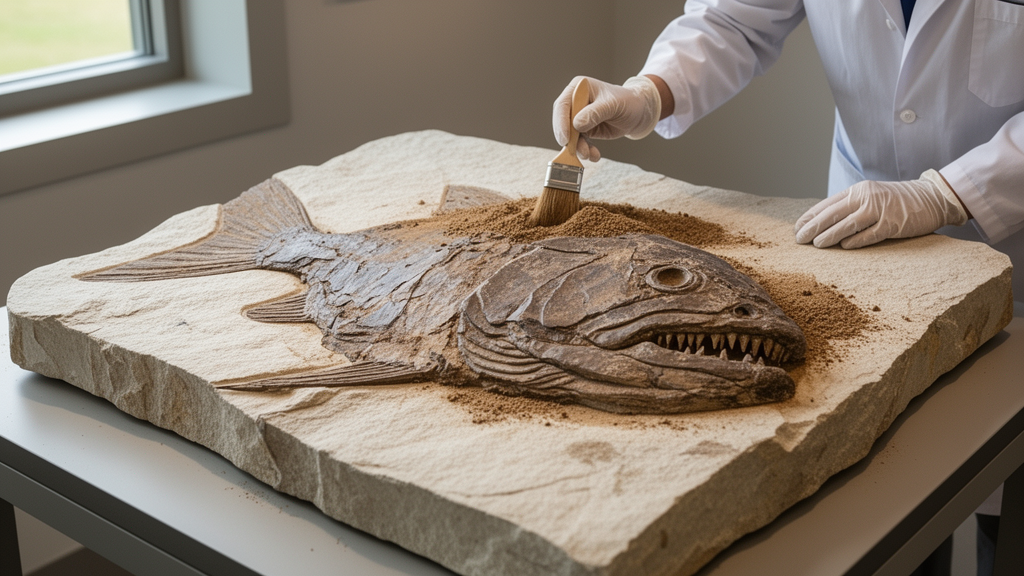
Deep in the Posongchong Formation of Guangnan County, in China’s southwestern Yunnan Province, paleontologists have unearthed the fossilized remains of an armored fish that is forcing a rewrite of one of the Devonian period’s most successful evolutionary stories. The creature, a new genus and species named Yangfanyu anachoresis, is a placoderm — one of those strange, jawed vertebrates whose heads and upper bodies were encased in interlocking plates of bone. More specifically, it belongs to the antiarchs, a clade of bottom-dwelling placoderms whose paired fins were modified into bizarre, jointed appendages that have puzzled comparative anatomists since the nineteenth century. What makes the new find genuinely remarkable is its age: the specimens come from Pragian-stage rocks roughly 410 million years old, in the Early Devonian, and they represent the earliest known member of the Euantiarcha, the most diverse subgroup of antiarchs. Until now, the oldest euantiarch fossils came from slightly younger Emsian-stage deposits in China, meaning the new discovery stretches the group’s fossil record back by approximately 10 million years.
The research, led by Zumin Xian, Qinyuan Xue, Yingtian Zhao, Qiang Li, and Min Zhu of the Institute of Vertebrate Paleontology and Paleoanthropology in Beijing and Qujing Normal University, is published in The Science of Nature. The team did not simply describe the external appearance of the fish. Because the specimens are articulated — meaning the bones are preserved in their life positions rather than scattered — the researchers were able to apply X-ray computed tomography, scanning the fossils layer by layer and then reconstructing the complete dermal head shield and trunk shield in three dimensions on a computer. This digital dissection revealed anatomical details that would be inaccessible on a crushed or partial specimen, including internal cavities, ridges, sensory canals, and the precise geometry of the plates that armored the animal’s face and torso.
To appreciate why this matters, it helps to understand what antiarchs actually were. They represent a highly specialized lineage of early jawed vertebrates that adapted to life on or near the sea floor, forming a major component of Devonian aquatic ecosystems. Unlike most placoderms, which had mobile neck joints allowing the head shield to lift during feeding, antiarchs evolved a rigid, box-like armor and relied on their modified pectoral appendages for locomotion and maneuvering over soft substrates. During the Middle and Late Devonian, euantiarchs achieved a nearly cosmopolitan distribution, with genera such as Bothriolepis turning up on every continent, including Antarctica. Their ubiquity makes them important index fossils for correlating Devonian rocks across the globe, and their abundance in some deposits suggests they formed dense schools in shallow waters, estuaries, and floodplains.
Yangfanyu anachoresis, however, is not just another euantiarch. In addition to displaying the diagnostic characters that define the group, the new fish retains several plesiomorphic — that is, ancestral or primitive — features that its later relatives had lost. Two of these are particularly significant: the cavity for the cranio-spinal process, an internal recess on the head shield that accommodated a bony projection from the trunk shield, and the oblique ridge on the lateral wall of the trunk shield. These features are hallmarks of more primitive antiarch lineages, such as the yunnanolepids that dominated Early Devonian faunas in South China. Their presence in Yangfanyu indicates that the earliest euantiarchs had not yet fully shed the anatomical baggage of their ancestors, providing paleontologists with a rare snapshot of a lineage caught in the act of transitioning from one body plan to another.
The phylogenetic analysis, which compiled a matrix of anatomical characters and ran them through the TNT software to generate an evolutionary tree, placed Yangfanyu at the most basal position among all known euantiarchs. In other words, it is the sister taxon to every other member of the clade — the earliest branch to split off from the euantiarch family tree. This placement is not merely a matter of adding one more twig to a branching diagram. Because Yangfanyu sits at the very base of the group, it refines what paleontologists call character polarity at the origin of the clade, clarifying which anatomical features were present in the common ancestor of all euantiarchs and which were acquired later. The result indicates that the characteristic euantiarch morphology — the distinctive head shield, the specialized pectoral appendages, the particular arrangement of trunk plates — was not assembled in a single evolutionary leap but rather through the sequential acquisition of derived characters during the earliest stages of euantiarch evolution.
This kind of finding is what evolutionary biologists refer to as a transitional form, and it is precisely the sort of evidence that can settle long-running debates about how major groups originated. For decades, the relationship between the primitive antiarch lineages of the Early Devonian and the highly successful euantiarchs of the Middle and Late Devonian has been murky, with gaps in the fossil record obscuring the sequence of anatomical changes. By extending the euantiarch record back into the Pragian, the new discovery narrows that gap and suggests that the morphological transition from primitive antiarchs to euantiarchs was underway by at least 410 million years ago, only a few million years after the first antiarchs appear in Silurian rocks.
The Guangnan locality itself is proving to be a treasure trove of Early Devonian vertebrates. The Posongchong Formation, which yields the new specimens, has previously produced a diverse array of early fish, including other placoderms and jawless forms, making it one of the most important windows into the earliest diversification of jawed vertebrates anywhere in the world. The new euantiarch adds to a growing list of discoveries from Yunnan Province that are reshaping our understanding of how the major jawed vertebrate lineages emerged and spread during the Devonian, a period sometimes called the Age of Fishes because of the extraordinary variety of aquatic vertebrates that flourished then.
What makes the discovery particularly compelling for a general audience is the sheer strangeness of the animals involved. Antiarchs are among the most morphologically bizarre of all placoderms, and their pectoral appendages — often described as fin-like or wing-like structures encased in bone — have been interpreted as adaptations for propping up the body, pushing along the substrate, or even digging into soft sediment. The fact that these appendages, along with the rest of the antiarch body plan, were already well established by the Pragian suggests that the ecological role of antiarchs as benthic specialists was in place very early in their history, long before they achieved their later cosmopolitan dominance.
The implications of the new study extend beyond antiarch phylogeny. Because euantiarchs are such abundant and widespread fossils, understanding their origins has knock-on effects for Devonian biostratigraphy — the business of using fossils to date and correlate rock layers. A 10-million-year extension of the group’s record means that euantiarch remains in rocks previously thought too old for the clade may need to be reinterpreted, and it raises the possibility that other early euantiarchs are waiting to be recognized in Pragian or even older deposits in South China and elsewhere. The researchers’ use of computed tomography and three-dimensional digital visualization also highlights a broader trend in vertebrate paleontology, in which digital dissection is revealing anatomical details that traditional preparation methods could never access, allowing paleontologists to reconstruct the complete anatomy of extinct animals from fragmentary or embedded fossils.
For now, Yangfanyu anachoresis stands as the earliest and most primitive known euantiarch, a 410-million-year-old armored fish from the riverbeds and shallow seas of what is now southwestern China. Its discovery extends the fossil record of one of the Devonian’s most successful vertebrate lineages by 10 million years, clarifies the sequence of anatomical changes that produced the classic euantiarch body plan, and adds yet another piece to the puzzle of how jawed vertebrates — the group that ultimately gave rise to sharks, bony fish, and every tetrapod, including humans — diversified during the earliest Devonian. As more specimens emerge from the Posongchong Formation and other Early Devonian localities in Yunnan, paleontologists expect the picture of antiarch origins to become even sharper, potentially revealing additional transitional forms that document the step-by-step assembly of one of the most distinctive body plans in the history of vertebrates.
Subject of Research: Paleontology
Article Title: The earliest euantiarch from the Pragian (Early Devonian) of Guangnan, Yunnan Province, China
Article References: Xian, Z., Xue, Q., Zhao, Y., Li, Q., & Zhu, M. (2026). The earliest euantiarch from the Pragian (Early Devonian) of Guangnan, Yunnan Province, China. The Science of Nature, 113(6), Article 134. https://doi.org/10.1007/s00114-026-02186-0
Image Credits: AI Generated
DOI: 10.1007/s00114-026-02186-0
Keywords: placoderms, Devonian, antiarchs, fossils, China, evolution, CT scanning, Yangfanyu, earliest, euantiarch, Pragian, Early
Cite Scienmag News
Gavin Prescott. (October 19, 2026). Ancient Armored Fish Rewrites the 410-Million-Year-Old Story of a Weird Jawed Vertebrate Clan. Scienmag. https://scienmag.com/ancient-armored-fish-rewrites-the-410-million-year-old-story-of-a-weird-jawed-vertebrate-clan/
Gavin Prescott. "Ancient Armored Fish Rewrites the 410-Million-Year-Old Story of a Weird Jawed Vertebrate Clan." Scienmag, 19 October 2026, https://scienmag.com/ancient-armored-fish-rewrites-the-410-million-year-old-story-of-a-weird-jawed-vertebrate-clan/. Accessed 19 October 2026.
Gavin Prescott. "Ancient Armored Fish Rewrites the 410-Million-Year-Old Story of a Weird Jawed Vertebrate Clan." Scienmag. October 19, 2026. https://scienmag.com/ancient-armored-fish-rewrites-the-410-million-year-old-story-of-a-weird-jawed-vertebrate-clan/


