


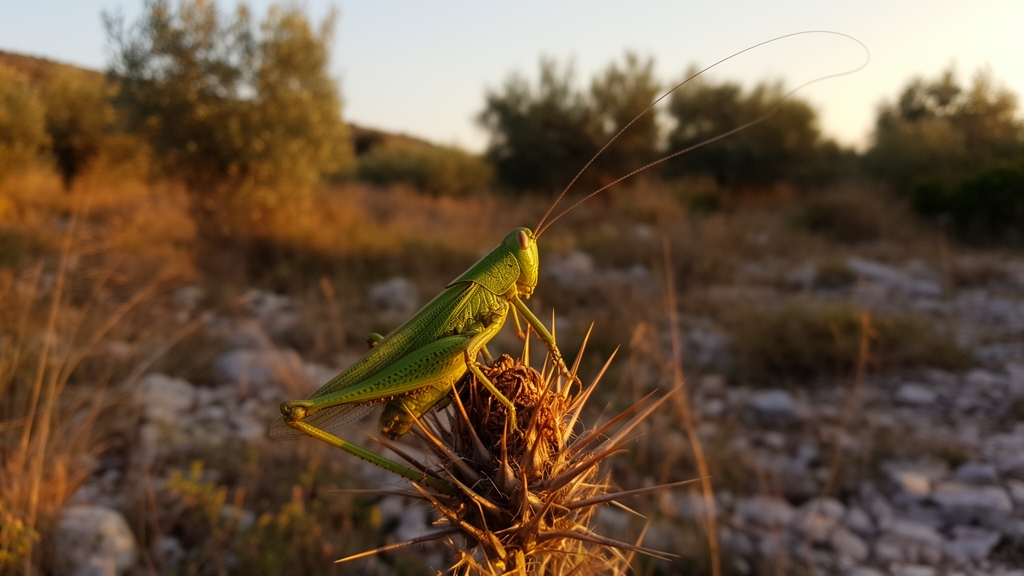
Deep inside a dense, thorny bush on the outskirts of Athens, an entomologist stumbled upon something remarkable: a bush-cricket species new to science, hiding in plain sight just beyond the sprawl of a modern European capital. The insect, now formally described as Eupholidoptera kekrops sp. nov., belongs to a genus of roughly 50 species concentrated in the northern and eastern Mediterranean, and it is the first known member of the E. prasina group from mainland Greece and mainland Europe. Until now, every species in this group had been recorded only from Aegean islands or western and southern Anatolia, usually with extremely restricted ranges.
The story of the discovery began in 2013, during an active search for Orthoptera in eastern Attiki, the region surrounding Athens. A single male Eupholidoptera was observed deep within a small, dense thorny bush of Sarcopoterium spinosum, a plant typical of dry coastal Mediterranean habitats. Because no other member of the genus was known from the area, the insect was collected immediately. With only one specimen available, the researchers refrained from dissecting it, and its visible characters keyed out to E. kykladica, a species endemic to the Cycladic islands of Andros, Tinos, and Kea. The Attiki insect was consequently and erroneously reported as that species in earlier publications.
Clarity came only when new material surfaced from a different locality. In 2017, a second male was collected at the eastern foothills of Mt. Imittos, where it was found sheltering under a large marble slab, apparently trying to escape the punishing heat of an exceptionally hot summer day. Differences in external morphology between the two specimens and E. kykladica then became obvious, most notably the presence of spines at the apical lobes of the subgenital plate. A dissection of the male genitalia revealed a spectrum of morphological differences confirming that the Attiki population represented an undescribed species.
The taxonomic description, published in the Journal of Orthoptera Research, rests on two male specimens deposited at the Korinthian Museum of Natural History in Korinthos, Greece. The holotype was collected on 1 July 2017 in the Chalidou gorge on Mt. Imittos, in the yard of the chapel of St. Eustathius, under a stone. The paratype, the 2013 male, was taken on 11 June 2013 from wasteland at Vravrona. Both were caught with entomological nets and prepared by standard entomological methods, with dissected male genitalia preserved in microtubes alongside the specimens.
Morphologically, E. kekrops is well defined and easily recognizable. The general appearance follows the pattern of the type species E. chabrieri: the legs are relatively short, the hind femur twice as long as the pronotum, and the ventral margin of the hind femur carries a black spine. The last abdominal tergite is blackish-brown, wider than long, with a wide heart-shaped, lighter-colored wrinkled impression divided posteriorly by a short median incision with rounded edges. The cercus clearly surpasses the last abdominal tergite, is simple and cylindrical, and curves slightly inwards. The absence of a tooth at the male cerci places the species firmly within the E. prasina group.
The subgenital plate provides some of the most diagnostic characters. It is slightly longer than wide, divided in half by a median triangular incision, and bears apical lobes that are triangular in ventral view, carry a median keel, and terminate in a robust, black-tipped spine pointing dorso-posteriorly. The styli are short, about three times their maximum width, inserted at the sides of the apical lobes and slightly surpassing the tip of the spine. The titillator, a component of the male genitalia, has apical parts as long as the basal parts, fused over most of their length, incised in the apical fifth, and almost straight in lateral view. These genital structures, mainly the subgenital plate and titillator, are the key features separating E. kekrops from its relatives.
Coloration adds further character. The species is generally green, with a greenish-yellow occiput marked anteriorly in black, small black spots on the frons, and a pronotum whose lateral lobes are mostly yellow along the lower margin and blackish green above. The elytra are solid black with lighter edges, and the abdomen is greenish but conspicuously reddish ventrally, a red hue that persists even in dried specimens. The hind femur is green with black dots dorsally at its base, black and brown on the distal half, and the knees are conspicuously black. Measured in millimeters, the pronotum length is 7, the hind femur length 14, and the body length 17. The female remains unknown.
In diagnosis, the presence of styli and spines at the apical lobes of the subgenital plate links E. kekrops to a handful of island endemics: E. jacquelinae from Gavdos, E. spinigera from Kithira, E. icariensis from Ikaria, and E. prasina from Chios, Samos, and western Turkey, as well as several Anatolian species including E. mersinensis, to which it shows some similarity in all key characters. Nevertheless, all of these species differ strongly in some or all key morphological features, including the subgenital plate, last abdominal tergite, cerci, and titillator. If the spines on the apical lobes are disregarded, E. kekrops closely resembles E. kykladica, its allopatric neighbor on islands just east of Attiki, sharing similar coloration, small size, and the shape of cerci, subgenital plate, and last abdominal tergite. The two can nonetheless be readily distinguished by the titillator and the presence or absence of the spines.
The biogeographic implications are striking. Previous phylogenetic analysis of the genus suggested that E. kykladica, E. spinigera, and E. icariensis are related to the mainly Anatolian E. karabagi group, a clade thought to derive from an ancestral population present in the central Aegean area during the Messinian Salinity Crisis, when the region was largely dry. At the end of the Miocene, when water again flooded the area, fragmentation and speciation were driven mainly by eustatic events such as water-level barriers. The isolation of an ancestral Eupholidoptera population in present-day lowland Attiki, and its evolution into an independent biological unit after the Cyclades archipelago was disconnected from the mainland, fits this scenario neatly. The center of diversification of the genus is considered to be the south Aegean area, where a common ancestor was present in the Mid-Miocene.
The new species is known only from East Sterea Ellas in Greece, specifically the eastern slopes of Mt. Imittos and the area of Vravrona in Attiki. The holotype was collected under a large marble slab placed for decorative reasons in the chapel yard, which is surrounded by maquis vegetation dominated by the kermes oak Quercus coccifera, while the paratype came from wasteland affected by human activity and covered with sparse low prickly shrubs. The species is named after Kekrops, the mythical first king of Attiki and founder of the city of Athens. That a proven undescribed species remained elusive at the very outskirts of a modern European capital is surprising, and it highlights the necessity for more intense field work in Greece, even in areas considered well explored.
Subject of Research: Description of a new bush-cricket species, Eupholidoptera kekrops sp. nov., from Attiki, Greece
Article Title: Eupholidoptera kekrops sp. nov. ( Orthoptera , Tettigoniidae ), new bush-cricket from Greece
Article References: Alexiou, S. (2024). Eupholidoptera kekrops sp. nov. (Orthoptera, Tettigoniidae), new bush-cricket from Greece. Journal of Orthoptera Research, 33(1), 67-70. https://doi.org/10.3897/jor.33.103790
Image Credits: AI Generated
Keywords: Eupholidoptera kekrops, bush-cricket, Orthoptera, Tettigoniidae, Greece, Athens, Attiki, taxonomy, new species, Aegean biogeography, entomology, Eupholidoptera
Cite Scienmag News
Margaret Porter. (October 19, 2026). New Bush-Cricket Species Discovered Hiding on the Outskirts of Athens. Scienmag. https://scienmag.com/new-bush-cricket-species-discovered-hiding-on-the-outskirts-of-athens/
Margaret Porter. "New Bush-Cricket Species Discovered Hiding on the Outskirts of Athens." Scienmag, 19 October 2026, https://scienmag.com/new-bush-cricket-species-discovered-hiding-on-the-outskirts-of-athens/. Accessed 19 October 2026.
Margaret Porter. "New Bush-Cricket Species Discovered Hiding on the Outskirts of Athens." Scienmag. October 19, 2026. https://scienmag.com/new-bush-cricket-species-discovered-hiding-on-the-outskirts-of-athens/


