


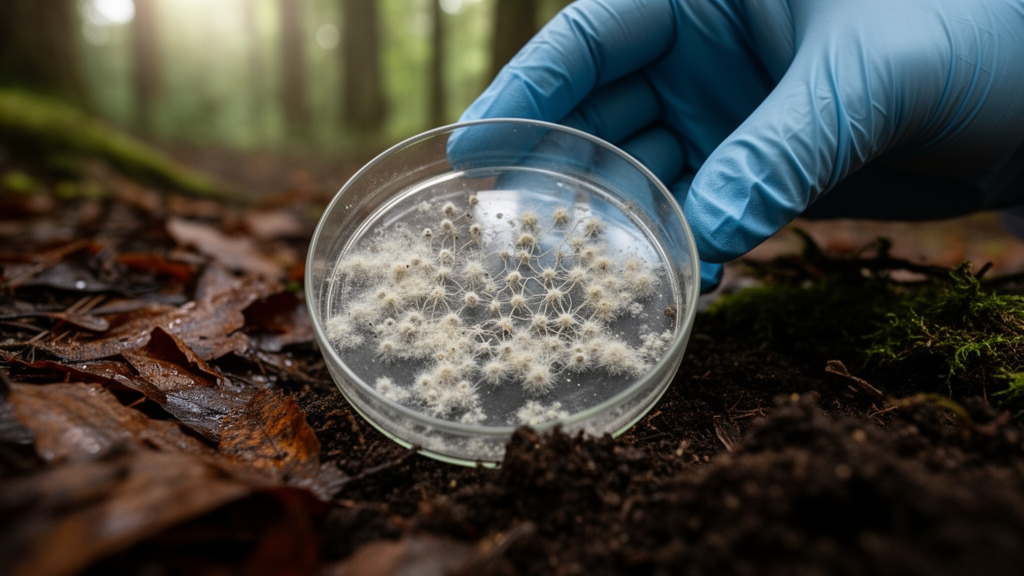
Deep in garden soil collected in Rotterdam, a previously unknown fungus has been quietly manufacturing some of the rarest antifungal molecules in nature. Researchers at the Westerdijk Fungal Biodiversity Institute have now formally described this soil-borne organism as Garciamycella chlamydospora, the founding species of an entirely new genus within the fungal order Sordariales. When the team fermented the fungus and analyzed its chemical output, they recovered seven secondary metabolites, including a previously undescribed member of the papulacandin family, a class of spirocyclic diglycosides celebrated for their potent ability to strip fungal cells of their cell walls. The discovery, published in IMA Fungus, doubles as a taxonomic milestone and a reminder that the most promising drug leads may be hiding in lineages that science has barely sampled.
The order Sordariales has long been recognized as a chemical treasure trove. Its members produce the sordarins, antifungal agents with a unique mode of action that have attracted serious clinical interest, alongside a dazzling array of polyketides, peptides, and heterodimers. Yet the natural products literature reveals a striking imbalance: according to data from the Natural Products Atlas, roughly seventy-five percent of all metabolites reported from Sordariales come from a single family, the Chaetomiaceae. Most genera, and even complete families, within the order remain chemically unexplored. This neglect is not merely an academic curiosity. Poorly resolved or unsampled phylogenetic lineages tend to be overlooked in targeted bioprospection campaigns, which means that entire branches of the fungal tree of life may be producing structurally unique bioactive molecules that no one has ever isolated.
Garciamycella chlamydospora emerged from a citizen science project run by the Westerdijk Institute in 2017, in which volunteers collected soil samples across the Netherlands. The team isolated axenic cultures using serial dilution methodology and deposited the living strain in the CBS Culture Collection as CBS 150388. Morphologically, the fungus proved distinctive: it produces phialidic conidiogenous cells bearing conspicuous collarettes, globose hyaline conidia borne singly along the vegetative hyphae, and thick-walled brown chlamydospores that give the species its name, derived from the Greek chlamydos, meaning cloak. Notably, the fungus produces an exclusively asexual state, with no sexual morph observed, and its colonies display velvety to slightly cottony textures with greyed-orange pigmentation on standard culture media.
To place the new species in its evolutionary context, the researchers sequenced four genetic loci: the internal transcribed spacer region (ITS), the nuclear rDNA large subunit (LSU), and fragments of the RNA polymerase II subunit 2 (rpb2) and beta-tubulin (tub2) genes. Each locus was aligned separately using MAFFT, and the four loci were concatenated into a combined dataset of 2,985 base pairs after confirming the absence of topological conflicts. Maximum likelihood analysis with RAxML and Bayesian inference with MrBayes both placed the strain in a well-supported clade within the family Schizotheciaceae, one of the largest families in Sordariales, together with type strains previously assigned to other genera. Because the type species of Ramophialophora, the genus to which some of these strains had been tentatively linked, belongs to a different family, the Bombardiaceae, the team erected the new genus Garciamycella to accommodate this monophyletic lineage, naming it in honor of the mycologist Dania García, an expert on the order.
The new genus now embraces three species. Alongside the novel G. chlamydospora, the researchers transferred Phialophora cyclaminis and Cercophora fici into Garciamycella as new combinations, G. cyclaminis and G. fici, with amended morphological descriptions. Garciamycella is characterized by ostiolate ascomata and two-celled ascospores in which both the upper and lower cells are septate, a feature that distinguishes it from its closest phylogenetic relative, Lundqvistomyces, which produces ascospores with aseptate cells. The genus also differs from Pseudoschizothecium, which shares the combination of collarette-bearing conidiogenous cells and sessile conidia, by the shape of its ascomatal neck: warty in Pseudoschizothecium, papillate in Garciamycella. Ascomatal morphology has been shown to be more informative for phylogenetic inference than ascospore morphology in the Sordariales, lending additional weight to this distinction.
With the taxonomy settled, the team turned to the fungus’s chemistry. The strain was grown on solid rice medium in forty Erlenmeyer flasks for fourteen days at twenty-three degrees Celsius in darkness. The mycelia were extracted with acetone under sonication, and the combined extracts were partitioned with ethyl acetate and then methanol and heptane to yield 1.4 grams of crude extract. Pre-fractionation by flash chromatography on silica produced eleven fractions, which were then purified by preparative high-performance liquid chromatography using a Gemini C18 column. The structures of all seven isolated compounds were elucidated through comprehensive one-dimensional and two-dimensional nuclear magnetic resonance spectroscopy, including 1H-1H COSY, HMBC, HSQC, and ROESY experiments, supplemented by high-resolution electrospray ionization mass spectrometry.
The most exciting find was compound 1, a light-brown amorphous solid with the molecular formula C45H66O16, established from a protonated molecular ion at m/z 863.4286 and a sodium adduct at m/z 885.4099. Its NMR spectra revealed two sugar residues, two conjugated olefinic spin systems corresponding to partially unsaturated fatty acyl chains, and a benzannulated spiroketal core. A literature search revealed its close structural kinship to the papulacandins, a family of potent antifungal metabolites originally isolated from Apiospora sphaerosperma and subsequently from a handful of other sordariomycetes. The new derivative, named papulacandin G, differs from the known compound Mer-WF3010, which was also isolated in this study, by the absence of one conjugated three-double-bond spin system in one of its fatty acid tails, explaining its higher molecular weight by six daltons. The disaccharide unit is presumed to consist of glucose and galactose linked via a beta-trans-1,4 bond, with the two fatty acyl moieties positioned at C-3 of the glucosyl and C-6′ of the galactosyl residues, as confirmed by key HMBC correlations.
Biological testing revealed that the papulacandin derivatives are the stars of the show. Papulacandin G exhibited antifungal activity against Schizosaccharomyces pombe and Candida albicans, with minimum inhibitory concentrations of 8.3 and 4.1 micrograms per milliliter respectively, alongside weak activity against the Gram-positive bacteria Bacillus subtilis and Staphylococcus aureus. Mer-WF3010 proved even more impressive, inhibiting C. albicans at just 0.2 micrograms per milliliter, a potency exceeding the 0.63 micrograms per milliliter previously reported for the same compound isolated from G. cyclaminis. Papulacandin D, the third papulacandin recovered, showed no activity under the test conditions, consistent with its reputation as the least potent member of the family; it differs from the others by lacking one of the long fatty acid residues entirely. This structure-activity pattern supports the notion that minor modifications in the fatty acid tails produce only small changes in biological activity, while more drastic alterations, such as full saturation, de-acylation, or the absence of one acyl chain, lead to a marked reduction in potency. Papulacandins kill fungi by targeting (1,3)-beta-D-glucan synthase, disrupting cell wall formation through reduced incorporation of the key polysaccharide beta-glucan, a mechanism distinct from that of most currently available systemic antifungals.
Beyond the papulacandins, the extract yielded four additional metabolites. Two were previously undescribed: penazaphilone M, a chlorinated azaphilone polyketide pigment whose absolute configuration was determined by comparing measured and calculated time-dependent density functional theory electronic circular dichroism spectra, and cremenoic acid, an opened-ring derivative of the 10-membered lactone cremenolide featuring a terminal free carboxylic acid moiety. Penazaphilone M showed mild cytotoxicity against the mouse fibroblast L929 cell line with a half-maximal inhibitory concentration of 26 micrograms per milliliter but no antimicrobial activity. Cremenoic acid, along with the known compounds cremenolide and aspinolide B, displayed no bioactivity against the tested cell lines or microbial pathogens. Intriguingly, Mer-WF3010 has now been reported exclusively from two species of the newly described genus Garciamycella and from no other taxa, suggesting it may serve as a chemotaxonomic marker that helps delimit the genus on chemical as well as molecular grounds.
The discovery arrives at a moment of mounting concern about fungal diseases and antifungal resistance. A considerable proportion of pathogens on the WHO Fungal Priority Pathogens List exhibit intrinsic resistance to current systemic antifungal agents, while others rapidly acquire resistance following exposure in environmental or clinical settings. The limited number of available therapeutic options, combined with the general neglect of fungal diseases in global health policy, makes the search for molecules with novel modes of action all the more urgent. The papulacandins, with their glucan synthase target and spiroketal architecture, represent promising leads for the development of new antifungal drugs. The Garciamycella study also underscores a broader lesson for natural products research: exploring taxonomically novel or neglected fungal lineages, rather than repeatedly mining the same well-studied families, can uncover structurally unique metabolites with significant pharmaceutical potential. Further investigations across related Sordariales may well reveal additional chemical diversity waiting to be tapped.
Subject of Research: Mycology and Natural Products Chemistry
Article Title: New sordarialean lineage Garciamycella chlamydospora ( Sordariales , Schizotheciaceae ) produces rare antifungal papulacandins
Article References: Agudelo-Restrepo, M., Hernández-Restrepo, M., Ibrahim, M. A. A., Charria-Girón, E., Ebada, S. S., & Marin-Felix, Y. (2026). New sordarialean lineage Garciamycella chlamydospora (Sordariales, Schizotheciaceae) produces rare antifungal papulacandins. IMA Fungus, 17, Article e177411. https://doi.org/10.3897/imafungus.17.177411
Image Credits: AI Generated
DOI: 10.3897/imafungus.17.177411
Keywords: mycology, Sordariales, Schizotheciaceae, papulacandins, antifungal, natural products, drug discovery, fungal taxonomy, Garciamycella, secondary metabolites, sordarialean, lineage
Cite Scienmag News
Roger Howard. (October 19, 2026). New Soil Fungus Garciamycella chlamydospora Yields Rare Antifungal Papulacandins. Scienmag. https://scienmag.com/new-soil-fungus-garciamycella-chlamydospora-yields-rare-antifungal-papulacandins/
Roger Howard. "New Soil Fungus Garciamycella chlamydospora Yields Rare Antifungal Papulacandins." Scienmag, 19 October 2026, https://scienmag.com/new-soil-fungus-garciamycella-chlamydospora-yields-rare-antifungal-papulacandins/. Accessed 19 October 2026.
Roger Howard. "New Soil Fungus Garciamycella chlamydospora Yields Rare Antifungal Papulacandins." Scienmag. October 19, 2026. https://scienmag.com/new-soil-fungus-garciamycella-chlamydospora-yields-rare-antifungal-papulacandins/


