


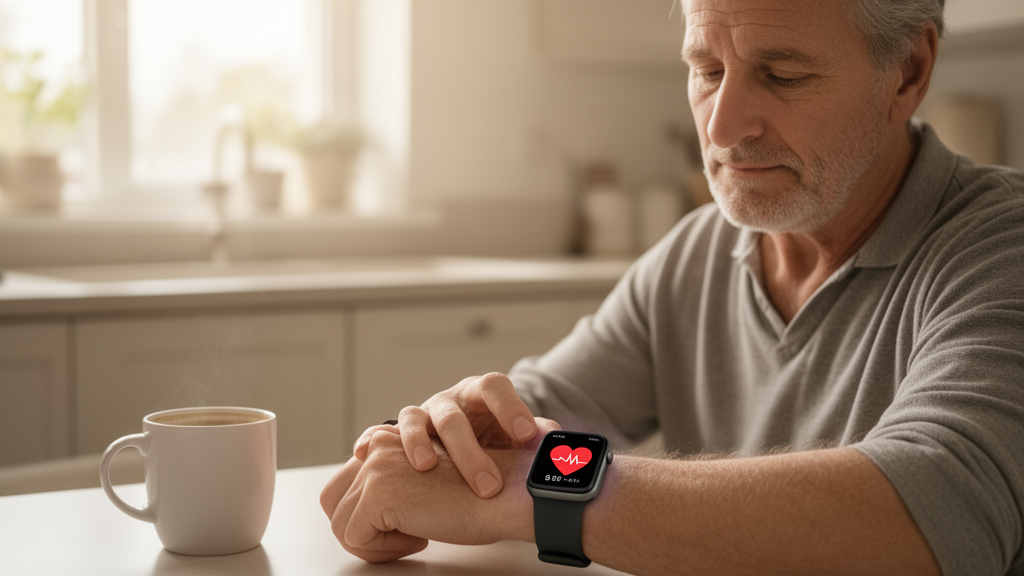
For millions of people who have undergone percutaneous coronary intervention (PCI) — the stent-placement procedure that reopens blocked coronary arteries — the recovery does not end when they leave the catheterization lab. It continues in kitchens, bedrooms, and workplaces, where an increasingly common companion now sits on their wrist: a smartwatch or fitness band quietly tracking heart rate, rhythm, sleep, and blood oxygen. A new qualitative study published in Frontiers in Cardiovascular Medicine offers one of the most detailed looks yet at how these patients actually interpret the flood of data such devices generate, and the findings complicate the popular narrative that wearables simply empower patients.
The research, led by Angang Tong, Ruiqi Luo, Pan Jin, and corresponding author Cuihuan Wu of the Department of Cardiology at Union Hospital, Tongji Medical College, Huazhong University of Science and Technology in Wuhan, China, interviewed 23 post-PCI patients between January and May 2026. All had used smartwatches or smart bands in daily life, with device use ranging from four months to three years. Using semi-structured interviews and thematic analysis, the team followed the Consolidated Criteria for Reporting Qualitative Research (COREQ) and continued recruiting until data saturation was reached at the twentieth interview, confirmed with three additional conversations.
The participants — 15 men and 8 women aged 52 to 74, an average of 62.4 years old — spanned the full clinical spectrum of PCI indications, from acute myocardial infarction and acute coronary syndrome to unstable angina and elective intervention for stable disease. Most carried additional cardiovascular risk factors: 65.2 percent had hypertension, 34.8 percent hyperlipidemia, and 30.4 percent diabetes. Crucially, 78.3 percent had already received an abnormality alert from their device, whether for elevated heart rate, rhythm disturbance, abnormal sleep, or low blood oxygen — meaning the researchers were not studying hypothetical reactions but lived encounters with algorithmic warnings.
From the transcripts, four themes emerged. The first describes how cardiac status became continuously datafied: heart rate, sleep quality, and activity levels, once visible only during periodic hospital follow-ups, now appear on the wrist throughout the day. One participant described the shift plainly, noting that before the watch, they only thought about their heart when something felt wrong; now the device displays heart rate and sleep data morning and night, acting as a constant reminder. Another said they no longer had to wait for a hospital visit to have some idea of how they were doing.
But this continuous exposure cuts both ways. For patients who had lived through chest pain, emergency admission, or the stent procedure itself, an alert was never just technical information — it reactivated memories of fear and illness. Several participants explicitly connected rhythm or heart-rate warnings to worries about whether the stent was still open or whether the vessel had re-occluded, even though consumer wearables cannot assess stent patency or diagnose restenosis. The device, in other words, was being read through the lens of a bodily history it cannot actually measure.
The second theme — calibrating risk between alerts and sensations — is perhaps the study’s most clinically consequential finding. When device alerts coincided with symptoms such as chest tightness, palpitations, or fatigue, patients found them credible and useful. When alerts arrived without any accompanying discomfort, patients were left confused, wondering whether they had failed to notice something or whether the device was simply inaccurate. Some dismissed single alerts and waited to see whether they recurred; others grew suspicious of the hardware itself. Bodily sensation remained, for many, the final arbiter of whether a warning mattered.
That reliance on symptoms carries real risk, the authors caution. Myocardial ischemia can occur without typical symptoms, and the absence of chest pain or palpitations is not evidence that cardiovascular risk is absent. At the same time, consumer-grade devices cannot independently diagnose ischemia, coronary restenosis, or stent complications. The study’s central tension is therefore that neither the algorithm nor the patient’s own senses should be trusted alone — yet in daily life, patients are forced to choose between them, often without any medical guidance on how to do so.
The third theme captures what patients say they actually need: medical interpretation. Participants could read the numbers, but not their meaning. One asked directly whether an “abnormal” flag was a small problem or a reason to go to the hospital; another said what they most wanted to know was not whether a number was high or low, but whether it had anything to do with the stent. Many were unsure whether the hospital even recognized device alerts, or whom to ask — the doctor, a nurse, customer service, or family. In the absence of a clear responsible party, alerts tended to circulate within families and informal networks rather than enter the formal healthcare system, with patients first consulting children or fellow patients before deciding whether to seek care.
The fourth theme documents the double edge of self-management. On the positive side, alerts reinforced awareness of antiplatelet and lipid-lowering medication, follow-up attendance, dietary restraint, exercise limits, sleep, and emotional stability — particularly for patients whose vigilance had faded months or years after the procedure. Several participants said the watch reminded them they were “still a patient” who needed to take medicine on time. But continuous monitoring also produced fatigue and anxiety. Some reported checking chest sensations more frequently after alerts, amplifying mild discomfort; others described feeling perpetually trapped in disease management with no end in sight. When a device says only that something is abnormal without explaining what to do, the authors note, it becomes a new source of uncertainty rather than a tool.
The implications reach beyond cardiology wards. The authors position smart wrist-worn devices as auxiliary tools for daily observation and clinician–patient communication — not substitutes for clinical examination or professional judgment. They recommend that device alerts distinguish between everyday fluctuations, changes worth watching, and situations warranting professional contact, rather than simply flashing “abnormal.” Clinicians, they suggest, should proactively ask patients about wearable use during follow-up, and health systems should build structured response pathways — including triage criteria, defined responsibilities among physicians and nurses, and closed-loop communication — so that patient-generated data becomes actionable rather than anxiety-inducing. For older patients and those with lower digital health literacy, who often depend on family members to interpret screens, additional human support such as telephone follow-up or nurse-led explanation may be essential.
The study has limitations the authors acknowledge: all participants came from a single tertiary hospital in China, so cultural expectations about medical authority may shape the findings; patients who abandoned wearables early — perhaps because of anxiety or frustration — were likely underrepresented; and the study did not compare device brands or assess clinical outcomes such as adherence or readmission. Still, as wearables move from fitness accessories toward quasi-medical instruments, this research delivers a timely message: the hardest problem is not whether a smartwatch can detect an irregular rhythm, but whether the healthcare system is prepared to tell the person wearing it what that detection actually means.
Subject of Research: How post-PCI patients interpret and respond to heart health data from smart wrist-worn devices
Article Title: Between algorithmic alerts and bodily sensations: a qualitative study of post-PCI patients' experiences with wrist-worn heart health information
Article References: Tong, A., Luo, R., Jin, P., & Wu, C. (2026). Between algorithmic alerts and bodily sensations: a qualitative study of post-PCI patients' experiences with wrist-worn heart health information. Frontiers in Cardiovascular Medicine, 13, Article 1926958. https://doi.org/10.3389/fcvm.2026.1926958
Image Credits: AI Generated
DOI: 10.3389/fcvm.2026.1926958
Keywords: wearable technology, smartwatch, PCI, coronary heart disease, patient-generated health data, qualitative research, self-management, cardiac monitoring, health anxiety, digital health, secondary prevention, stent
Cite Scienmag News
Ophelia Keating. (October 19, 2026). Smartwatches After a Stent: New Study Reveals How Heart Patients Really Judge Wrist-Worn Alerts. Scienmag. https://scienmag.com/smartwatches-after-a-stent-new-study-reveals-how-heart-patients-really-judge-wrist-worn-alerts/
Ophelia Keating. "Smartwatches After a Stent: New Study Reveals How Heart Patients Really Judge Wrist-Worn Alerts." Scienmag, 19 October 2026, https://scienmag.com/smartwatches-after-a-stent-new-study-reveals-how-heart-patients-really-judge-wrist-worn-alerts/. Accessed 19 October 2026.
Ophelia Keating. "Smartwatches After a Stent: New Study Reveals How Heart Patients Really Judge Wrist-Worn Alerts." Scienmag. October 19, 2026. https://scienmag.com/smartwatches-after-a-stent-new-study-reveals-how-heart-patients-really-judge-wrist-worn-alerts/


