


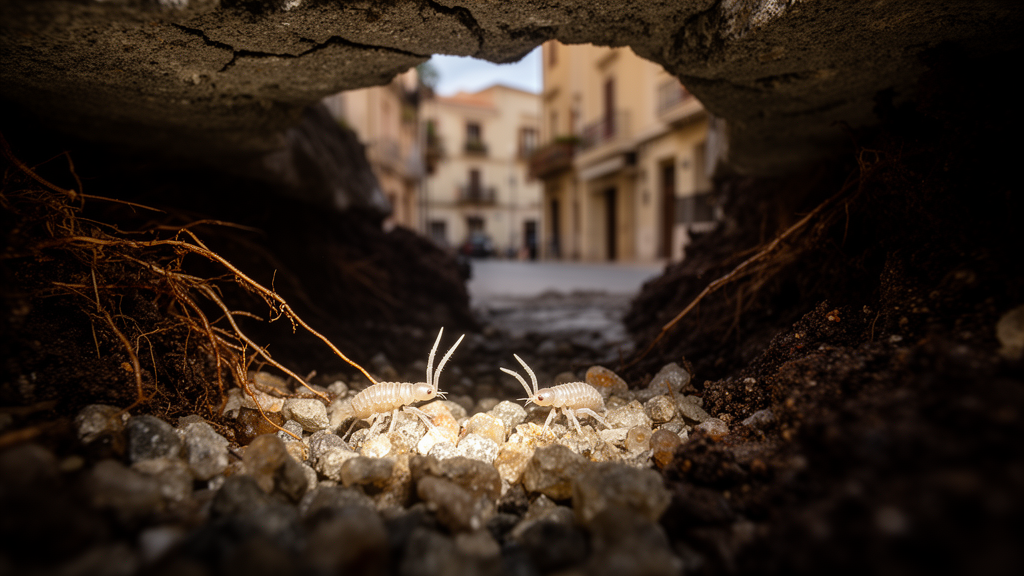
Beneath the streets of Tarragona, a historic port city on Spain’s Mediterranean coast, scientists have identified two species of springtail previously unknown to science. The tiny arthropods were recovered from Cova Urbana, a natural cave lying directly under the urban center, and their formal description in the journal Subterranean Biology adds to a growing body of evidence that even heavily populated landscapes can conceal remarkable subterranean life. The discovery is particularly striking because the cave in question is one of the most nutrient-poor environments ever surveyed for these animals, making the presence of any specialized cave fauna unexpected.
Cova Urbana was discovered by accident in 1996, when workers laying the foundations of a new building broke into a cavity that had already been hinted at in a nineteenth-century book about the city’s monuments. The cave developed in a small core of Jurassic dolomite, carved out along a stratification joint and expanded by the corrosive action of groundwater at the level of the Mediterranean Sea. It contains wells, lakes, large chambers, and an extensive underwater network that remains only partially explored. An opening in an ancient Roman water-conduction gallery provides access, and the site can be visited through the Societat d’Investigacions Espeleològiques de Tarragona, the caving association that manages the cavity.
The physical conditions inside the cave are unusual in several respects. Temperature varies only slightly across the system, ranging between 20.1 and 21.9 degrees Celsius, while relative humidity is exceptionally high at 97.9 percent, a consequence of constant evaporation from the large volume of phreatic water filling much of the cavity. Oxygen concentrations fluctuate between 18.7 and 20.5 percent depending on location, dropping to 17.2 percent in one of the Roman galleries that is half-clogged with debris. Chemical analysis of the water shows very low levels of chlorides and sodium, ruling out any infiltration of seawater despite the cave’s proximity to the coast, and the dolomite massif is isolated from other karstifiable rock formations by alluvial and Quaternary foothill deposits.
This geological isolation, combined with the absence of organic matter from percolating water or accumulated detritus, makes Cova Urbana what biologists describe as an oligotrophic cave, one with extremely limited food resources. The research team characterized the biological condition of the cavity as almost azoic with respect to troglobitic fauna, meaning animals adapted exclusively to underground life. Despite numerous visits and the deployment of both pitfall and aquatic traps, the only other animals detected were a few terrestrial isopods near the base of the entrance wells, a single tiny amphipod captured accidentally in a water sample, and a handful of trogloxene and troglophile species such as spiders, cockroaches, dipteran larvae, and a centipede that inhabit the Roman galleries and entrance areas where some contact with the outside environment persists.
Springtails, however, proved to be the most representative troglobitic fauna of the cave, and sampling efforts concentrated on capturing them. After many attempts, specimens were found in only one location: the Maginet Room, near the main siphon of the cavity, on a piece of wood abandoned during cave conditioning works. Subsequent placement of attraction baits at this point yielded additional springtails, but only of a single cosmopolitan species, Folsomia candida, which is common in many habitats and sometimes problematic in caves because it can transport fungi from the surface that alter the underground ecosystem. In total, across three sampling campaigns, just four species of Collembola were recorded, along with one mite specimen considered likely accidental.
The first of the two new species belongs to the genus Coecobrya and has been named Coecobrya urbana, after the cave itself, whose entrance lies in the heart of the city. The species is small, reaching up to 1.7 millimeters in body length excluding antennae, lacks eyes entirely, and is whitish with no pigment, all classic adaptations to life in permanent darkness. Its antennae are relatively long, measuring between 1.41 and 1.85 times the length of the head, and its body is covered with characteristic patterns of bristles called chaetae that taxonomists use to distinguish between species. Detailed examination under both light microscopy and scanning electron microscopy revealed a combination of features not seen in any previously described member of the genus.
What sets Coecobrya urbana apart most clearly is the structure of its claws, which bear four internal teeth rather than the more typical arrangement found in related species. Only four other described species of Coecobrya share this trait, occurring in India, Afghanistan, Thailand, and Portugal, and each differs from the new Spanish species in claw morphology, bristle patterns, or other anatomical details. The researchers compared type specimens from museum collections, including material from Stach’s collection at the Polish Academy of Sciences in Warsaw, to confirm that the Tarragona animals represent a distinct lineage. The finding reinforces a pattern well recognized in cave biology: populations of springtails isolated in caves that are geographically close to one another frequently diverge into separate species over evolutionary time.
The second new species, named Pygmarrhopalites sietae, belongs to a different order of springtails characterized by a globular body shape. It is even smaller than Coecobrya urbana, with a head measuring 0.23 millimeters and a body of 0.62 millimeters in the holotype specimen. Like the first species, it is unpigmented and its eyes are reduced to a single unpigmented pair. The species name honors the Societat d’Investigacions Espeleològiques de Tarragona, the association that maintains the cavity and organizes visits. Pygmarrhopalites sietae was captured only near the main siphon of the Maginet Room, the same restricted area that yielded the other new species, suggesting that this zone may represent the last remnant of suitable habitat within an otherwise inhospitable cave.
Distinguishing Pygmarrhopalites sietae from its closest relatives required careful comparison with species described more than seventy years ago. Only two previously known species share the combination of a single eye per side, absence of spine-like bristles on the posterior head, a distinctive papilla on the third antennal segment, and a similar arrangement of spines on the jumping organ, or furca. Both differ in details of claw and empodium structure and in the shape of the anal appendage, a feature used in this group for species-level identification. The researchers note that historical descriptions of one of these relatives, Pygmarrhopalites ornatus, are inconsistent with one another, and that future comparisons with type material would be needed if additional specimens are found in the cave.
Beyond the two formally described species, the team also recovered a single specimen of the genus Arrhopalites that appears to belong to yet another undescribed species, based on the number and arrangement of spines and bristles around its anal valves. With only one individual available, however, the researchers could not complete a formal description, and they emphasize that more specimens would be necessary. The overall picture that emerges from Cova Urbana is one of a remarkably depauperate but evolutionarily significant community, shaped by the cave’s isolation, its scarcity of organic matter, and, as the authors note, the role that human activity can play in directing the distribution of subterranean fauna, whether through the accidental discovery of the cave itself or through the introduction of the wood that provided the only foothold for these tiny inhabitants.
Subject of Research: Discovery and description of two new species of cave-dwelling springtails from Cova Urbana beneath the city of Tarragona, Spain
Article Title: Two new species of Collembola ( Arthropoda , Hexapoda ) from Cova Urbana, a cave under a city
Article References: Baquero, E., Jordana, R., & Fadrique, F. (2024). Two new species of Collembola (Arthropoda, Hexapoda) from Cova Urbana, a cave under a city. Subterranean Biology, 49, 163-184. https://doi.org/10.3897/subtbiol.49.120956
Image Credits: AI Generated
DOI: 10.3897/subtbiol.49.120956
Keywords: Collembola, springtails, cave biology, biospeleology, new species, Tarragona, Cova Urbana, Coecobrya urbana, Pygmarrhopalites sietae, subterranean fauna, troglobitic, Spain
Cite Scienmag News
Gavin Prescott. (October 19, 2026). Two New Springtail Species Discovered Beneath a Spanish City. Scienmag. https://scienmag.com/two-new-springtail-species-discovered-beneath-a-spanish-city/
Gavin Prescott. "Two New Springtail Species Discovered Beneath a Spanish City." Scienmag, 19 October 2026, https://scienmag.com/two-new-springtail-species-discovered-beneath-a-spanish-city/. Accessed 19 October 2026.
Gavin Prescott. "Two New Springtail Species Discovered Beneath a Spanish City." Scienmag. October 19, 2026. https://scienmag.com/two-new-springtail-species-discovered-beneath-a-spanish-city/


