


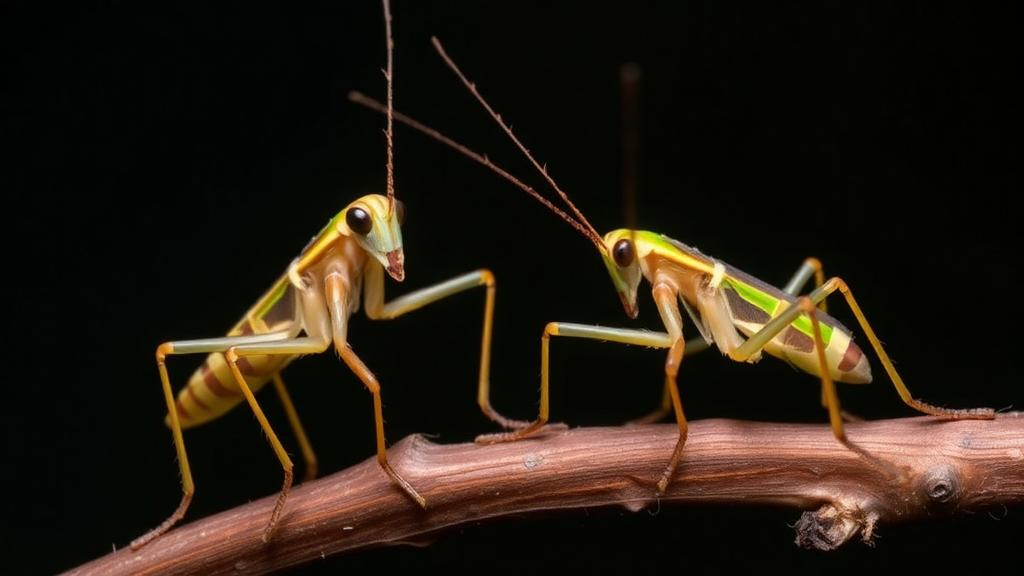
The Madeira archipelago, a volcanic cluster of islands off the northwest African coast, has quietly yielded a discovery that is making entomologists sit up and listen—literally. Researchers surveying crickets on the islands of Madeira and Porto Santo have recorded the tree cricket Oecanthus dulcisonans there for the first time, and in doing so have resolved a decades-long identity confusion surrounding its near-identical relative, Oecanthus pellucens. The findings, published in the Journal of Orthoptera Research, establish that these two species reach the westernmost limit of their Palearctic distributions on this small Atlantic archipelago, a biogeographical detail with implications far beyond the islands’ shores.
The story begins with a puzzle. Oecanthus pellucens, a pale, delicate tree cricket first described in 1763, had been recorded on Madeira Island since 1938. But in 1993, Russian entomologist Andrei Gorochov described a new species, Oecanthus dulcisonans, from specimens collected in Tenerife and the Arabian Peninsula. The two species are morphologically so similar that field records made before 1993 cannot be reliably assigned to either one. Because Madeira’s historical records of O. pellucens predate the description of O. dulcisonans, and because online photographic records rarely capture the one structure that separates the two species, genuine doubt had arisen about which cricket actually inhabited the island.
The key to the mystery lies in a small but decisive anatomical feature: the metasternal plate, a structure on the underside of the thorax. In O. dulcisonans, this plate is longer and thinner than in O. pellucens. Male genitalia, specifically the epiphallus, offer a second distinguishing character, while body proportions provide supporting evidence. O. dulcisonans males measure roughly 14 to 17 millimeters in body length with hind wings protruding 3 to 4 millimeters beyond the forewings, whereas O. pellucens males are smaller, around 10 to 13 millimeters, with protruding wings of only about 1 millimeter. Armed with these criteria, the research team examined both freshly collected specimens and older material held in the University of Madeira Insect Collection.
The fieldwork itself relied on one of the most charming methods in entomology: eavesdropping on cricket song. During night surveys in June 2023 on Madeira, the researchers walked paths through vegetation between 22:00 and midnight, tracing the source of each stridulation. On Porto Santo in October 2022, they drove slowly along roads at 15 kilometers per hour between 20:00 and 23:00, stopping whenever a calling song reached them. Once located, insects were captured by hand or with a net, and each collection point was logged with GPS precision of three meters. This acoustic approach is particularly effective for tree crickets, whose songs are species-specific and can be analyzed quantitatively.
The results were striking. The team collected 21 specimens of O. dulcisonans on Madeira Island, at Ponta de São Lourenço on the island’s eastern tip and at Reis Magos on the south coast, plus a single male on Porto Santo at Campo de Baixo—the first record of any Oecanthus species on that island. Four confirmed specimens of O. pellucens were also documented on Madeira, from Boca da Corrida at 1,202 meters elevation, Garachico, and Ponta do Pargo, along with a nymph found on the endemic plant Rumex maderensis in the Funchal Ecological Park. In total, the archipelago’s Orthoptera list now stands at 29 species, with 27 on Madeira and 13 on Porto Santo.
Song analysis added an independent line of evidence. O. dulcisonans produces continuous long echemes without gaps, a signature trait confirmed by recordings made on Porto Santo at 23°C using a smartphone with 48 kHz sampling frequency and 16-bit resolution. The researchers generated oscillograms with the seewave package in R and compared their recordings with reference data for O. pellucens from the Orthoptera Species Files Online, which show regular gaps between echemes at an echeme repetition rate of approximately one per second. Because the two species’ songs differ in this continuous versus non-continuous pattern, acoustic monitoring offers a practical tool for mapping their distributions without needing to capture every individual.
Morphometric data from the new specimens revealed intriguing variation. The Porto Santo male of O. dulcisonans measured 17.34 millimeters in body length, slightly exceeding the 14.00 to 17.00 millimeter range reported elsewhere, while its hind femur at 7.03 millimeters fell below the 8.70 to 10.00 millimeter range documented in previous studies. Madeira males averaged 14.44 millimeters in body length with hind femora of 7.98 millimeters, also deviating from literature values. The mean oviscape length in Madeira females, 5.48 millimeters, exceeded the value reported by earlier authors. These discrepancies hint that the archipelago’s populations may be morphologically distinct, and the researchers propose genetic comparisons with continental European specimens to explore this possibility.
Ecologically, the two species showed a consistent altitudinal segregation that mirrors patterns observed in the Canary Islands and Mallorca. O. dulcisonans was prevalent at lower altitudes, stridulating on stems within patches of tall herbaceous vegetation dominated by the grass Hyparrhenia hirta, often between buildings on Porto Santo and near lighthouses and coastal roads on Madeira. O. pellucens, by contrast, was encountered at higher elevations, consistent with its reported association with tall trees and shrubs. This habitat association matters for conservation planning, since Oecanthus species are closely tied to specific vegetation types and microhabitats that can be protected or restored through informed land management.
The biogeographical significance of the discovery is considerable. With both species now confirmed on Madeira, the archipelago—together with the Canary Islands—marks the westernmost limit of the Palearctic ranges of O. dulcisonans and O. pellucens, meaning their distributional extension within the region is larger than previously thought. Yet these crickets appear surprisingly rare across Macaronesia. Since its first record in 1938, only 17 specimens of O. pellucens have been collected on Madeira, and reports from the Azores have not been repeated since 1999. Whether this apparent rarity reflects genuinely small populations, limited survey effort, or habitat constraints remains an open question that further research in the Macaronesian islands must address.
Conservation concerns loom over these findings. Only around 20 percent of Madeira’s native Laurel Forest survives today, and the island’s south coast has been largely converted to urban and agricultural land. Porto Santo, the oldest island in the archipelago at 14 million years, retains only scattered remnants of native vegetation on cliffs and mountaintops, while erosion and nutrient runoff have degraded its soils since the fifteenth century. In the past decade, intensive tourist construction has further diminished the coastal herbaceous habitats these crickets depend on. The researchers stress that confirming the species’ presence on Madeira’s north coast and conducting comprehensive surveys across both islands are urgent priorities, and they see the charismatic singing crickets as an opportunity to engage the public and students in biodiversity education on these increasingly fragile islands.
Subject of Research: New records of Oecanthus tree crickets in the Madeira archipelago
Article Title: New records of Oecanthus species ( Orthoptera , Oecanthidae ) in the Madeira archipelago
Article References: Silva, H. M., Avivar-Lozano, L., Gomes, G., Rhee, H., Dellinger, T., & Aguín-Pombo, D. (2024). New records of Oecanthus species (Orthoptera, Oecanthidae) in the Madeira archipelago. Journal of Orthoptera Research, 33(1), 95-102. https://doi.org/10.3897/jor.33.113947
Image Credits: AI Generated
Keywords: Oecanthus dulcisonans, Oecanthus pellucens, tree crickets, Orthoptera, Madeira, Porto Santo, Macaronesia, biogeography, acoustic monitoring, biodiversity, conservation, records
Cite Scienmag News
Gavin Prescott. (October 19, 2026). Two tree cricket species revealed on Madeira, extending their Palearctic range westward. Scienmag. https://scienmag.com/two-tree-cricket-species-revealed-on-madeira-extending-their-palearctic-range-westward/
Gavin Prescott. "Two tree cricket species revealed on Madeira, extending their Palearctic range westward." Scienmag, 19 October 2026, https://scienmag.com/two-tree-cricket-species-revealed-on-madeira-extending-their-palearctic-range-westward/. Accessed 19 October 2026.
Gavin Prescott. "Two tree cricket species revealed on Madeira, extending their Palearctic range westward." Scienmag. October 19, 2026. https://scienmag.com/two-tree-cricket-species-revealed-on-madeira-extending-their-palearctic-range-westward/


