


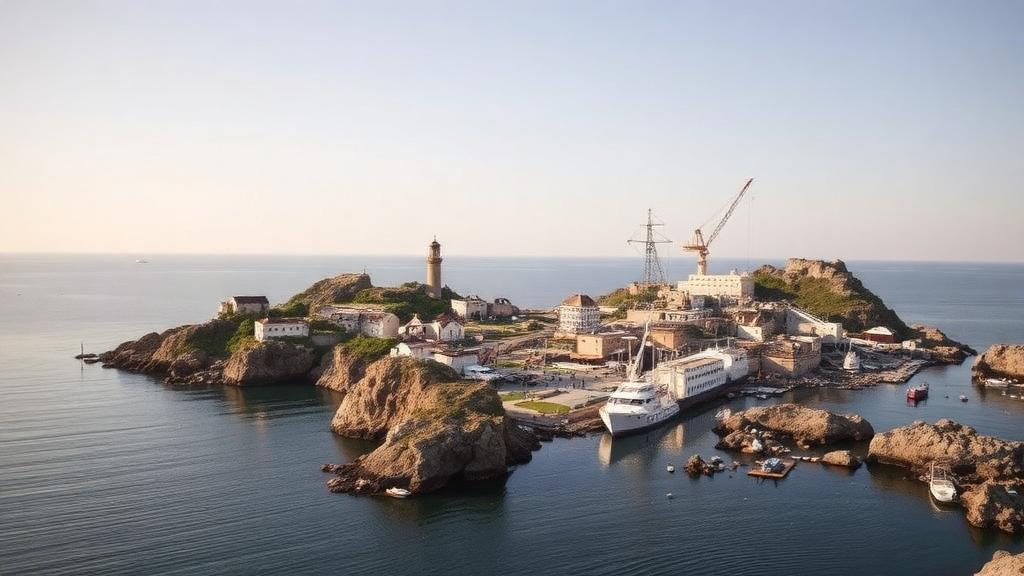
Europe’s islands are emptying out. A new analysis of 234 islands across seven European archipelagos finds that nearly a third of them—29.5 percent—have been abandoned by humans in just the last 150 years. The study, published in Frontiers of Biogeography, offers one of the first quantitative portraits of modern island abandonment, a process that archaeologists have long documented for prehistoric times but that has remained surprisingly poorly measured for the industrial era.
The research, conducted by a biogeographer at the University of Vienna, compiled historical census records, books, and peer-reviewed publications to determine which islands were inhabited around 1850 and which are inhabited today. The archipelagos span a remarkable latitudinal range: from the Macaronesian islands of the Azores, Madeira, and the Canaries in the subtropical Atlantic, through the Mediterranean-adjacent Maddalena archipelago and the Quarnero/Kvarner group in the Adriatic, up to the Channel Islands, western Ireland, Shetland, and the small islands off western Iceland. The cutoff date of 1850 was chosen deliberately, because while the Industrial Revolution began in Britain in the eighteenth century, most other European countries only began to industrialize during the nineteenth.
The headline numbers are striking. Of the 234 islands examined, 29.5 percent were abandoned between roughly 1850 and the present, while 32.1 percent have been continuously inhabited. Another 38.4 percent were uninhabited in both periods—data points the author deliberately retained, since consistently empty islands carry real statistical information. Abandonment rates varied enormously by region, from a mere 3.33 percent in Macaronesia to a staggering 56 percent among the small islands off western Iceland. In between lay western Ireland at 39 percent, the Channel Islands at 32.5 percent, Shetland at 32.4 percent, the Quarnero/Kvarner at 29 percent, and the Maddalena islands at 15.15 percent.
The most robust pattern to emerge is that island abandonment is scale-dependent. Using logistic regressions that modeled human presence or absence as a function of island area and time period, the study found that smaller islands were abandoned more consistently than larger ones—for every archipelago except Macaronesia. The logic follows directly from island biogeography. Small islands offer finite resources: less fresh water, less fertile soil, fewer fuel sources, and fewer habitat types. They can physically support only small populations, and small populations are inherently more vulnerable to extinction or emigration. The result mirrors classic species-area relationships, with humans behaving much like any other island-dwelling species whose persistence depends on patch size.
Latitude mattered too. Rates of abandonment increased significantly toward the poles, with latitude explaining a remarkable 81 percent of the variation in abandonment rates among archipelagos. Northern European islands, battered by the North Atlantic Drift and exposed to strong winds and ocean-borne disturbances, were abandoned far more consistently than their sheltered Mediterranean and Macaronesian counterparts. The islands west of Iceland and Ireland, in particular, face some of the harshest maritime conditions in Europe. The study also tested whether the minimum island size needed to sustain human settlement—the inflection point extracted from the logistic models—shifted toward larger islands at higher latitudes. The trend was positive, suggesting that harsh climates compound with limited space to push even moderately sized islands past the threshold of viability, but it did not reach statistical significance, hinting that cultural and political factors also shape where the line falls.
The historical context is essential to interpreting these numbers. The Industrial Revolution triggered massive rural-to-urban migration across Europe, and islands—peripheral both geographically and politically—were especially susceptible. As road networks expanded and superseded sea transport, islands lost whatever connectivity advantage they once had. Agriculture became less economically viable on remote outposts, and new technologies arrived late and at high cost. Emigration, once begun, tended to be self-reinforcing: as populations shrank, schools, churches, and services followed, making remaining life harder still.
Yet the study is careful to emphasize that broad trends conceal deeply idiosyncratic local histories. The Great Famine devastated Irish island communities—places like Inishark, Mason Island, Island Eddy, and Inchamakinna saw sharp population declines and eventual abandonment. The phylloxera epidemic that destroyed European vineyards in the late nineteenth century likely drove emigration from Adriatic islands. The mid-twentieth-century collapse of North Atlantic fisheries emptied islands off western Iceland, including Bildsey, Fagurey, Hergilsey, and Hoskuldsey. On the Channel Islands, tiny rocky islets such as the Écréhous sustained human presence through smuggling and fishing, while Napoleonic-era fortresses kept other islets occupied. And sometimes abandonment was temporary: the Icelandic island of Heimaey was evacuated during a volcanic eruption in 1973 and later resettled.
The future, the author argues, may look quite different from the past. Global warming could render southern islands increasingly inhospitable while making higher-latitude islands relatively more attractive—a reversal of the historical latitudinal gradient. New economic engines such as tourism, remote work, and renewable energy no longer depend on the amount of arable land available, decoupling settlement viability from the agricultural constraints that once governed island life. Some regions are even building artificial islands, as in the Seychelles. But repopulation, if it comes, may favor already-inhabited islands with urban infrastructure rather than empty outposts. Shetland illustrates the point: the main island’s population, which nearly halved between the 1850s and the 1970s, rebounded to near-historical levels after the discovery of offshore oil, while small abandoned islands like Hascosay remained empty. Many deserted islands have instead found a second life as conservation areas or UNESCO World Heritage Sites—visited by tourists, but unlikely to be settled again.
The study’s limitations are acknowledged candidly. Only seven archipelagos could be included, constrained by the availability of digitized historical records and by language barriers—the author could work only with English and Italian sources, introducing a documented language bias into the dataset. Danish records only become usable in the twentieth century, and Åland Islands data were aggregated by parish rather than by island. With only two time points and presence-absence data rather than population counts, the analysis cannot directly quantify the specific contributions of industrialization and urbanization, which remain plausible but unproven drivers. Nor is abandonment a purely European phenomenon: colonial-era epidemics and forced relocations, from the Gulf of California to the Chagos Islands, produced abandonment through very different mechanisms, and a global assessment accounting for these historical contingencies remains a pressing need.
Still, the core finding stands as a quantitative bridge between archaeology and modern biogeography. Humans have cycled on and off islands for millennia, occupying them in favorable times and leaving in unfavorable ones—and the industrial era simply continued that ancient rhythm at accelerated pace, hitting smallest and northernmost islands hardest. With roughly one in three European islands emptied in a century and a half, the geography of human island life turns out to be as structured, and as predictable, as the geography of any other species.
Subject of Research: Recent patterns and drivers of human island abandonment across European archipelagos
Article Title: The process of island abandonment by humans in recent European history
Article References: Mologni, F. (2024). The process of island abandonment by humans in recent European history. Frontiers of Biogeography, 17, Article e132245. https://doi.org/10.21425/fob.17.132245
Image Credits: AI Generated
Keywords: island biogeography, island abandonment, Europe, human migration, Industrial Revolution, latitude, island area, Macaronesia, Shetland, Iceland, conservation, demography
Cite Scienmag News
Violet Maxwell. (October 19, 2026). Nearly a Third of Europe’s Islands Have Been Abandoned in Just 150 Years. Scienmag. https://scienmag.com/nearly-a-third-of-europes-islands-have-been-abandoned-in-just-150-years/
Violet Maxwell. "Nearly a Third of Europe’s Islands Have Been Abandoned in Just 150 Years." Scienmag, 19 October 2026, https://scienmag.com/nearly-a-third-of-europes-islands-have-been-abandoned-in-just-150-years/. Accessed 19 October 2026.
Violet Maxwell. "Nearly a Third of Europe’s Islands Have Been Abandoned in Just 150 Years." Scienmag. October 19, 2026. https://scienmag.com/nearly-a-third-of-europes-islands-have-been-abandoned-in-just-150-years/


