


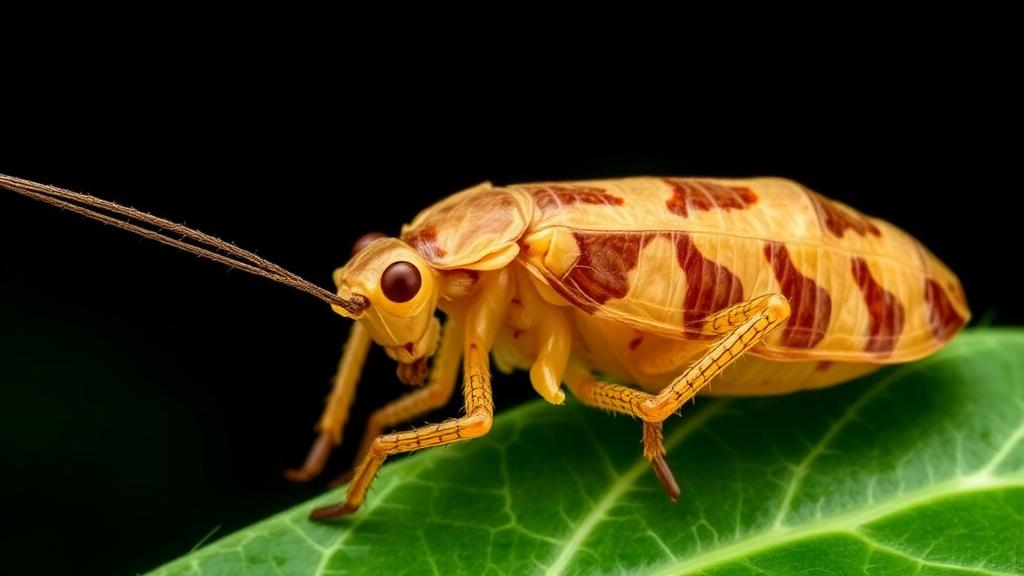
Katydids, the often leaf-like singers of the night, have quietly been hiding one of entomology’s most consistent anatomical signatures in the least glamorous place imaginable: their eggs. A sweeping global review published in the Journal of Orthoptera Research has compiled measurements of length, width and height for 352 species and subspecies of Tettigonioidea, the superfamily that contains the bush crickets or katydids, including newly collected data for 158 species that had never been assessed before. The verdict is striking. Across nearly every branch of this enormous insect lineage, eggs conform to a familiar ovoid-cylindrical outline, sometimes described as sausage-shaped, with rounded ends and a width roughly equal to the height. One subfamily, however, breaks the rule with almost perfect reliability: the Phaneropterinae, whose eggs are consistently flattened, wider than they are thick, in a pattern so stable that the authors argue it should be treated as a diagnostic character for the entire group.
The scale of the new dataset is what gives the finding its weight. Earlier comparative work on insect eggs, notably a large analysis covering more than 6,700 species, managed to include only about 30 tettigonioid species drawn from a handful of papers, even though the basic idea that katydid eggs differ between groups dates back over a century. The entomologist Bei-Bienko noted in 1954 that the markedly flat form of the egg is highly typical of the Phaneropterinae in contrast to other Palearctic Tettigoniidae, yet the observation was never followed by a comprehensive global test. Regional studies hinted at the pattern, and individual species descriptions occasionally mentioned unusual eggs, but nobody had assembled the numbers needed to confirm that flatness holds across continents, tribes and body sizes. The new review, drawing on 458 eggs from 158 species examined directly plus every usable literature record the authors could localize, finally closes that gap.
The technical approach was deliberately simple and repeatable. Eggs were obtained from mated and unmated females kept in captivity, dissected as ripe eggs from freshly prepared specimens, or extracted from material preserved in ethanol, then stored in 70 percent ethanol or dried. Each egg was photographed at a single fixed magnification under a stereo zoom microscope, positioned horizontally and vertically with plasticine, and measured from the images. The largest dimension was defined as length, the second largest as width and the smallest as height or thickness. From these three figures the team calculated the aspect ratio, the ratio of length to width, along with a relative thickness measure and an estimated volume treating the egg as an ellipsoid. In phaneropterines, the aspect ratio rarely exceeds three and never reaches four, a numerical fingerprint of the flattened body plan that separates them cleanly from their cylindrical-egged relatives.
Size itself varies enormously across the lineage, and the new data push the known extremes further apart than ever before. Among roughly 339 tettigonioid species with measurements, egg length runs from just 1.6 millimeters in the tiny Amyttosa insectivora up to 12.6 millimeters in the large predatory Saga ephippigera, while estimated volumes span from 0.1 cubic millimeters in Indiamba malkini to a hefty 46 cubic millimeters in Philoscirtus cordipennis. That volume range already exceeds the scale reported in previous global syntheses by more than an order of magnitude, and the authors note that data for the very smallest species are still missing, meaning the true spread is likely wider still. Within the Phaneropterinae specifically, egg length ranges from 2.8 millimeters in Caedicia flexuosa to 8.8 millimeters in Zeuneria biramosa, and egg size tracks body size closely across the subfamily.
That body-size relationship was quantified in an elegant way. Because direct mass data for females are scarce, the researchers turned to the species-rich genus Poecilimon and its relatives, where male body mass had been measured and could serve as a proxy for female mass. Plotting estimated egg volume against male body mass produced a tight regression with a coefficient of determination of 0.80, indicating that every additional gram of body mass corresponds to an increase of slightly more than five cubic millimeters in egg volume. Since egg volume correlates directly with egg mass in the species where both have been measured, the result links a readily observable morphological trait to reproductive investment, and it does so across a genus complex that spans a wide range of body sizes.
The flattened phaneropterine egg, however, is only the headline act in a review full of oddities. Among more than 150 phaneropterid species examined, some eggs are genuinely strange. The female of Debrona cervina lays her eggs individually on the upper surface of leaves, each one perched on a short vertical stalk. Three African species, Tropidonotacris grandis and two species of Ectomoptera, produce extremely thin eggs bearing a flat lateral extension on one side, while three Asian holochlorine genera, including Arnobia and Stictophaula, show a similar extension running around the egg’s circumference with widths that differ between species. The egg of Phlaurocentrum mecopodoides is flattened but carries a peak on both its upper and lower sides. These sculptural flourishes may serve to stabilize such thin eggs during oviposition, and their differing forms suggest they evolved independently in at least two lineages.
Other subfamilies keep the cylindrical baseline but decorate it in distinctive ways. Most mecopodine eggs are elongate, often with a longitudinal groove and a hook at one pole, features thought to be involved in air regulation, although some species lack both. In Pseudophyllinae, the modification is even more dramatic: in nearly all species studied, up to half of the egg’s length is structurally differentiated, with the anterior portion covered by a parchment-like spongy process that is moulded during oviposition into a flat strip of tissue. When a female Onomarchus cretaceus laid eggs into wood, only these strips were visible at the surface, hinting that the structures help the developing embryo exchange air and take up the water it needs. Meanwhile the Conocephalinae produce thin, elongate, semi-transparent eggs with unusually high aspect ratios, and the Meconematinae, a subfamily of small predators, turn out to be a hotspot of egg diversity, with one tribe whose eggs terminate in a cap or cover plate that lies flat on the plant surface and is pushed open by the hatching nymph.
Perhaps the most provocative case is the genus Brinckiella, whose eggs are elongated and cylindrical, utterly unlike any other known phaneropterine. The genus had been moved from Meconematinae into Phaneropterinae in 1996, but the new egg data, combined with an unusual mix of other characters, have prompted the authors to propose re-transferring it back to Meconematinae. It is a tidy demonstration of the review’s central methodological point: egg morphology, long neglected in taxonomy, can carry real phylogenetic signal. Eggs are admittedly less stable than chitinous structures such as the pronotum or hind femora, since they absorb water during development and can swell by 50 to 150 percent in mass, or shrink when dried without visibly collapsing. But the basic shape appears largely unaffected by these changes, which makes the relationships between the three dimensions more reliable than any single measurement.
Why would flat eggs evolve in the first place? The authors propose a hypothesis centered on glue. Many phaneropterines attach their eggs directly to leaves and twigs with adhesive fluids, sometimes uncovered, and even species that insert eggs into leaves often use glue as well. Females are astonishingly precise, capable of slipping eggs between the upper and lower epidermis of a living leaf, and some have even been observed depositing eggs into sheets of blotting paper. Some species attach extra material to conceal the eggs or prevent desiccation, and the nature and origin of the adhesive fluids, whether from oral glands, the abdomen or both, remain almost entirely unknown. A flattened egg presents a larger contact area for adhesion, sticking more securely and reducing the risk of falling, an advantage that holds even for eggs too thick to be inserted into plant tissue. On this view, the ultra-thin eggs tucked inside leaf edges may be a secondary specialization built on an older adhesive habit.
Tellingly, flatness is almost never lost, even when the insects abandon plants altogether. The flightless Barbitistini of the western Palearctic, a species-rich tribe supported by molecular studies, includes genera such as Leptophyes whose eggs range from flat to very flat even when laid in bark or old galls, while the ground-laying giants Isophya and Poecilimon retain eggs that are wider than high despite being relatively thick, with Poecilimon pergamicus coming closest to a cylindrical form. The authors anticipate that the poorly studied Meconematinae, with their small eggs and little-known oviposition behavior, will yield the next round of surprises, and they flag entire subfamilies such as Microtettigoniinae and Pterochrozinae for which no egg data exist at all. For a structure that has been ignored in general biology and taxonomy for decades, the katydid egg is finally getting its due, and it turns out to be a small, elegant record of how a lineage builds its future one glued, flattened, carefully placed egg at a time.
Subject of Research: Egg shape and size variation across katydid lineages and its link to oviposition behavior
Article Title: Egg shape and size in Phaneropterinae and other Tettigonioidea ( Orthoptera , Ensifera ): A global review with new data
Article References: Heller, K.-G., & Hemp, C. (2024). Egg shape and size in Phaneropterinae and other Tettigonioidea (Orthoptera, Ensifera): A global review with new data. Journal of Orthoptera Research, 33(1), 103-112. https://doi.org/10.3897/jor.33.116173
Image Credits: AI Generated
Keywords: Tettigonioidea, Phaneropterinae, katydids, egg morphology, oviposition, aspect ratio, Brinckiella, Meconematinae, Pseudophyllinae, Mecopodinae, taxonomy, Orthoptera
Cite Scienmag News
Gavin Prescott. (October 19, 2026). Katydids’ Flattened Eggs Reveal a Global Story of Glue, Leaves and Evolution. Scienmag. https://scienmag.com/katydids-flattened-eggs-reveal-a-global-story-of-glue-leaves-and-evolution/
Gavin Prescott. "Katydids’ Flattened Eggs Reveal a Global Story of Glue, Leaves and Evolution." Scienmag, 19 October 2026, https://scienmag.com/katydids-flattened-eggs-reveal-a-global-story-of-glue-leaves-and-evolution/. Accessed 19 October 2026.
Gavin Prescott. "Katydids’ Flattened Eggs Reveal a Global Story of Glue, Leaves and Evolution." Scienmag. October 19, 2026. https://scienmag.com/katydids-flattened-eggs-reveal-a-global-story-of-glue-leaves-and-evolution/


