


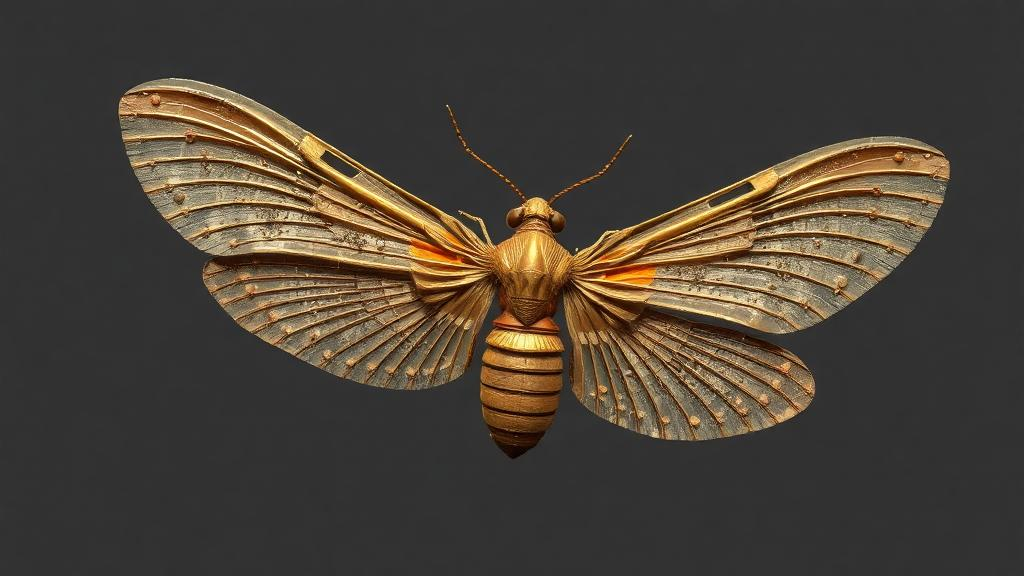
A single fossilized insect wing unearthed from a rock outcrop in Shanxi Province, China, has rewritten a small but significant chapter in the history of winged insects. The specimen, described in the journal Fossil Record, belongs to a previously unknown genus and species of Diaphanopterodea, an enigmatic order of Palaeozoic insects that vanished long before the dinosaurs ever walked the Earth. Named Sinoelmoa yangquanensis, the new taxon represents the first record of a Permian Diaphanopterodea from China, and simultaneously the earliest and most easterly occurrence of the family Parelmoidae anywhere in the world. For paleontologists who have spent decades mapping the distribution of these rare insects across Europe and North America, the discovery stretches their known range thousands of kilometers eastward, to the ancient shores of the Palaeotethys Ocean on the North China Block.
Diaphanopterodea were members of the broader group Megasecopteromorpha, an assemblage of extinct insects that flourished during the Late Palaeozoic, roughly 300 million years ago. Compared with other lineages of this group, diaphanopterodeans are known from relatively few species and fossil specimens, which makes every new find valuable. What has long fascinated researchers about these insects is their ability to fold their wings backwards along the abdomen at rest, a capacity known as neoptery. This trait was once considered the ancestral condition for all winged insects, but most specialists now accept that it evolved convergently, appearing independently within Megasecopteromorpha and within the larger neopteran radiation. Over the roughly 75 million years of their evolutionary history, diaphanopterodeans also diversified into remarkably small forms with greatly reduced wing venation, a body plan that superficially recalls that of modern wasps and bees.
The new specimen, catalogued as YQZYW 15, was collected from a siltstone layer in the middle part of the Shanxi Formation at a locality called Shuiquan Gully, in the Duanjiabei District near the city of Yangquan. The Shanxi Formation is a sequence of deposits laid down under conditions of continental and oceanic interaction, consisting mainly of coal, mudstone, siltstone and sandstone. It conformably overlies the Taiyuan Formation and underlies the Xiashihezi Formation. The fossil-bearing layer is grey and packed with plant fossils, including the seed fern foliage Neuropteris ovata, several species of the tree fern Pecopteris, and the cordaitalean conifer relative Cordaites. Based on its lithological characters, this layer is assigned to the Asselian age of the Permian, the earliest stage of the Cisuralian epoch, dating the insect to approximately 299 to 293 million years ago. The upper part of the fossiliferous interval contains marine invertebrates such as brachiopods and gastropods, painting a picture of a humid, vegetated coastal environment where insects thrived among dense forests.
Only a single right forewing was preserved, split between a part and counterpart slab, with the distal portion missing. Even so, its preservation quality proved sufficient for detailed analysis. The preserved wing measures 15.4 millimeters in length and 5.5 millimeters in width, and its venation pattern carries a suite of diagnostic features: a dark area between the anterior wing margin and the radius, a subcostal vein that vanishes before reaching the radius, a forked cubitus posterior, and an exceptionally well-developed anal area bearing eight terminal branches. The researchers documented the fossil using high-resolution photography under both dry and ethanol immersion conditions, combining images from both sides of the slab to capture the maximum anatomical detail, and complemented the photographs with careful hand-drafted interpretive drawings made with a stereomicroscope equipped with a drawing tube.
Assigning the specimen to its correct position in the insect family tree required a broad comparative analysis of wing venation across all known members of the families Parelmoidae and Elmoidae, the two closest relatives of the new material. The key turned out to be a very short, oblique cross-vein in the region between the anterior and posterior cubital veins, a feature that places the specimen firmly within Diaphanopterodea while excluding affinity with the Sinodiaphidae. A long fusion of the anterior cubital vein with the combined radial and medial stem rules out the Diaphanopteridae, and the overall configuration of veins points squarely to the Parelmoidae. Affinity with the Elmoidae was also tested and rejected: elmoid insects have a narrow anal area with a simple anal vein, whereas the new specimen shows a broad anal fan with numerous long veins, a signature of the Parelmoidae.
Within the Parelmoidae, comparisons with individual genera further confirmed that the Chinese wing belongs to something new. In the genera Parelmoa, Pseudelmoa and Elmodiapha, known from the famous Early Permian localities of Elmo and Midco in Kansas and Oklahoma, and from Obora in the Czech Republic, the split between the anterior and posterior branches of the media lies well beyond the split of the radius, whereas the two splits occur at the same level in the Chinese fossil. The new species also differs from these genera and from Permuralia of Russia by its brief cross-vein connection between the radius posterior and media anterior, and by its forked cubitus posterior. Comparison with Permelmoa magnifica from the Lodève locality in France prompted the researchers to re-examine the French holotype using reflectance transformation imaging, a technique that captures how a fossil surface reflects light from dozens of directions and allows virtual relighting of the specimen.
That re-examination yielded a series of corrections to the earlier interpretation of Permelmoa magnifica. The original description reported three branches of the radius posterior, but the new analysis found four; the course of the anterior cubital vein was reinterpreted; and a structure previously identified as a basal portion of the posterior media was reassigned as a twin, shifted impression of the anterior cubitus, a preservation artifact documented in other material from Lodève. The authors also proposed an alternative homology for the medial vein system, suggesting that the media anterior may run fused with the radius for some distance rather than arising from a free medial stem. However the debate on the French species resolves, the Chinese fossil remains distinct from it in numerous respects, justifying the erection of a new genus and species.
Beyond the taxonomy, the good preservation of Sinoelmoa yangquanensis allowed the team to resolve a lingering uncertainty about the arrangement of the main veins near the wing base in Diaphanopterodea. In most members of the order, the space between the cubital stem and the combined radial-medial stem is extremely narrow, and the free distal portion of the anterior cubitus diverges right next to the point where the radius and media separate, making it nearly impossible to tell whether the entire cubital stem, or only its anterior branch, fused with the radial-medial stem. In the new specimen, an independent cubital stem is clearly visible, with a simple anterior cubitus running alongside the radial-medial stem for some distance before diverging abruptly. This observation overturns the assumption of an early common stem combining all three vein systems, and instead corroborates previous observations of a more or less brief connection between the anterior cubitus and the radial-medial stem, a pattern likely general to most diaphanopterodean families and probably present in the specialized families Martynoviidae and Asthenohymenidae as well.
The biogeographic implications of the find may prove just as important as its anatomical ones. Until now, the Parelmoidae were known only from localities in what are now the Czech Republic, the United States, France and Russia, all in the western and central parts of the Palaeozoic world. Sinoelmoa yangquanensis, being Asselian in age, constitutes the earliest occurrence of the family, and being situated along the eastern margin of the Palaeotethys on the North China Block, it is also the most oriental. Together, these two superlatives suggest that these rather infrequent insects enjoyed a far broader geographic distribution than the sparse fossil record had indicated, at least along the lower latitudes of the Northern Hemisphere, when the supercontinent Pangaea was still assembling and dense coal-forming forests stretched across the tropical belt.
The discovery also underscores how much remains to be learned from even a single wing. Because diaphanopterodeans are rare and their fossils often deformed or incomplete, paleontologists must rely on subtle details of venation, the branching patterns and cross-veins etched into chitin hundreds of millions of years ago, to reconstruct their evolutionary relationships. Sinoelmoa yangquanensis demonstrates that careful comparison of these features, supported by modern imaging techniques and re-examination of old museum specimens, can still overturn long-held assumptions about how these ancient insects were built. It is a reminder that the earliest experiments in wing folding, a capability that today defines the vast majority of insect species, were unfolding in parallel lineages across a Permian world whose full diversity is only beginning to come into view, one slab of siltstone at a time.
Subject of Research: Early Permian diaphanopterodean insects and the discovery of a new Parelmoidae species from China
Article Title: The first Permian Diaphanopterodea ( Insecta , Megasecopteromorpha ) from China
Article References: Yang, N., Cui, Y., Xu, Z., Xu, Y., Ren, D., & Béthoux, O. (2024). The first Permian Diaphanopterodea (Insecta, Megasecopteromorpha) from China. Fossil Record, 27(2), 247-258. https://doi.org/10.3897/fr.27.128892
Image Credits: AI Generated
DOI: 10.3897/fr.27.128892
Keywords: Diaphanopterodea, Parelmoidae, Sinoelmoa yangquanensis, Permian insects, Shanxi Formation, fossil insects, wing venation, palaeontology, China, North China Block, Cisuralian, Megasecopteromorpha
Cite Scienmag News
Gavin Prescott. (October 19, 2026). Ancient Wing Fossil Reveals First Permian Diaphanopterodea Insect Found in China. Scienmag. https://scienmag.com/ancient-wing-fossil-reveals-first-permian-diaphanopterodea-insect-found-in-china/
Gavin Prescott. "Ancient Wing Fossil Reveals First Permian Diaphanopterodea Insect Found in China." Scienmag, 19 October 2026, https://scienmag.com/ancient-wing-fossil-reveals-first-permian-diaphanopterodea-insect-found-in-china/. Accessed 19 October 2026.
Gavin Prescott. "Ancient Wing Fossil Reveals First Permian Diaphanopterodea Insect Found in China." Scienmag. October 19, 2026. https://scienmag.com/ancient-wing-fossil-reveals-first-permian-diaphanopterodea-insect-found-in-china/


