


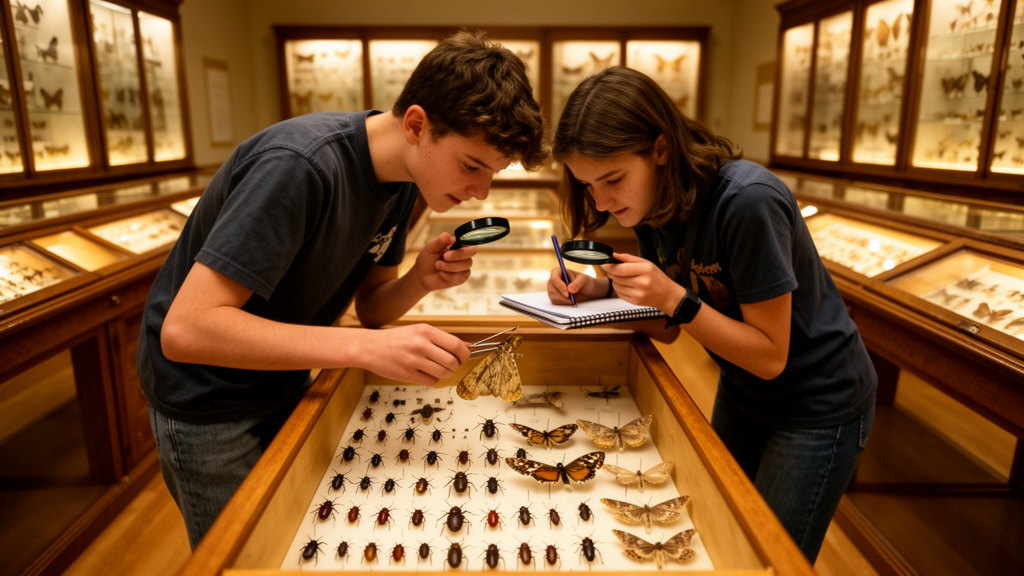
At University Laboratory High School in Urbana, Illinois, a four-day elective course called “Bugged Out: From Fashion to Forensics” gave students a rare chance to explore the hidden roles insects play in human life, from solving crimes to inspiring robotic wings. The course, described in the journal Natural History Collections and Museomics, was built around a deceptively simple resource: pinned insect specimens arranged in museum display drawers. Rather than relying on live animals or lectures alone, the instructor, a graduate student, placed outreach drawers from the Illinois Natural History Survey Insect Collection at the center of every lesson, letting teenagers handle, examine, and discuss real specimens at their own pace.
The class took place during Agora Days, an annual tradition at the selective public high school run by the University of Illinois at Urbana-Champaign. For four days each year, regular classes are suspended and students choose from roughly 125 elective courses proposed by teachers, students, and community members. Topics range from Circus Arts to Soft Robotics, and the program is deliberately free of homework and exams. Priority for course selection goes to twelfth graders and descends by grade, so the insect course drew a mixed group of ninth through twelfth graders whose class size ranged from nine to eleven students depending on absences. Each session lasted 45 minutes, matching the rhythm of a normal school day.
The course was organized around four themes: insects in forensics, insects in art, insects in medicine and technology, and insects in food. Each theme was paired with a dedicated outreach drawer containing specimens highlighted during that day’s lesson. The forensics drawer, created specifically for the event, displayed blow flies, flesh flies, cheese skippers, carrion beetles, and flesh beetles, and mapped which insects appear at each stage of carcass decay. The art drawer offered drawing utensils alongside pinned specimens as a self-guided way for students to admire insect form. The medicine and food drawers came from the existing collection, the latter displaying an edible product made by insects.
Instruction was kept short, roughly 10 to 15 minutes per day, leaving 30 to 35 minutes for self-guided activities. Students explored two to three activities related to the day’s topic, with the paired outreach drawer always among them. In the forensics session, students identified insects from a drawer and debated what stage of decay a hypothetical carcass represented. In the technology session, they compared sputter-coated grasshopper wings with prototypes of robotic wings to understand the design process. In another activity, they assembled animal skeleton puzzles cleaned by dermestid beetles, connecting the insects to real museum preparation techniques. Because Agora Days carries no grades, activities required no end product beyond what each student chose to learn or create.
The self-paced design was grounded in prior research. Previous studies have shown that while students often begin with fear or discomfort around insects, engaging with insect collections and hands-on activities measurably increases their comfort levels. Using pinned specimens instead of live ones was an intentional choice: it allowed hesitant students to approach insects gradually, without the unpredictability of living animals. Several students who expressed fear at the start of the course were able to explore the drawers without distress, consistent with findings that display specimens can serve as a bridge toward comfort with entomology.
To gauge whether the course changed attitudes, the instructor administered optional surveys at the beginning of the first day and at the end of the fourth, modeled after a 2025 study by Miller and colleagues. The questions asked whether students liked insects and whether they believed insects could be beneficial or harmful to humans. Before the program, six of eight respondents, 75 percent, said they liked insects, while two said no. After the course, every respondent who answered, six students, reported liking insects, with none answering no. All respondents, before and after, agreed that insects can be both beneficial and harmful to humans. The instructor cautioned that absences and the small sample size mean the results do not warrant conclusions about the course’s efficacy; they serve instead as a model of assessment that future outreach events are encouraged to implement.
Reception was broadly positive. Most students explored all the activities after the short lecture, rotating at their own pace or converging on activities that sparked group interest. Students frequently worked in groups, discussing and collaborating during the self-guided exercises. A recurring theme in conversation was the instructor’s own path into science: students asked how the instructor became a scientist and what the daily life and career of an entomologist actually look like. Prior research has shown that outreach events geared toward children can increase their interest in becoming scientists, and the instructor qualitatively found that these activities inspired students’ interest in STEM-related fields, suggesting that having a working scientist participate is a valuable component of any future use of this curriculum.
Beyond pedagogy, the course highlights a practical point for museums and collections: outreach drawers are a cost-effective, accessible resource for sharing science with the local community. For the graduate student instructor, borrowing drawers from the Illinois Natural History Survey Insect Collection required no external funding, making the event feasible without grants or institutional support. Two of the four drawers, those for forensics and art, were created specifically for the event, demonstrating that collections can assemble targeted outreach materials relatively cheaply when existing drawers do not fit a lesson. The instructor has published the course structure, activity descriptions, lecture slides, and drawer layouts so that other insect collections can replicate the model for similar outreach events.
The broader significance lies in what the model suggests about informal science education. Elective programs like Agora Days remove the pressure of grades and exams, and the evidence from this course indicates that students with even mild entomophobia will engage deeply when specimens are pinned rather than alive and exploration is self-directed. Insect collections, often seen as archival resources for researchers, emerge here as versatile teaching instruments capable of connecting teenagers to forensics, art, medicine, robotics, and food systems in a single week. Future implementations are encouraged to adopt the Miller-style pre- and post-course surveys to expand what the field knows about using insect collections in outreach, turning a small Illinois classroom experiment into a replicable framework for collections worldwide.
Subject of Research: Entomology outreach education
Article Title: Bugged out: A High School outreach class using display drawers to highlight the importance of insects
Article References: Weber, A. (2025). Bugged out: A High School outreach class using display drawers to highlight the importance of insects. Natural History Collections and Museomics, 2, 1-8. https://doi.org/10.3897/nhcm.2.153323
Image Credits: AI Generated
Keywords: insects, entomology, science education, museum collections, outreach, Agora Days, Natural History Survey, Bugged, High, School, class, display
Cite Scienmag News
Gavin Prescott. (October 19, 2026). Bugged Out: High Schoolers Explore Insect Science Through Museum Display Drawers. Scienmag. https://scienmag.com/bugged-out-high-schoolers-explore-insect-science-through-museum-display-drawers/
Gavin Prescott. "Bugged Out: High Schoolers Explore Insect Science Through Museum Display Drawers." Scienmag, 19 October 2026, https://scienmag.com/bugged-out-high-schoolers-explore-insect-science-through-museum-display-drawers/. Accessed 19 October 2026.
Gavin Prescott. "Bugged Out: High Schoolers Explore Insect Science Through Museum Display Drawers." Scienmag. October 19, 2026. https://scienmag.com/bugged-out-high-schoolers-explore-insect-science-through-museum-display-drawers/


