


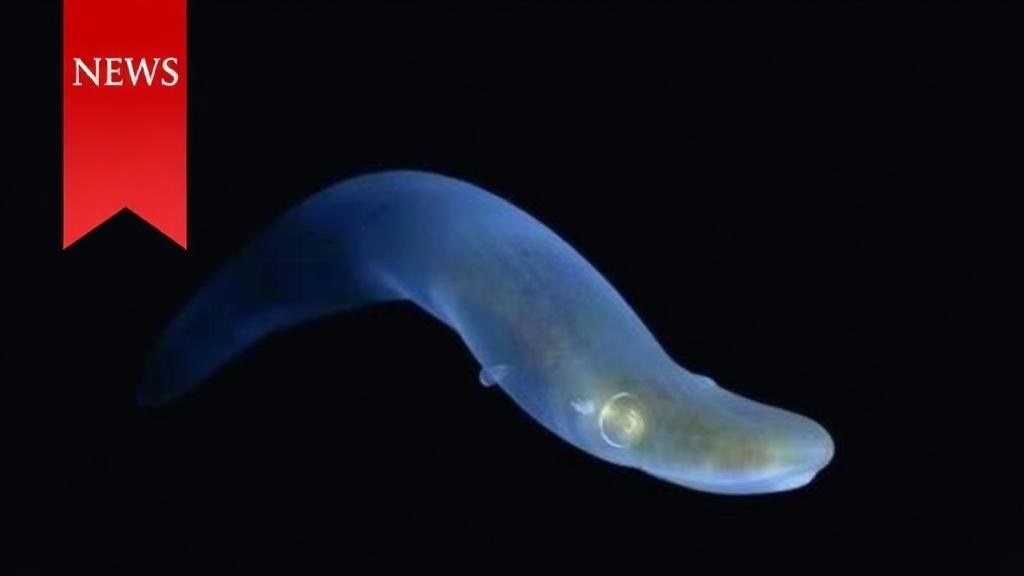
A slender, eel-like fish with a faint dark edging on its fins has quietly rewritten the map of marine biodiversity in the Indian Ocean. Researchers working at a busy fishing port on India’s southwestern coast have documented the blackedge cusk, Ophidion muraenolepis, from the Laccadive Sea for the first time, pushing the known boundaries of this mysterious deep-dwelling species roughly 5,500 kilometers further west than any previous verified record. The discovery, published in the journal Acta Ichthyologica et Piscatoria, marks not only a first for India but also the westernmost occurrence of the species anywhere in the Indo–west Pacific region, and it raises tantalizing questions about how widely these secretive fish actually range beneath the waves.
The four specimens responsible for the finding were not collected on an ambitious research cruise to unexplored depths. Instead, they came ashore the mundane way much of marine science does: tangled in the by-catch of commercial trawlers unloading at the Sakthikulangara Landing Centre near Kollam in the state of Kerala. Landing centers like this one are often the front line of fish discovery in the tropics, where the sheer volume of catch can sweep up rare or unfamiliar species that scientific surveys rarely encounter. The fish measured between roughly 183 and 202 millimeters in standard length, a respectable size for a cusk eel, and were collected in November 2023 before being deposited in the National Fish Repository of the ICAR National Bureau of Fish Genetic Resources in Lucknow for permanent safekeeping and study.
Cusk eels of the family Ophidiidae are among the ocean’s most underappreciated inhabitants. These benthopelagic fishes live close to the seabed in tropical and temperate seas from shallow coastal waters down to depths exceeding 7,695 meters, yet the family remains poorly studied, with major gaps in knowledge of its systematics, biogeography and life histories. Worldwide, the family comprises 279 species in 46 genera. Their defining anatomy reads like a checklist of subtle features: dorsal, caudal and anal fins fused into a single continuous fringe around the body; small scales; a supramaxilla bone in the upper jaw; a dorsal fin that originates ahead of the anal fin; and dorsal-fin rays that run longer than their anal-fin counterparts. Because they spend their lives hugging the bottom, often in darkness, many species are known from only a handful of specimens, and some have never been seen since their original description.
The genus Ophidion itself, established by Linnaeus in 1758, is a taxonomist’s headache. It currently contains 28 valid species, but scientists have long suspected that the genus is paraphyletic, meaning its members do not all descend from a single exclusive common ancestor, and its phylogenetic relationships to related clades remain murky. Diagnostic traits include a scaleless head, body scales set at oblique angles, pelvic fins positioned below the eye with two unequal rays, four to seven developed gill rakers, 15 to 18 precaudal vertebrae, and the absence of black bands on the head and body. Before this study, only five Ophidion species had been reported across the entire Indo–west Pacific, and just one of them, O. smithi, had ever been recorded from Indian waters, itself considered a very rare fish.
Confirming that the Kerala specimens truly were O. muraenolepis required meticulous measurement and counting. The team used digital vernier calipers to capture morphometric data to the nearest hundredth of a millimeter, following classical methods established by Hubbs and Lagler, and took vertebral counts from radiographs. The results aligned closely with earlier descriptions of the species, with only minor variations in dorsal and anal fin ray counts. The numbers are striking: the specimens carried 140 to 178 dorsal-fin rays and 126 to 153 anal-fin rays, along with 72 to 73 total vertebrae and just four developed gill rakers on the lower limb. The body is covered in small scales arranged in oblique, non-overlapping rows, while the head remains entirely naked. A weakly developed ethmoid spine, a spineless preopercle and a large mouth with villiform teeth in bands complete the diagnostic picture.
Coloration provided further confirmation. The Kerala fish show a light brown back with a distinctive basket-weave pattern on the scales, pale ventral surfaces, and dorsal and anal fins edged in black at their distal margins, the feature that gives the blackedge cusk its common name. The caudal fin, too, bears a dark distal margin, while the pelvic fin rays are whitish and the pectorals translucent. This external appearance also matters for separating the species from its closest Indo–west Pacific relatives. Ophidion genyopus, found off New South Wales, Australia, carries a greenish upper body dotted with dark spots, whereas the blackedge cusk is plain brown above, and the two species differ in exactly where the pelvic fins sit beneath the eye.
Meristic counts, the tallies of fin rays, vertebrae and gill rakers, remain the primary tools for distinguishing Ophidion species, and the new data place O. muraenolepis clearly apart from its neighbors. Compared with O. smithi, the blackedge cusk has far higher counts: more than 140 dorsal-fin rays and 110 anal-fin rays versus fewer than 111 of each in O. smithi, and 70 to 73 vertebrae versus 56 to 60. Against O. asiro, known from the northwestern Pacific, the vertebral counts of 70 to 73 exceed the 64 to 65 of that species, which also bears pale yellowish body spots absent in O. muraenolepis. The comparison with O. exul of Easter Island is closer, with overlapping vertebral ranges and similar pelvic-fin proportions, underscoring just how fine the lines between these species can be. Some researchers have even suggested that O. asiro may be a junior synonym of O. muraenolepis, though without comparative genetic work that question remains open.
Geographically, the discovery is the headline act. Ophidion muraenolepis was originally described in 1880 by Albert Günther from material collected at the Kai Islands in the Arafura Sea of Indonesia, and for more than a century its verified range stretched from northwestern Australia eastward to the Hawaiian Islands, north to Japan’s Ogasawara Islands and south to New Caledonia. The Laccadive Sea record extends that footprint an enormous 5,500 kilometers to the west, suggesting the species may enjoy a continuous distribution across the tropical Indian Ocean rather than being confined to the Pacific fringe. Intriguingly, an earlier report of an unidentified Ophidion species from Myanmar carried meristic counts hinting it too might be O. muraenolepis, hinting at an even broader hidden range across the Bay of Bengal and beyond.
What the fish actually does with its life remains largely a matter of educated inference drawn from its relatives. Like other cusk eels, adults are presumed to be cryptic burrowers, digging into sediment by day and emerging to feed, which helps explain why they so rarely appear in catches and surveys. They are oviparous, releasing oval pelagic eggs wrapped in a gelatinous mass, and pass through a biphasic life cycle in which drifting larvae give way to bottom-dwelling adults. Their diet centers on small crustaceans, particularly penaeid and caridean shrimps. That gelatinous, buoyant egg mass offers one plausible mechanism for long-distance dispersal: larvae riding ocean currents could, over evolutionary time, carry a species from the western Pacific across the vast Indian Ocean, which is exactly the kind of connectivity the new record implies.
The bigger lesson from the Kollam landing dock is how much ocean biodiversity still hides in plain sight, surfacing daily in trawl nets without anyone naming it. The authors argue that cryptic species and species complexes within Ophidion, combined with inventory gaps across regional ichthyofaunas, mean the true diversity of these fishes is almost certainly underestimated, and that resolving the genus will demand an integrative approach marrying morphological and meristic analysis with molecular phylogenetics. Until such work is done, even the number of species swimming beneath Indian Ocean fishing fleets remains uncertain. For now, the blackedge cusk stands as a reminder that a routine catch inspection at a Kerala fish market can still deliver a discovery spanning half an ocean’s width, and that the most productive frontier in marine science may lie wherever fishermen bring their nets ashore.
Subject of Research: First record of the cusk eel Ophidion muraenolepis from the Laccadive Sea, western Indian Ocean, based on morphometric and meristic analysis of four specimens
Article Title: First record of Ophidion muraenolepis ( Actinopterygii , Ophidiiformes , Ophidiidae ) from the Laccadive Sea, western Indian Ocean, with taxonomic notes
Article References: Jayakumar, T. T. K., Fricke, R., Kumar, T. T. A., & Sarkar, U. K. (2025). First record of Ophidion muraenolepis (Actinopterygii, Ophidiiformes, Ophidiidae) from the Laccadive Sea, western Indian Ocean, with taxonomic notes. Acta Ichthyologica et Piscatoria, 55, 161-166. https://doi.org/10.3897/aiep.55.155497
Image Credits: AI Generated
Keywords: Ophidion muraenolepis, blackedge cusk, cusk eels, Ophidiidae, Laccadive Sea, range extension, marine biodiversity, taxonomy, meristics, vertebrae, Indian Ocean fisheries, by-catch
Cite Scienmag News
Violet Maxwell. (October 19, 2026). Ghost of the Seafloor: Elusive Cusk Eel Turns Up 5,500 Kilometers From Its Known Home. Scienmag. https://scienmag.com/ghost-of-the-seafloor-elusive-cusk-eel-turns-up-5500-kilometers-from-its-known-home/
Violet Maxwell. "Ghost of the Seafloor: Elusive Cusk Eel Turns Up 5,500 Kilometers From Its Known Home." Scienmag, 19 October 2026, https://scienmag.com/ghost-of-the-seafloor-elusive-cusk-eel-turns-up-5500-kilometers-from-its-known-home/. Accessed 19 October 2026.
Violet Maxwell. "Ghost of the Seafloor: Elusive Cusk Eel Turns Up 5,500 Kilometers From Its Known Home." Scienmag. October 19, 2026. https://scienmag.com/ghost-of-the-seafloor-elusive-cusk-eel-turns-up-5500-kilometers-from-its-known-home/


