


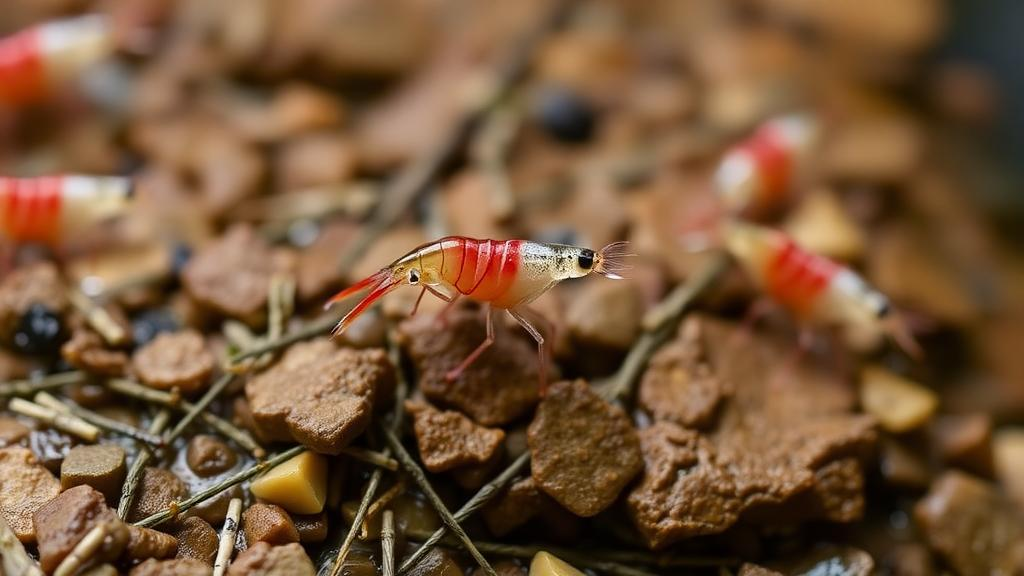
Hidden in the short, steep streams of a small coastal nature reserve on China’s Hainan Island lives a translucent, reddish-brown shrimp that no one had ever formally recorded. A two-year survey of the freshwater shrimp of Tongguling National Nature Reserve has now revealed it to be a species entirely new to science, described as Caridina tonggulinensis in the journal Zoosystematics and Evolution. The find is remarkable not only for its novelty but for its fragility: the species appears to exist nowhere on Earth except within the boundaries of a 44-square-kilometer reserve.
The survey, conducted between 2022 and 2024 across eight sampling sites in the reserve’s streams and ditches, documented three species belonging to the genus Caridina, the largest genus in the shrimp family Atyidae, which numbers more than 350 valid species worldwide. Alongside the new species, the team collected two known species, C. lanceifrons and C. elongapoda, both of which represent the first records of atyid shrimp from the reserve. For a biodiversity hotspot like Hainan, an island separated from the mainland by the Qiongzhou Strait roughly 65 million years ago, the discovery underscores how much of the island’s freshwater fauna remains unmapped.
Distinguishing one Caridina species from another is notoriously difficult, and the researchers behind the new study relied on a combination of careful anatomy and DNA barcoding. Under a stereomicroscope, C. tonggulinensis displays a short, usually unarmed rostrum, the spear-like projection at the front of the head, and slender, sub-cylindrical body. Males grow to about 3.9 millimeters in carapace length, while females reach up to 5.8 millimeters. The decisive traits lie in the fine details of the male sexual appendages: the endopod of the first pleopod is sub-oval rather than sub-triangular, and the appendix masculina and appendix interna of the second pleopod are proportionally longer than in its closest relative.
That closest relative, C. breviata, is known from Guangdong Province on the Chinese mainland. The two species share a short rostrum and similar limb proportions, but they differ in the armature of the rostrum, the shape of the male first pleopod, and the size of their eggs. The eggs of C. tonggulinensis, at 0.60 to 0.66 millimeters across and 1.00 to 1.10 millimeters long, are noticeably larger than those of C. breviata. Egg size is far more than a trivial measurement in shrimp biology; it encodes the species’ entire reproductive strategy and dispersal capacity.
Molecular evidence clinched the species’ status. The team sequenced two mitochondrial markers, partial 16S ribosomal RNA and the cytochrome c oxidase subunit I gene, trimmed to 453 and 489 base pairs respectively, and reconstructed phylogenetic trees using maximum likelihood analysis with 1,000 bootstrap replicates. Within the new species, genetic variation was vanishingly small, between 0.0 and 0.6 percent for COI, yet it diverged from C. breviata by 9.6 to 9.8 percent at that locus, a gap consistent with long-isolated, distinct lineages. The concatenated two-gene dataset placed C. tonggulinensis firmly as a separate branch, robustly supported.
Genetic distance also tells a story of isolation. The new species is landlocked, cut off from the sea within stream systems that flow westward into the Baoling River. Its large, few eggs, averaging about 30 per female, stand in stark contrast to the reproductive biology of its neighbor in the reserve, C. elongapoda, which lays hundreds of minute eggs between 0.35 and 0.40 millimeters. Those tiny eggs hatch into planktonic larvae that drift out to sea and disperse on ocean currents, which is why C. elongapoda ranges across Southeast Asia. C. tonggulinensis, by contrast, completes its whole life cycle in fresh water, a strategy that trades mobility for fidelity to a very small home.
Two years of field observation revealed a species finely tuned to a challenging hydrological rhythm. The streams it inhabits are short, 600 to 1,000 meters long, narrow and shallow, tumbling down slopes with drops of up to 170 meters. Water levels peak at around 0.8 meters during the April-to-June monsoon and fall so low in the dry season that some segments dry out entirely. The shrimp responds with a bimodal reproductive schedule, peaking from April to May, when roughly 80 percent of females carry eggs, and again from October to December, when about 60 percent do. Juveniles mature in five to six months, and over a lifespan of roughly one year, a single female can produce three to five broods.
The population itself surges and ebbs with the seasons. Numbers climb between January and April, when stable low flows and accumulated leaf litter provide abundant food for juveniles recruited the previous year. Rainy-season floods flush out organic detritus and wash away adults past their reproductive prime, and by late summer the shrinking population is confined to remnant pools. Yet the species shows a striking capacity for recovery, regenerating each year so consistently that the researchers report only minor differences in abundance between years.
Ecologically, Caridina shrimps are unsung workhorses of freshwater systems, feeding on periphyton and detritus and passing that energy upward to fish, crabs, and birds. Two of the three species documented in the reserve also matter to people. C. lanceifrons, abundant in estuaries, ponds, and rice fields from southern China to Vietnam and Thailand, forms part of the diet of the mangrove-raised saline-water ducks of Wenchang and is trapped, sun-dried, and sold in local markets. C. elongapoda, with its translucent body traced in vivid red and its graceful planktonic swimming, is a favorite of aquarium enthusiasts, who market it as the Native Red Nose Shrimp.
The contrast in conservation outlook could hardly be sharper. C. lanceifrons and C. elongapoda are both assessed as Least Concern on the IUCN Red List, thanks to their wide distributions. C. tonggulinensis, confined to just five streams within the reserve and threatened by hydrological alteration and habitat change, has been assessed only as Data Deficient, a label that reflects how little is known rather than how little danger it faces. The authors argue that the species warrants high conservation priority, together with population monitoring and deeper ecological and genetic study. The discovery is a pointed reminder that even within the borders of a protected area, on an island celebrated for its endemics, small and easily overlooked creatures can still be hiding in plain sight, and can just as easily be lost before they are ever named.
Subject of Research: Discovery and description of a new landlocked atyid shrimp species, Caridina tonggulinensis, from Tongguling National Nature Reserve, Hainan, China
Article Title: Atyid shrimps ( Decapoda , Atyidae ) from Tongguling National Nature Reserve, Hainan, China, with description of a new species
Article References: Zhang, J., Hou, J., Fan, J., Xu, Y., Chen, Q., & Guo, Z. (2026). Atyid shrimps (Decapoda, Atyidae) from Tongguling National Nature Reserve, Hainan, China, with description of a new species. Zoosystematics and Evolution, 102(1), 145-157. https://doi.org/10.3897/zse.102.179487
Image Credits: AI Generated
Keywords: Caridina, Atyidae, freshwater shrimp, Hainan Island, new species, taxonomy, Tongguling National Nature Reserve, molecular phylogenetics, COI, 16S rRNA, conservation, endemism
Cite Scienmag News
Margaret Porter. (October 19, 2026). Tiny New Shrimp Species Survives in a Single Patch of Hainan’s Streams. Scienmag. https://scienmag.com/tiny-new-shrimp-species-survives-in-a-single-patch-of-hainans-streams/
Margaret Porter. "Tiny New Shrimp Species Survives in a Single Patch of Hainan’s Streams." Scienmag, 19 October 2026, https://scienmag.com/tiny-new-shrimp-species-survives-in-a-single-patch-of-hainans-streams/. Accessed 19 October 2026.
Margaret Porter. "Tiny New Shrimp Species Survives in a Single Patch of Hainan’s Streams." Scienmag. October 19, 2026. https://scienmag.com/tiny-new-shrimp-species-survives-in-a-single-patch-of-hainans-streams/


