


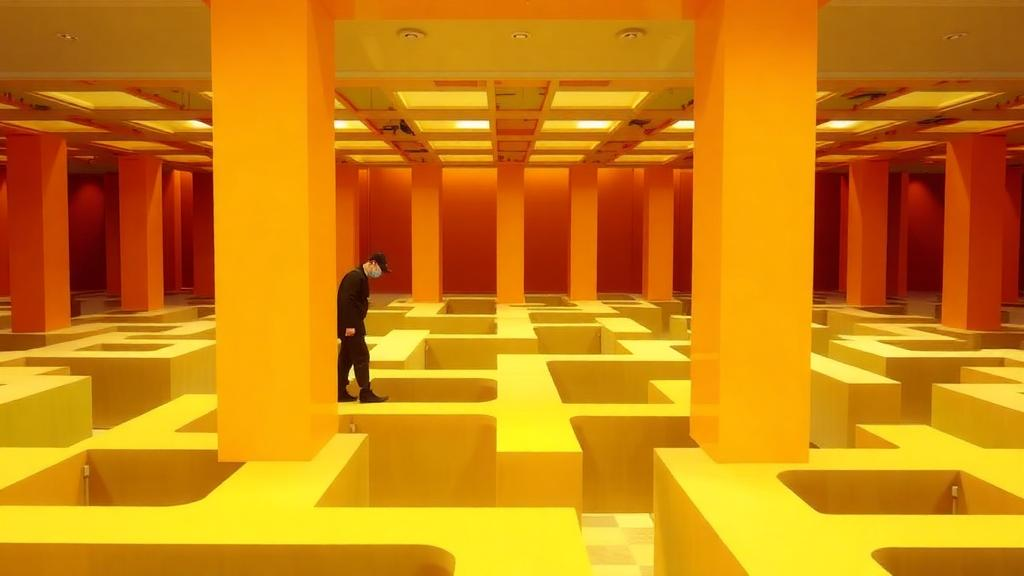
Most laboratory studies of spatial learning quietly assume something the real world rarely offers: that the environment stays put while we learn it. A supermarket does not rearrange its aisles overnight, and a city does not tear down streets between commutes. Yet in reality, buildings are renovated, routes are closed, and landmarks vanish. A new study published in Scientific Reports set out to break that assumption deliberately, asking what happens to human problem-solving when the very structure of a maze rewrites itself after every attempt.
The research team, led by Vera Tolchennikova of RUDN University in Moscow together with colleagues at Lomonosov Moscow State University and Grodno State Medical University, built two desktop virtual mazes and placed 132 participants inside them. In the stable version, the internal organization of the maze remained identical from trial to trial, so any improvement in performance could be attributed to ordinary spatial learning. In the reconfigurable version, the maze’s topology changed after every trial based on the route the participant had chosen, ensuring that no memorized map could ever serve twice.
The task itself was deceptively simple. Participants had to find and collect coins hidden in two of four chests scattered through the maze. The optimal strategy was to navigate directly to the two rewarding compartments while avoiding unnecessary detours into the others. Measuring how quickly people converged on that strategy allowed the researchers to separate two distinct components of cognition: the acquisition of the task’s rules, and the efficiency with which those rules were executed in space.
The technical vocabulary at the heart of the paper is topological instability. Topology, in this context, refers to how the parts of the maze are connected, which corridors link to which junctions, and which compartments are reachable from which entrances. Instability means those connections are not fixed. A route that worked on one trial might be severed on the next, while entirely new passages could open. This is a fundamentally different challenge from merely reshuffling visual details; it attacks the abstract relational structure that spatial memory depends on.
Both groups of participants improved significantly across trials, which the authors interpret as evidence that the task rules themselves were learnable even in a perpetually shifting world. People could still work out that coins sat in two specific chests and that certain compartments were dead ends. Rule extraction, in other words, survived the chaos. But the price of that chaos showed up clearly in the kinematics of navigation, in the raw distances walked and the time spent inside the maze.
The reconfigurable group showed slower reductions in both path length and trial duration as trials accumulated. Quantitatively, participants in the changing maze had path length reductions across trials that lagged the stable group by a factor described by an incidence rate ratio of 1.10, and their trial duration improved more slowly still, with a ratio of 1.26. When the researchers statistically controlled for path length, the duration difference shrank but remained significant at a ratio of 1.17, suggesting that instability imposes a genuine temporal cost beyond simply forcing longer routes.
That residual effect is intriguing. If unstable participants were merely walking farther, controlling for path length should have erased the duration gap entirely. The fact that it did not hints at additional cognitive overhead: moments of hesitation at junctions, re-planning after encountering a blocked passage, or the constant double-checking of a mental map that can never be trusted. Topological instability, the authors conclude, imposes a measurable cost on task-solving efficiency even when the underlying rules are understood.
Not every hypothesis survived the statistical gauntlet. The reconfigurable group also showed a trend toward slower acquisition of optimal behavior, defined as collecting both coins without ever approaching an unnecessary compartment. However, that trend did not hold up under multiple comparison correction, a safeguard against false positives when many tests are run. The researchers are appropriately cautious: with the present sample, they could not determine whether instability truly slows rule acquisition, and they call for replication with a larger number of participants before drawing firm conclusions.
The study’s broader significance may lie less in its single set of statistics than in the tool it introduces. Virtual desktop mazes are cheap, scalable, and easy to deploy, and a reconfigurable variant opens a window onto a cognitive capacity that traditional paradigms struggle to isolate: flexibility in the face of structural change. The authors suggest that, with proper adaptation, the paradigm could be applied in developmental research, in studies of aging, and in clinical populations where cognitive flexibility is impaired, from attention deficits to neurodegenerative disease.
Funded by the Russian Science Foundation, the work arrives at a moment when researchers are increasingly questioning the ecological validity of static laboratory environments. Real-world navigation is a negotiation with a world that changes, and the brain systems supporting it, from hippocampal map-making to prefrontal planning, evolved under exactly such flux. By making a maze that refuses to stay still, this experiment takes a first quantitative step toward understanding what instability costs us, and how resilient human problem-solving turns out to be when the floor keeps shifting beneath our feet.
Subject of Research: Effects of changing environmental structure on human spatial problem-solving in virtual mazes
Article Title: Effects of topological instability on spatial problem solving in a virtual desktop maze task
Article References: Tolchennikova, V., Manukyan, P., Romanova, E., Shlepnev, P., & Aleksandrovich, A. (2026). Effects of topological instability on spatial problem solving in a virtual desktop maze task. Scientific Reports. https://doi.org/10.1038/s41598-026-73754-7
Image Credits: AI Generated
DOI: 10.1038/s41598-026-73754-7
Keywords: virtual maze, spatial learning, spatial problem-solving, topological instability, cognitive flexibility, navigation, virtual reality, Scientific Reports, reconfigurable environment, human cognition, task-rule acquisition, trial duration
Cite Scienmag News
Denise Maddox. (October 19, 2026). Shifting Mazes Slow Human Problem-Solvers, Virtual Experiment Shows. Scienmag. https://scienmag.com/shifting-mazes-slow-human-problem-solvers-virtual-experiment-shows/
Denise Maddox. "Shifting Mazes Slow Human Problem-Solvers, Virtual Experiment Shows." Scienmag, 19 October 2026, https://scienmag.com/shifting-mazes-slow-human-problem-solvers-virtual-experiment-shows/. Accessed 19 October 2026.
Denise Maddox. "Shifting Mazes Slow Human Problem-Solvers, Virtual Experiment Shows." Scienmag. October 19, 2026. https://scienmag.com/shifting-mazes-slow-human-problem-solvers-virtual-experiment-shows/


