


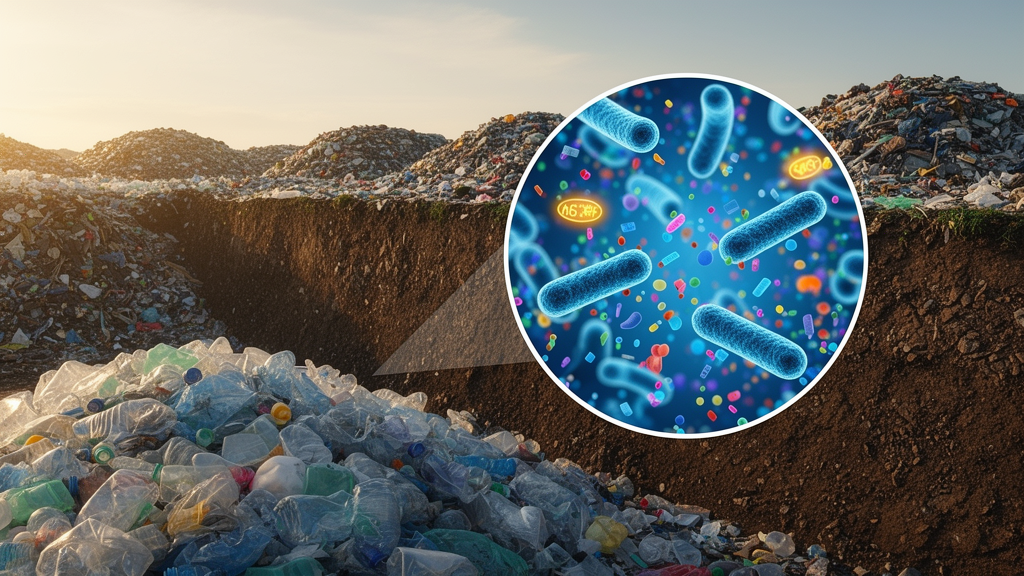
Beneath the surface of the world’s municipal landfills, an invisible and deeply unsettling partnership is forming. Microplastics, the tiny fragments shed by discarded packaging, bags, and containers, are not merely sitting inert in the waste mass. According to a comprehensive review published in Environmental Monitoring and Assessment by Peng Sun and colleagues at Zhejiang University of Technology, these particles are actively interacting with antibiotic resistance genes, creating a novel form of composite pollution that could quietly reshape how resistance spreads through the environment. The review synthesizes evidence from dozens of studies to map where these pollutants occur, how they move, and why their combination may be far more dangerous than either one alone.
The scale of the problem begins with the sheer abundance of plastic in landfill systems. The dominant polymers recovered from landfill waste and leachate are polyethylene, polypropylene, and polystyrene, the same materials that make up the bulk of consumer packaging. Crucially, the review notes that microplastic abundance and fragmentation increase with depth in landfill bodies, meaning that the deeper and older the waste, the more broken-down plastic particles it contains. Mechanical stress, chemical attack, and microbial activity all conspire to shred larger items into ever smaller fragments. As particles shrink, their surface area relative to their volume grows dramatically, and weathering introduces oxygen-containing functional groups onto their surfaces, making them more hydrophilic and more chemically reactive than the pristine plastic that entered the site.
This aging process is not a footnote; it is the engine of the problem. Fresh plastic is relatively hostile to microbial colonization, but weathered plastic is a different story. The oxidized surfaces and large specific surface areas of aged microplastics provide ideal attachment points for biofilms, dense microbial communities that researchers have dubbed the plastisphere. Within landfill leachate, a nutrient-rich and microbially crowded fluid, these biofilms can harbor not only ordinary bacteria but also pathogens and bacteria carrying antibiotic resistance genes. Studies cited in the review found that polystyrene microplastics in landfill leachate selectively enrich certain resistance genes and pathogens, and that the long-term aging of particles enhances their role as vectors for resistance genes, effectively turning plastic debris into microscopic ferries for some of medicine’s most feared genetic cargo.
The mechanism by which microplastics promote the spread of resistance centers on horizontal gene transfer, the process by which bacteria swap genetic material across species boundaries rather than passing it only to their offspring. Microplastic-associated biofilms pack diverse microbes into intimate contact on a shared surface, multiplying the opportunities for conjugation, the bacterial equivalent of mating through which plasmids carrying resistance genes move between cells. Under some experimental conditions, microplastics also promote horizontal transfer by triggering oxidative stress responses and altering bacterial membrane permeability, changes that make cells more willing to take up foreign DNA. Size matters too: research on micro- and nanoplastics shows that smaller particles can enhance the conjugative transfer of resistance genes in a size-dependent manner, with nanoplastics exerting particularly strong effects. In leachate treatment systems, the presence of microplastics has been shown to alter the migration trajectory of resistance genes, redirecting their spread through the microbial community.
Landfills are not passive containers for this activity; they are active generators and distributors of it. Leachate, the liquid that percolates through the waste mass, carries microplastics out of the landfill and into surrounding soil and water systems. Studies from sites in Iran, Indonesia, Thailand, Hong Kong, and Japan have documented microplastics in leachate and underlying soils, and informal, unlined dumps contribute plastic pollution to their immediate surroundings even more readily. Airborne transport adds another route: lichens sampled near an Italian landfill accumulated airborne microplastics, demonstrating that particles can escape the site entirely. Meanwhile, antibiotic resistance genes have been detected migrating from landfill leachate into groundwater, and bioaerosols rising from landfill surfaces carry both pathogens and resistance genes into the air around these facilities. The landfill, in short, functions as a hub from which composite pollution radiates outward through water, soil, and air.
The genetic traffic inside landfills is shaped by more than plastic alone. The review emphasizes a significant association between antibiotic resistance genes and heavy metals, which are abundant in mixed municipal waste. Heavy metals exert a selective pressure that favors microbes carrying resistance genes, and sub-inhibitory concentrations of metals have been shown to facilitate the horizontal transfer of plasmid-mediated resistance genes in water environments. Metal resistance genes can also modulate the expression of antibiotic resistance genes, and the coexistence of microplastics, resistance genes, and heavy metals triggers co-selection pressure that amplifies the composite pollution problem. Landfill age, seasonal variation, and pH all influence resistance gene abundance, with studies showing that genes are enriched as refuse ages, and that seasonal dynamics shift the microbial communities and gene profiles in leachate. Even non-antibiotic pharmaceuticals and personal care products appear capable of influencing resistance gene levels in landfill refuse, adding further layers to an already tangled web of selective forces.
Where does this pollution ultimately go? The review traces potential pathways through soil-water systems and into food webs, where composite pollutants may accumulate in organisms. Trophic transfer of microplastics has been demonstrated in estuarine food chain models, and microplastics are known to adsorb and transport other toxic pollutants, including heavy metals and additive chemicals such as phthalates and bisphenol A, which have been detected alongside microplastics in landfill leachate. Yet the authors are careful about the human health endpoint: while microplastics have been detected in human placenta, urine, and kidney tissue in separate studies, evidence directly linking landfill-derived pollutants to human tissue exposure remains limited. That caveat is important, but it is a statement about the difficulty of tracing exposure pathways, not about the absence of risk. The genes and particles are demonstrably mobile, and the reservoir they occupy is enormous.
What makes the situation particularly difficult to manage is its concealment and complexity. Composite pollution involving microplastics, resistance genes, and heavy metals resists conventional remediation, which is typically designed to handle a single contaminant class. The review also identifies systemic weaknesses in the research itself: a lack of detailed policies, standardized methodologies, and consistent research strategies currently hinders cross-study comparisons, making it hard to build a coherent global picture of the hazard. Detection methods for microplastics in complex matrices like leachate and mineralized refuse remain technically demanding, and the abundance of plastic continues to climb, with global production figures and OECD projections suggesting that plastic pollution will worsen substantially by 2040 without policy intervention. Landfills, as long-term repositories of that plastic, will keep generating microplastics and hosting microbial exchange for decades after closure.
The authors frame their synthesis as a foundation for systematic management and future risk warning, and the implications are clear. Landfills should no longer be viewed merely as engineered burial sites but as active bioreactors where plastic weathering, biofilm formation, horizontal gene transfer, and metal co-selection converge. Monitoring programs that track only conventional contaminants will miss the composite threat entirely. Effective responses will likely require coordinated measures across the plastic lifecycle, from reducing the volume of plastic entering waste streams to improving leachate treatment, controlling informal dumping, and developing standardized methods for detecting microplastics and resistance genes in environmental samples. As the review makes plain, the interaction between microplastics and antibiotic resistance genes in landfills is not a hypothetical concern for the distant future. It is a present-day, self-reinforcing process unfolding beneath our feet, and understanding its mechanisms is the first step toward containing a form of pollution that hides in plain sight.
Subject of Research: Interaction between microplastics and antibiotic resistance genes in landfill environments
Article Title: Microplastics and antibiotic resistance genes in landfills: interaction mechanisms, environmental risks, and composite pollution implications
Article References: Sun, P., Wang, X., Qiu, Y., Liu, H., Long, Y., & Fang, C. (2026). Microplastics and antibiotic resistance genes in landfills: interaction mechanisms, environmental risks, and composite pollution implications. Environmental Monitoring and Assessment, 198(9), Article 1017. https://doi.org/10.1007/s10661-026-15844-7
Image Credits: AI Generated
DOI: 10.1007/s10661-026-15844-7
Keywords: microplastics, antibiotic resistance genes, landfills, leachate, horizontal gene transfer, plastisphere, heavy metals, composite pollution, biofilms, environmental risk, plastic aging, groundwater contamination
Cite Scienmag News
Juliet Wilcox. (October 19, 2026). Landfills Emerge as Breeding Grounds Where Microplastics Supercharge Antibiotic Resistance. Scienmag. https://scienmag.com/landfills-emerge-as-breeding-grounds-where-microplastics-supercharge-antibiotic-resistance/
Juliet Wilcox. "Landfills Emerge as Breeding Grounds Where Microplastics Supercharge Antibiotic Resistance." Scienmag, 19 October 2026, https://scienmag.com/landfills-emerge-as-breeding-grounds-where-microplastics-supercharge-antibiotic-resistance/. Accessed 19 October 2026.
Juliet Wilcox. "Landfills Emerge as Breeding Grounds Where Microplastics Supercharge Antibiotic Resistance." Scienmag. October 19, 2026. https://scienmag.com/landfills-emerge-as-breeding-grounds-where-microplastics-supercharge-antibiotic-resistance/


