


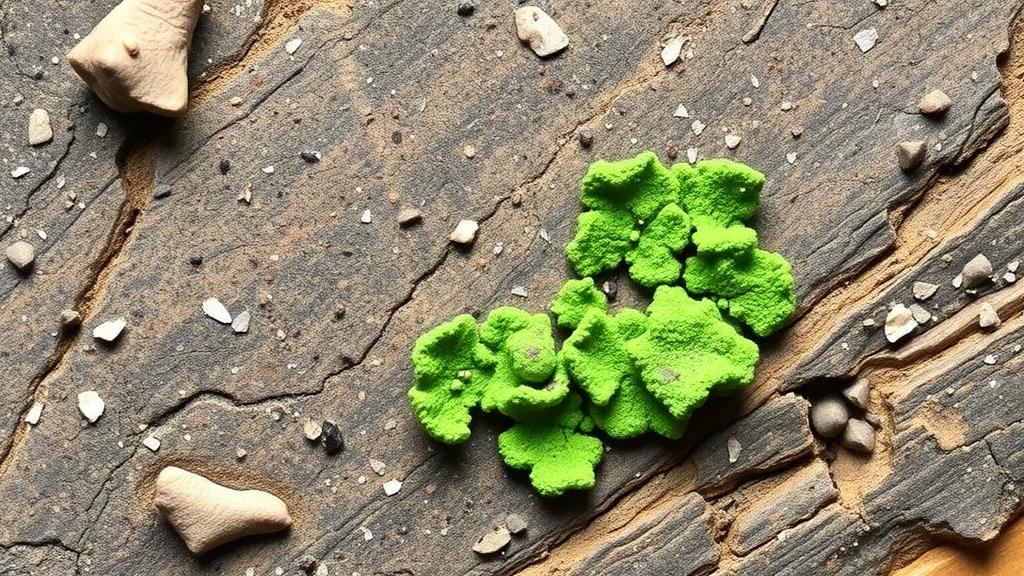
On silent stones scattered across the mountains of China, a group of barely noticeable lichens has been quietly guarding secrets of evolution. A new taxonomic study of the genus Willeya, a lineage of crustose lichen-forming fungi in the family Verrucariaceae, has uncovered two species new to science and confirmed two species recorded in China for the first time. The findings, published in MycoKeys, transform what was once a poorly documented corner of Chinese lichen diversity into one of the better understood regions for the genus worldwide, complete with the first dichotomous key covering all known Willeya species.
Willeya is not a glamorous organism at first glance. Its thallus, the body of the lichen, forms a thin crust firmly bonded to rock surfaces, ranging in color from pale gray and olive green to deep brown. But under the microscope, the genus reveals a suite of traits that set it apart. Willeya partners with green algae of the genus Diplosphaera, embeds algal cells directly inside the hymenium of its flask-shaped fruiting bodies known as perithecia, and produces muriform ascospores, meaning spores divided by both transverse and longitudinal walls, that remain hyaline to pale brownish at maturity. This last character contrasts sharply with the closely related genus Staurothele, whose spores darken to rich brown.
The genus carries an unusually tangled taxonomic history. Established in 1883 by the Swiss botanist Johannes Müller to accommodate a species with pale ascospores, Willeya was later swept into synonymy with Staurothele by most lichenologists, and for over a century it languished as an accepted name. Molecular phylogenetics changed everything. Early DNA-based studies demonstrated that the type species of Willeya was not closely related to Staurothele at all, but instead formed its own distinct lineage, sister to the genus Endocarpon. That evidence allowed Willeya to be resurrected as a legitimate genus, now recognized with 16 species distributed mostly in tropical and subtropical regions, from southeastern Asia to Australasia and North America.
Despite this global picture, China remained an open question. Only five species had ever been reported from the country, based on scattered records that lacked detailed morphological documentation and, crucially, molecular confirmation. To close this gap, researchers Xin Yi Wang and Xiang Zhao, working with colleagues, examined specimens collected from four Chinese provinces: Guizhou, Henan, Shaanxi, and Yunnan. Twelve specimens in total were subjected to careful morphological study, chemical analysis, and DNA sequencing.
The methodology combined three complementary lines of evidence. Morphological features were examined under stereo and compound microscopes, with hand-cut sections of perithecia mounted in water, potassium hydroxide, Lugol’s iodine, and lactophenol cotton blue to reveal internal anatomy. Chemical spot tests and thin-layer chromatography were used to screen for secondary metabolites. For the molecular work, DNA was extracted from three to four perithecia per specimen, and three loci were amplified and sequenced: the nuclear ribosomal internal transcribed spacer, the nuclear large subunit ribosomal RNA gene, and the mitochondrial small subunit ribosomal RNA gene. The resulting sequences were aligned, concatenated into a three-gene dataset, and analyzed using both maximum likelihood and Bayesian inference methods to reconstruct the evolutionary relationships among the specimens.
The phylogenetic tree that emerged confirmed that all sampled Willeya species form a single, well-supported monophyletic clade, with posterior probability of 1.00 and maximum likelihood bootstrap support of 100 percent. Within this framework, the two new species stood out sharply. The first, named Willeya bispora for its distinctive two-spored asci, was collected from siliceous rock near a spring on Mount Wanxian in Henan Province at an altitude of roughly 1080 meters. This species is unlike any other known Willeya, since all previously described members of the genus produce four to eight spores per ascus rather than two. It also possesses notably large muriform ascospores, measuring between 30.4 and 41.0 micrometers long.
The second new species, Willeya guizhouensis, was collected from Mount Huanggu in Guizhou Province and is characterized by a medium brown to black thallus with a greenish tinge, perithecia that form hemispherical projections above the thallus surface, a black basal layer, and eight-spored asci containing relatively small muriform ascospores. In the phylogeny, it occupies its own branch as sister to Willeya japonica, though this relationship received only weak statistical support. Morphologically, it is easily separated from that species by its projecting, mound-like perithecia and thinner thallus.
Two further species were newly recorded for China. Willeya japonica, previously known from Japan and Nepal, was found in Guizhou Province, where its morphology matches the Japanese type closely and its internal transcribed spacer sequences show 99.46 percent identity with a Nepalese specimen, confirming conspecificity. Willeya protrudens, previously documented only from Vietnam, was collected in both Guizhou and Shaanxi provinces, and the Chinese specimens form a strongly supported clade with Vietnamese material, confirming that this species ranges further north than previously understood. In addition, a new locality for Willeya iwatsukii, previously known from Japan and Yunnan, was documented in Henan Province, extending the known distribution of that species within China.
Perhaps the most intriguing result concerns Willeya pallidipora, a species originally described from Australia and later reported from Vietnam and Nepal. A specimen from Shaanxi clustered within a broad clade labeled pallidipora in the broad sense, which genetic analyses show contains at least two well-separated subgroups that cannot be reliably told apart morphologically. The authors tentatively assign the Chinese material to this species complex, noting that the specimen may represent a distinct cryptic lineage, but that stable diagnostic characters are currently lacking. Resolving this puzzle will require denser sampling, additional gene regions, and comparison with type material across the complex, illustrating how much hidden diversity may still be buried beneath the name of a single species.
Beyond the four headline discoveries, the study also reviewed all Willeya species previously reported from China, including Willeya honghensis from Yunnan and Nepal, Willeya microlepis known only from its 1914 type locality, and Willeya tetraspora, which was described from limestone imported from China to a Dutch botanical garden and has yet to be collected in the wild here. The authors supplemented their findings with a dichotomous key to all 18 recognized species worldwide, providing a practical identification tool for future researchers. By pairing molecular phylogenetics with meticulous anatomical observation and chemistry, the work demonstrates how a genus once treated as a taxonomic afterthought can, when examined properly, reshape our understanding of lichen diversity across an entire continent, and it signals that many more species likely await discovery on China’s damp, shadowed rock faces.
Subject of Research: Phylogenetic and taxonomic revision of the lichen genus Willeya in China
Article Title: Phylogeny and taxonomy of Willeya ( Verrucariales , Verrucariaceae ), including two new species and two newly recorded species from China
Article References: Wang, X., Wang, Y., Leavitt, S. D., Zhu, W., & Zhao, X. (2026). Phylogeny and taxonomy of Willeya (Verrucariales, Verrucariaceae), including two new species and two newly recorded species from China. MycoKeys, 137, 21-42. https://doi.org/10.3897/mycokeys.137.197566
Image Credits: AI Generated
DOI: 10.3897/mycokeys.137.197566
Keywords: Willeya, Verrucariaceae, lichen-forming fungi, China, new species, phylogenetics, taxonomy, ascospores, biodiversity, mycology, crustose lichens, dichotomous key
Cite Scienmag News
Roger Howard. (October 19, 2026). Hidden Rock Lichens Reveal Two New Species and Fresh Records in China. Scienmag. https://scienmag.com/hidden-rock-lichens-reveal-two-new-species-and-fresh-records-in-china/
Roger Howard. "Hidden Rock Lichens Reveal Two New Species and Fresh Records in China." Scienmag, 19 October 2026, https://scienmag.com/hidden-rock-lichens-reveal-two-new-species-and-fresh-records-in-china/. Accessed 19 October 2026.
Roger Howard. "Hidden Rock Lichens Reveal Two New Species and Fresh Records in China." Scienmag. October 19, 2026. https://scienmag.com/hidden-rock-lichens-reveal-two-new-species-and-fresh-records-in-china/


