


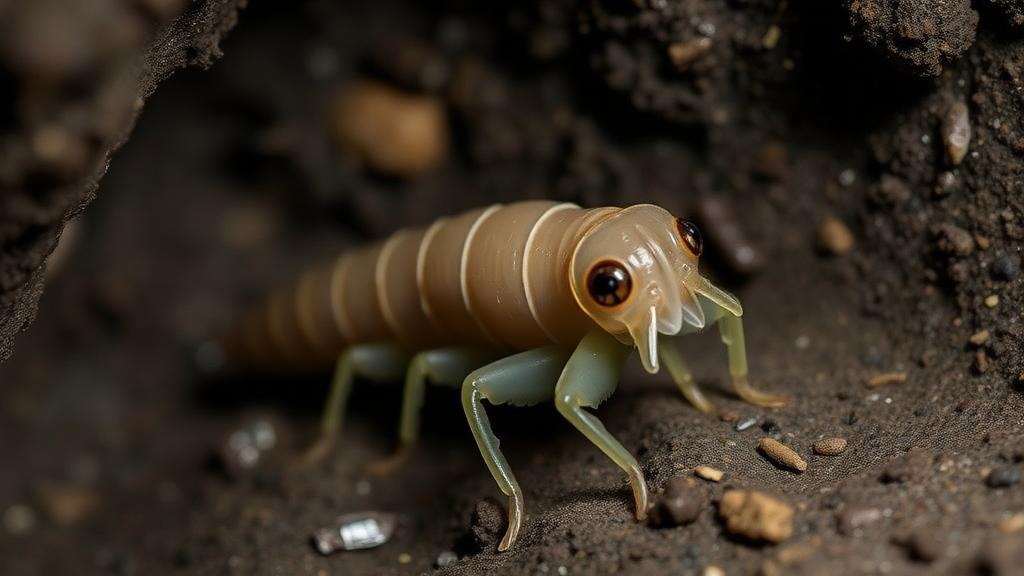
Deep inside limestone caves in the semiarid backlands of Bahia state, northeastern Brazil, researchers have identified three previously unknown species of amphibious, cave-restricted isopods belonging to the genus Xangoniscus. The tiny crustaceans, described in the journal Subterranean Biology, were found in caves that enjoy no legal protection, and the authors argue that the act of formally naming them is itself a conservation tool for Brazil’s speleological heritage. The new species, Xangoniscus antiquus, Xangoniscus chaimowiczi, and Xangoniscus jonasi, bring the genus to 13 known troglobitic species, all of them confined to limestone caves of the Bambui Geomorphological Group in the states of Bahia and Minas Gerais.
Terrestrial isopods, the suborder Oniscidea, are among the most diverse groups within the order Isopoda, comprising more than 4,000 species across 38 or 39 families and more than 500 genera. These woodlice-like crustaceans have colonized an extraordinary range of terrestrial habitats, from tropical forests to deserts and from the supralittoral zone to mountain forests. A significant number of species also inhabit caves, where from an ecological and evolutionary perspective they fall into two categories: troglophilous species, which are facultative cave dwellers, and troglobitic species, which are restricted to cave habitats and typically show classic signs of subterranean adaptation such as reduced pigmentation and the loss of eyes. All three of the newly described species are colourless and eyeless, hallmarks of a life evolved in perpetual darkness.
Brazil stands out as a global hotspot for cave-dwelling isopods. More than 50 percent of the country’s terrestrial isopod species are found in caves, and to date over 230 species have been identified, of which more than 40 are considered troglobitic. These belong to the families Armadillidae, Philosciidae, Pudeoniscidae, Scleropactidae, and Styloniscidae. Within the Styloniscidae, a family of 128 species in 17 genera distributed across a wide range of terrestrial environments, nine genera have been recorded in Brazil, representing over half of the global generic diversity of the family. The genus Xangoniscus, erected in 2014 to accommodate the troglobitic amphibious species X. aganju from Gruna do Mandiaçu cave in Bahia, has since become one of the most species-rich styloniscid lineages in the country, and the new descriptions make it the second most species-rich genus of Styloniscidae in Brazil.
The specimens came from three limestone caves in southwestern Bahia, in the transition zone between the Caatinga and Cerrado biomes, an area characterized by a dry tropical climate with average annual rainfall of up to 640 millimeters. The Gruna da Serra Solta cave lies in the Serra do Ramalho karst area, which is considered a hotspot of subterranean biodiversity but has no legal protection zones; the systems there are threatened by deforestation for crops, wood extraction, and potential mining projects. Farther north, Gruta do Padre, located between the municipalities of Santana and Santa Maria da Vitória, is one of the largest caves in Brazil at 16.4 kilometers, with two known entrances and a characteristically dry environment. Gruta da Represa lies nearby in the same karst terrain.
Specimens were collected by hand and stored in 75 percent ethanol, and identifications were based on morphological characteristics using micropreparations in Hoyer’s medium. The researchers documented each species with stereomicroscope photography and camera-lucida illustrations prepared using established digital methods. Type material is deposited in the Collection of the Laboratório de Estudos Subterrâneos at the Universidade Federal de São Carlos and in the Museu de Zoologia of the Universidade de São Paulo. Because the taxonomy of Xangoniscus rests on fine anatomical detail, the descriptions are unusually technical, and the male reproductive and locomotory appendages provide the decisive characters separating species.
Xangoniscus chaimowiczi, from Gruta do Padre, reaches a maximum body length of 10.2 millimeters in males and 6.5 millimeters in females. It differs from all other species of the genus in having an antennula bearing twelve long aesthetascs, the sensory structures at the tip of the small first antenna, compared with two in X. aganju, X. lapaensis, and X. odara, three in X. ibiracatuensis, X. lundi, and X. santinhoi, four in X. dagua, four or five in X. ceci, five in X. loboi, and six in X. itacarambiensis. Additional unique traits include a tiny lobe on the proximal margin of the carpus of the fifth walking leg, an enlarged sixth pereopod carpus, and a longitudinal furrow on the sixth pereopod propodus. The species was named after Dr. Flavio Chaimowicz, who collected the specimens in July 1987 and made important contributions to Brazilian speleology. In life, the animals inhabit the river sediments within the cave’s conducto das plaquetas and also live in travertine ponds, a behavior documented in several other Xangoniscus species.
Xangoniscus jonasi, from Gruna da Serra Solta, is known from a single male specimen measuring 6.5 millimeters, captured in the cave’s aphotic zone on very wet, muddy substrate beneath cracks formed by the stream current, just a few meters from a pond. Its antennula carries eight very long aesthetascs, and its male pleopod 1 basipod has a semicircular distal apex longer than the exopod, distinguishing it from every other species in the genus. The etymology is a nod to popular culture: the species is named after Jonas Kahnwald, the protagonist of the series Dark, who explores caves to travel through time and space. The authors explain that the epithet honors the isolation and sense of separation from time and space that caves represent, evoking the central theme of the show, and reflects the species’ extreme adaptation to dark depths, just as Jonas adapts to the complexities and paradoxes of time.
Xangoniscus antiquus, from Gruta da Represa, is based on material collected in February 1986 by A. Auler, and the authors suggest it may represent the first specimens of Xangoniscus ever collected in Brazil. The Latin name antiquus, meaning old, refers to the long period the samples remained preserved before their description. The species, with a maximum male body length of 7.8 millimeters, resembles X. chaimowiczi in the modifications of the male pereopods and the number of articles in the antennal flagellum, but differs in having eight rather than twelve aesthetascs on the antennula, an almost straight rather than rounded telson apex, and a semicircular rather than acute distal margin on the pleopod 1 basipod. Its specific microhabitat within Gruta da Represa remains unknown, and the authors note that further research into these subterranean environments is needed to understand the ecology and habits of the species living there.
The new descriptions also prompted a redefinition of the genus itself. The diagnostic characters originally proposed for Xangoniscus, including well-developed epimera on pleonites 3 to 5, long apical aesthetascs on the antennule, a three-article antennal flagellum, and a male pleopod 1 exopod shorter than the endopod, do not hold across the now 13 species. The authors therefore modified the genus diagnosis: the pleonite epimera may be well developed or short with small posterior points directed backward, the antennule may bear long or short apical aesthetascs, the antennal flagellum may comprise three to six articles, and the male pleopod 1 exopod may be longer or shorter than the endopod. Two features remain definable as synapomorphies of the genus: a cephalon with a transversal groove on the vertex along the frontal margin, and the complex apex of the male pleopod 2 endopod. The shape and size of the distal margin of the male pleopod 1 basipodite is additionally taxonomically important for differentiating some species.
Conservation concerns run through the entire study. Species of Xangoniscus live in travertine pools and streams formed by infiltrating water, in microhabitats of rocky substrates, silty sediment, sand, and decomposing plant material, making them vulnerable to any alteration of the cave water regime. Of the 13 known species, only five, X. dagua, X. itacarambiensis, X. lundi, X. odara, and X. santinhoi, occur in national conservation units in Minas Gerais, and even these are threatened by uncontrolled tourism and expanding agriculture. In Bahia, there are no conservation areas dedicated to the protection and management of speleological resources in the caves studied. Water extraction, documented at Gruna da Serra Solta where hoses are used to draw water from inside the cave, could negatively affect populations of amphibious species. Gruta do Padre, by contrast, retains a good conservation status; since the Tatus II project of 1987, when a group of speleologists stayed inside for 21 days, the cave has been only sporadically visited and its resources remain unexploited. With the description of X. chaimowiczi, the number of troglobitic species known from Gruta do Padre rises to six. The authors argue that areas such as Serra do Ramalho should be prioritized for proposals to create new legally protected areas, and that caves with water or tributaries of the São Francisco River basin within the Bambui group hold high potential for further discoveries, pending increased sampling and macroecological and molecular studies that could reveal cryptic diversity within widespread species such as X. aganju.
Subject of Research: Three new troglobitic amphibious isopod species of the genus Xangoniscus described from unprotected limestone caves in Bahia, northeastern Brazil.
Article Title: Describing to preserve – three new species of Xangoniscus ( Oniscidea , Styloniscidae ) of unprotected caves in dry areas from Bahia state, northeastern Brazil
Article References: López-Orozco, C. M., Borja-Arrieta, R., Carpio-Díaz, Y. M., Gallão, J. E., Campos-Filho, I. S., & Bichuette, M. E. (2024). Describing to preserve – three new species of Xangoniscus (Oniscidea, Styloniscidae) of unprotected caves in dry areas from Bahia state, northeastern Brazil. Subterranean Biology, 50, 79-104. https://doi.org/10.3897/subtbiol.50.139914
Image Credits: AI Generated
DOI: 10.3897/subtbiol.50.139914
Keywords: Xangoniscus, terrestrial isopods, Oniscidea, Styloniscidae, troglobitic species, cave biodiversity, Bambui Group, Bahia, semiarid caves, speleology, new species, Brazil conservation
Cite Scienmag News
Margaret Porter. (October 19, 2026). Three new blind cave isopod species discovered in unprotected Brazilian caves. Scienmag. https://scienmag.com/three-new-blind-cave-isopod-species-discovered-in-unprotected-brazilian-caves/
Margaret Porter. "Three new blind cave isopod species discovered in unprotected Brazilian caves." Scienmag, 19 October 2026, https://scienmag.com/three-new-blind-cave-isopod-species-discovered-in-unprotected-brazilian-caves/. Accessed 19 October 2026.
Margaret Porter. "Three new blind cave isopod species discovered in unprotected Brazilian caves." Scienmag. October 19, 2026. https://scienmag.com/three-new-blind-cave-isopod-species-discovered-in-unprotected-brazilian-caves/


