


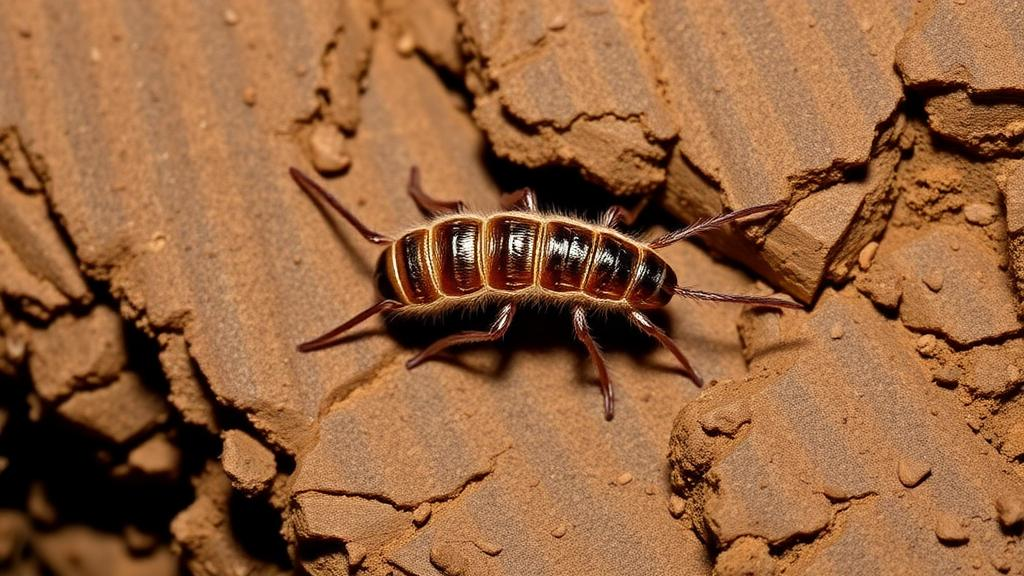
Deep in a limestone quarry in eastern Georgia, scientists have confirmed the presence of a woodlouse species never before recorded in the country, a discovery that quietly rewrites the map of terrestrial isopod diversity in the Caucasus. The species, Chaetophiloscia hastata, was found at the Saskhori limestone quarry in Mtskheta municipality, and the finding, published in the journal Caucasiana, marks the first confirmed record of both the genus Chaetophiloscia and the species for the Georgian fauna. For a region whose small crustacean fauna remains surprisingly underexplored, the confirmation carries weight far beyond its modest subject: it fills a conspicuous gap in the distribution of a species that stretches from Italy to Iran, and it suggests that Georgia’s invertebrate inventory is far from complete.
Woodlice, or terrestrial isopods, belong to the suborder Oniscidea, a group of crustaceans that made the remarkable evolutionary transition from the sea to dry land. Despite their ubiquity under stones and logs across Europe and Asia, the Caucasus isopod fauna is poorly investigated. Before this discovery, only 35 species of Oniscidea in 19 genera and 8 families had been recorded from Georgia, based on decades of scattered literature. Remarkably, no species of the family Philosciidae, one of the larger woodlouse families, had ever been documented in the country at all. The Saskhori specimens therefore do not merely add a species; they add an entire family to the national checklist, a taxonomic milestone for Georgian zoology.
The specimens were collected during an investigation of soil biodiversity at the Saskhori quarry, a project supported by the Quarry Life Award program of HeidelbergCement Georgia and carried out with the participation of local school pupils. Researchers deployed pitfall traps containing formalin at several points across the quarry, which sits at roughly 655 meters above sea level. The traps yielded three specimens of C. hastata: one male captured on 13 April 2022 at trap N4, and a male and female taken on 13 May 2022 at trap N1. The material is deposited in the collections of the Institute of Zoology at Ilia State University in Tbilisi and the Museum of Natural History Zoology Section La Specola of the University of Florence in Italy, ensuring that the record can be verified by future researchers.
Identification followed the classic descriptive literature on the genus, drawing on the works of Verhoeff, Radu, Dalens, Schmalfuss, and Giurginca and Vănoaica. To make the determination as transparent as possible, the authors illustrated the species in full detail, using a camera lucida mounted on Wild M5 and Wild M20 microscopes. The resulting figures, digitally refined with Microsoft PowerPoint 2013, IrfanView, and Adobe Photoshop CS6, document every diagnostic structure from the head to the tail, providing a complete visual reference intended to facilitate identification by anyone working with the genus.
So what does Chaetophiloscia hastata actually look like under the microscope, and why did the authors go to such lengths to illustrate it? The species carries a suite of characters that, taken together, distinguish it from all other members of a genus comprising, with certainty, 17 species distributed mainly around the Mediterranean and Black Sea. The most striking features are found in the males. The carpus, the segment of the first walking leg, or pereopod 1, is conspicuously enlarged, and to a lesser extent so is that of pereopod 2. The male pleopod 2 endopod, one of the paired swimming-like appendages on the rear of the body, is extremely elongated, and the male pleopod 5 exopod is elongated to the point that it surpasses the telson, the terminal segment of the body. These exaggerated structures are so distinctive that they might, on their own, suggest placing the species in a separate genus.
Yet the authors conclude that all other characters align with the genus Chaetophiloscia as defined by its type species, Chaetophiloscia elongata. Among these confirming traits are the position of the noduli laterales, small sensory organs on the body whose d/c coordinates reach a maximum on pereonite 4; a head, or cephalon, bearing a suprantennal line but no frontal line; a pleon, the rear body region, that is narrower than the pereon with reduced epimera; mandibles with a dichotomized molar penicil; a maxillula whose inner set of teeth is apically cleft; and a maxilliped whose endite lacks a penicil. The full illustration set, covering the dorsal and lateral views, the mouthparts, the walking legs, the genital papilla, and all five pleopods, was designed to allow direct comparison with every other species in the genus, a resource the authors deemed necessary even for a species already well characterized in the literature.
The taxonomic history of the species adds a technical wrinkle. Verhoeff first cited C. hastata in 1928 to distinguish it from C. elongata, providing the enlarged male pereopod 1 and 2 carpus, the extreme elongation of the male pleopod 5 exopod surpassing the telson, illustrations of the male pleopod 1 endopod and the male pereopod 7 merus. Since these data unequivocally distinguish the species from all others in the genus, the authors confirm that Verhoeff, 1928, rather than the fuller 1929 description based on specimens from Euxinograd, Bulgaria, should be considered the authorship of the species. Earlier citations of the species as C. elongata by Arcangeli in 1923 and 1926 reflect the confusion that preceded its formal separation.
The known distribution of C. hastata reads like a tour of the Mediterranean and Black Sea basins. The species has been recorded from Slovenia’s Istria, from multiple Italian regions including Veneto, Marche, Latium, Emilia Romagna, and Tuscany, from San Marino, Croatia’s Cres island, Bulgaria, Romania, Cyprus, Libya’s Cyrenaica, Egypt, Greece, Turkey, Azerbaijan, Russia’s Caucasus and Black Sea coast, Iraq, and Iran. A record from Palestine cited by Vandel and Strouhal is considered doubtful according to Schmalfuss. Within the Caucasus specifically, the species was previously known only from Azerbaijan and from southern Russia, including the Abrau Peninsula and Sochi. The Saskhori quarry now plugs Georgia into this chain, confirming the species’ presence in a country that sits squarely between its Azerbaijani and Russian outposts.
An intriguing footnote concerns the Black Sea coast. On 8 April 2022, a record of C. hastata appeared on the iNaturalist website from the Batumi area of Georgia, based on photographs. The authors treat that record as doubtful, because the main characters needed to identify the species, the male appendages documented in their figures, cannot be seen in photos. Still, given the high similarity of the photographed specimens to C. hastata, the authors believe the species may also occur along Georgia’s Black Sea coast and may be more widespread throughout the country than the single quarry record suggests. The pitfall-trap method, which samples ground-active arthropods as they wander, is well suited to detecting such cryptic surface dwellers, and continued sampling in other Georgian habitats could soon extend the range map further.
The genus Chaetophiloscia itself remains a mostly Mediterranean affair, with only a few species introduced elsewhere: C. sicula has turned up in the United States and in greenhouses in England. Five other species presently assigned to the genus, from Brazil, Costa Rica, Panama, Australia, the Azores, and Tadjikistan, certainly do not belong to it and await re-examination for placement in the correct genera. Against this backdrop, the Georgian record stands as a reminder that even well-studied groups in well-traveled regions can still surprise. A quarry worked by cement producers, monitored with the help of school pupils and simple pitfall traps, has delivered the first member of a whole woodlouse family to Georgian science, and it hints that the full inventory of Caucasian terrestrial isopods, currently a mere 35 species, is only the beginning of what the region’s forests, coastlines, and quarries have yet to yield.
,
Subject of Research: New record of Chaetophiloscia hastata Verhoeff, 1928 for Georgia (Isopoda, Oniscidea, Philosciidae)
Article Title: New record of Chaetophiloscia hastata Verhoeff, 1928 for Georgia ( Isopoda , Oniscidea , Philosciidae )
Article References: Shavadze, L., Barjadze, S., & Taiti, S. (2023). New record of Chaetophiloscia hastata Verhoeff, 1928 for Georgia (Isopoda, Oniscidea, Philosciidae). Caucasiana, 2, 1-7. https://doi.org/10.3897/caucasiana.2.e98241
Image Credits: AI Generated
DOI: 10.3897/caucasiana.2.e98241
Keywords: record, Chaetophiloscia, hastata, Verhoeff, Georgia, Isopoda, Oniscidea, Philosciidae, scientific research
Cite Scienmag News
Gavin Prescott. (October 19, 2026). Limestone Quarry Discovery Reveals Woodlouse Species New to Georgia. Scienmag. https://scienmag.com/limestone-quarry-discovery-reveals-woodlouse-species-new-to-georgia/
Gavin Prescott. "Limestone Quarry Discovery Reveals Woodlouse Species New to Georgia." Scienmag, 19 October 2026, https://scienmag.com/limestone-quarry-discovery-reveals-woodlouse-species-new-to-georgia/. Accessed 19 October 2026.
Gavin Prescott. "Limestone Quarry Discovery Reveals Woodlouse Species New to Georgia." Scienmag. October 19, 2026. https://scienmag.com/limestone-quarry-discovery-reveals-woodlouse-species-new-to-georgia/


