


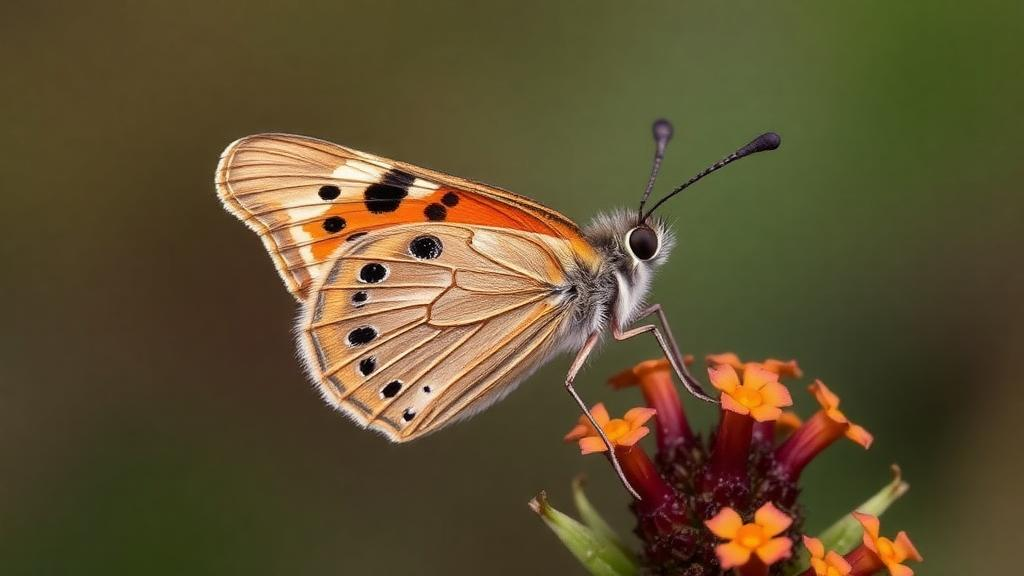
The Brown Hairstreak butterfly, Thecla betulae, is one of the least observed butterflies in the entire Palaearctic region, despite a distribution that stretches from Portugal in the west to Russia and Korea in the far east. Adults spend their lives almost exclusively at canopy level, feeding on tree sap, aphid secretions and dew rather than descending to flowers, which means that even experienced lepidopterists have seen the imago only a handful of times. A new integrative review published in Nota Lepidopterologica has now pulled together every strand of evidence on the species in the Iberian Peninsula, combining a full literature review, new fieldwork in Portugal, citizen-science databases and a species-distribution model to produce the most complete picture yet of this elusive woodland butterfly at the south-western edge of its range.
Before 1999, when the species was recorded for the first time in Portugal, the Iberian distribution of Thecla betulae was considered to be limited to the temperate Euro-Siberian northern third of Spain. The first Portuguese record was itself a deceased adult, found at Serra da Lousã, a location far from the nearest known localities in Galicia at the time, and a live adult was not observed in the country until 2011. This late addition to the national species list is a direct reflection of the butterfly’s arboreal lifestyle. Because adults are so seldom seen, the species is overwhelmingly monitored through the detection of its bright white overwintering eggs on the dark bark of blackthorn and related food plants during winter, when the deciduous hosts have shed their leaves and the eggs contrast sharply with the bare branches.
The caterpillars of Thecla betulae are moderately polyphagous and feed on a variety of rosaceous shrubs and trees in the genus Prunus, especially blackthorn, Prunus spinosa, but also plum, Prunus domestica, its wild relative Prunus insititia, and other allied species in the subfamily Amygdaloideae. The species is univoltine, with adults on the wing from July to October in one extended generation. Eggs are laid most often at the base of lateral shoots of the food plant, positioned between half a metre and two metres above ground, and overwintering happens in the egg stage. In early spring, right after the mass flowering of the host plant, young caterpillars emerge synchronously with the first leaves and feed on their underside until pupation by May or June, accomplished either at ground level in the leaf litter or on nearby branches.
The research team reviewed the literature from 2002 to 2021, since the publication of the first comprehensive Iberian butterfly atlas, which had mapped the species in 122 landscape-scale quadrats of 10 by 10 kilometres. They complemented this with opportunistic field surveys in Portugal from 2004 to 2021, searching for adults in summer and eggs later in the year, and with records from online databases such as GBIF and iNaturalist, which added a further 16 quadrats not covered by any other source. All point coordinates and area data were standardised to 10 by 10 kilometre UTM quadrats, producing an up-to-date distribution map built from a total of 442 occurrence points for the peninsula.
The resulting map reveals an almost continuous distribution across the northern third of Iberia, from the pre-Pyrenean area and coastal ranges of Catalonia in the east, through the Pyrenees and Cantabrian ranges, westwards to the Galician and Leonese ranges, and widespread in Galicia up to the coast and into northern Portugal. Further south, populations are mostly mountain-bound, clustering in the Central Iberian Mountain System from Serra da Lousã to Serra da Estrela, in Serra da Malcata, Sierra de Gata, Candelario and Sierra de Gredos. Notably, no records yet exist eastwards in the Sierra de Guadarrama or Segovia province that would connect these southern pockets to the main northern distribution area through Spain, a gap that popular generalist European sources have long failed to bridge, often not extending the species beyond the Pyrenees and the Cantabrian belt at all.
In Portugal alone, the fieldwork confirmed the species at 19 new sites, an increase of about 428 percent in known Portuguese localities, bringing the total to roughly 31 sites of occurrence. These records cluster in three to four areas: the Portuguese part of the Central Mountain System in the ranges of Serra da Lousã, Serra do Açor, Serra da Estrela and Serra da Malcata; the environs of Bragança around Serra de Montesinho and Serra da Nogueira; and a newly discovered, more fragmented cluster from the northern border with Ourense near Boticas and Montalegre southwards to Serra do Alvão near Vila Real. The species was also found in Serra da Peneda, although whether these populations are in contact with the others remains to be confirmed.
To help target future searches, the team built a species-distribution model using maximum entropy analysis implemented in MAXENT, contrasting the 442 occurrence points against 19 current bioclimatic variables from the WORLDCLIM database. The model achieved an AUC of 0.977, well above the 0.7 usually desired in such studies, meaning the known occupation of the territory is very well explained by the variables used. Four variables framed the distribution especially well: temperature seasonality, the mean temperature of the driest quarter, the temperature annual range and annual precipitation. In essence, Thecla betulae is positively affected by relatively stable temperatures over the year, summers that are not too hot, and relatively high annual precipitation for Iberian conditions, confirming that a temperate climate is essential for the species’ presence in a peninsula with a predominantly Mediterranean climate.
The model highlights several areas as highly climatically suitable but still under-sampled or poorly known, including the extreme north of Aragon, the northern half of Burgos and Palencia provinces, most of Cantabria, western Zamora, the north-east of Trás-os-Montes in Portugal, and the northern slopes of Sierra de Guadarrama, from which no records are yet known. The mountain ranges of all northern and central Portugal appear suitable, possibly extending southwards to the Gardunha range or even the Serra de Aire area. The authors expect that these projections will help naturalists and researchers plan future fieldwork in both Spain and Portugal to complete the Iberian distribution map of the species.
One of the most intriguing outcomes of the fieldwork was the detection of eggs on almond trees, Prunus dulcis, a food plant hitherto unknown for Thecla betulae anywhere in its range. The observation comes from the south-western part of Serra da Estrela, under a thermophilic situation that allows young almond trees to grow, a condition not usually met at the butterfly’s other potential sites. This discovery broadens the ecological spectrum of the species towards a more Mediterranean environment, and the finding that the flight period in Portugal can start as early as late May, earlier than expected elsewhere in Europe, further supports this broadening of the niche and shows how novel life-history traits may still turn up in a relatively well-known butterfly.
The study also sounds a note of conservation concern. As more records surface, Portuguese populations seem to face an increasing risk from the spread of Eucalyptus globulus monocultures and the invasion of semi-natural habitats by alien Acacia trees, which is rampant in central Portugal. These changes bring an elevated fire risk, and the massive wildfires of 2017 burnt a large part of central Portugal, affecting known sites for the butterfly. Following the fires, new management rules oblige landowners to clear vegetation around houses and along roads, removing the marginal vegetation such as blackthorn where the species survives. For a butterfly already near its southern bioclimatic threshold in Europe, these pressures should be accounted for in any conservation status evaluation. The new baseline of knowledge set by this review should foster further studies and a better understanding of other elusive, underrecorded species that share its temperate woodland refuges.
Subject of Research: Ecology
Article Title: A review of the distribution and ecology of the elusive Brown Hairstreak butterfly Thecla betulae ( Lepidoptera , Lycaenidae ) in the Iberian Peninsula
Article References: Marabuto, E., Pires, P., Romão, F., Lemos, P., & Merckx, T. (2022). A review of the distribution and ecology of the elusive Brown Hairstreak butterfly Thecla betulae (Lepidoptera, Lycaenidae) in the Iberian Peninsula. Nota Lepidopterologica, 45, 101-118. https://doi.org/10.3897/nl.45.76222
Image Credits: AI Generated
DOI: 10.3897/nl.45.76222
Keywords: Brown Hairstreak, Thecla betulae, butterflies, Iberian Peninsula, species distribution modelling, Portugal, Spain, conservation, review, distribution, ecology, elusive
Cite Scienmag News
Gavin Prescott. (October 19, 2026). Brown Hairstreak butterfly reveals hidden Iberian strongholds through egg surveys and climate modelling. Scienmag. https://scienmag.com/brown-hairstreak-butterfly-reveals-hidden-iberian-strongholds-through-egg-surveys-and-climate-modelling/
Gavin Prescott. "Brown Hairstreak butterfly reveals hidden Iberian strongholds through egg surveys and climate modelling." Scienmag, 19 October 2026, https://scienmag.com/brown-hairstreak-butterfly-reveals-hidden-iberian-strongholds-through-egg-surveys-and-climate-modelling/. Accessed 19 October 2026.
Gavin Prescott. "Brown Hairstreak butterfly reveals hidden Iberian strongholds through egg surveys and climate modelling." Scienmag. October 19, 2026. https://scienmag.com/brown-hairstreak-butterfly-reveals-hidden-iberian-strongholds-through-egg-surveys-and-climate-modelling/


