


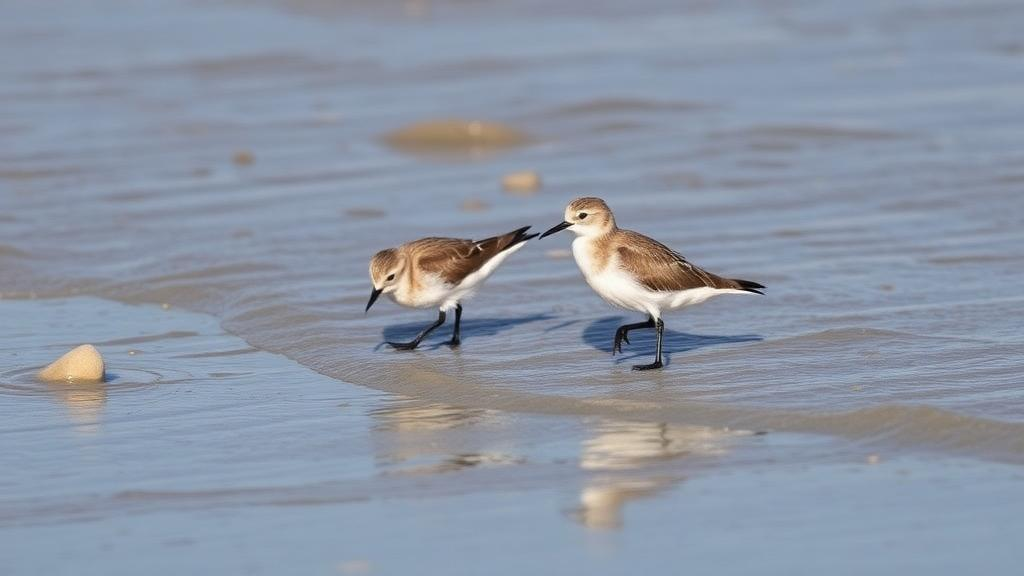
On a rocky stretch of the Peruvian coast, wedged between a busy promenade and the Pacific Ocean, a small migratory shorebird is teaching scientists a lesson in how urban habitats can still sustain long-distance travellers. The sanderling, Calidris alba, is a boreal-breeding sandpiper best known to beachgoers as the pale bird that dashes back and forth with the waves. A new study conducted at the Coastal Wetland Poza La Arenilla in La Punta, Callao, has now documented in fine detail how the frequency and duration of sanderling behaviour shift across different habitats and tidal stages, revealing that the humble mid-tide may be the most important moment of the bird’s day.
The research, published in Neotropical Biology and Conservation, set out to answer two deceptively simple questions: do sanderling behaviour patterns change with tide level and habitat, and are the frequency and duration of those behaviours correlated with one another? To find out, the team built on an earlier ethogram of the species, a catalogue of 58 distinct types of behaviour grouped into eight categories, ranging from pecking and running to resting and long-range flight. Observations were carried out over 12 days in August and September 2019, coinciding with the period when sanderlings arrive at the wetland as part of their annual migratory cycle, and totalled 670 effective minutes of observation, or 40,200 seconds of recorded activity.
The setting itself is remarkable. Poza La Arenilla was not designed as a nature reserve; it came into existence accidentally between 1965 and 1967, when two rocky barriers were built to shield the southern district of La Punta from abnormal sea surges. Strong surges later filled a 50-metre-wide inlet between the barriers, creating Isla de Guilligan and enclosing an area of calm, semi-stagnant water that is now recognised as one of the three most significant wetlands in Callao. Today the site supports 98 bird species and serves as a mandatory stopover for migratory birds, all within arm’s reach of an urban environment separated only by a promenade used for tourism and birdwatching.
Within the wetland, the researchers focused on three habitats that sanderlings use most intensively for feeding and resting: the Cobbles from Boulder Zone, an area of relatively shallow water among rocks, and two sand shores, Sand Shore 1 and Sand Shore 2. The two sand shores differ in their hydrology: Sand Shore 1 receives water flows directly from the western inlet, while Sand Shore 2 borders a lentic water body fed by the eastern inlet that experiences lower water flow. Sampling was conducted during low, mid and high tide using the focal animal technique, in which a single randomly selected individual is tracked and its behaviours recorded. Each focal subject was filmed for ten minutes, and when an individual left the area mid-sample, the observer immediately shifted to another bird without interrupting the timeframe.
The statistical treatment of the resulting data was deliberately multi-layered. A Kruskal-Wallis test, a non-parametric method suited to data that do not meet the assumptions of normality, was used to test for overall differences in behaviour frequency and duration among habitats and tides. The team then applied the Bray-Curtis similarity index, a quantitative measure widely used in ecology to compare the composition of samples, to identify which habitat-tide combinations shared the most behaviour types. To gauge behavioural diversity, they calculated the equivalent number of behaviour types based on the Shannon-Wiener entropy index, a metric that converts the evenness and richness of observations into an intuitive count of effectively equally common behaviours. Finally, Spearman correlation analysis tested the relationship between how often each behaviour occurred and how long it lasted.
The results were striking. The Kruskal-Wallis test revealed highly significant overall differences in both the frequency and duration of behaviour between habitats across tidal conditions, with P values below 0.0001 in both cases. The Bray-Curtis analysis uncovered clusters of similarity exceeding 50 percent: for behaviour frequency, Sand Shore 1 at mid-tide matched Sand Shore 2 at high tide with 80 percent similarity, while the boulder zone at mid-tide shared 54 percent of its behaviour frequency profile with Sand Shore 1 at mid-tide and 52 percent with Sand Shore 2 at high tide. For behaviour duration, the strongest pairing again linked Sand Shore 1 at mid-tide with Sand Shore 2 at high tide at 68 percent similarity. Notably, no behaviours at all were recorded in the boulder zone or Sand Shore 1 during high tide, nor in Sand Shore 2 during low tide.
The diversity analysis delivered the study’s headline finding: the greatest diversity of behaviour, measured both by frequency and duration, occurred in the rocky boulder zone during mid-tide conditions. There, the equivalent number of behaviour types reached 26.8 for frequency and 25.3 for duration, far above the lowest values of 7.0 for frequency on Sand Shore 2 at mid-tide and 3.9 for duration in the boulder zone at low tide. In total, the boulder zone at mid-tide accounted for all 58 recorded behaviour types across eight categories, with 1,033 occurrences and more than 22,000 seconds of recorded activity. Yet a curious nuance emerged: although the rocky habitat offered the richest behavioural repertoire, the most common behaviour there was resting, not foraging, with locomotion covering more than 65 percent of total observed time.
The sandy shores told a different story. Foraging and locomotion dominated the behaviour of sanderlings on the sand shores, particularly during low tide, when the researchers note that invertebrate biomass is high. This pattern aligns with earlier work showing that shorebirds forage more efficiently on soft substrates, where wet sediment is easier to penetrate and invertebrates become more active and exposed as the tide inundates and then recedes. The sanderling, one of the smallest sandpipers with a correspondingly short bill, depends on soft substrate for probing, which helps explain why both the waterlogged rocky zone at extreme tides and the drier sand at low tide saw foraging decline. On Sand Shore 1 at low tide, the behaviour with the greatest duration was long-range flight, suggesting that birds were leaving to search for better feeding or roosting conditions as local abundance drops with the falling tide.
The correlation analysis added a methodological bonus: in nearly every habitat-tide combination, the frequency and duration of behaviours were strongly correlated, with Spearman coefficients above 0.82 and P values below 0.05. The lone exception was Sand Shore 2 at mid-tide, where the coefficient fell to 0.36 and lost statistical significance. The researchers attribute this to rare but prolonged behaviours, such as resting with the beak between wings and long-range flight, each observed only once but lasting up to seven times longer than frequent behaviours like pecking. They suggest that Sand Shore 2, one of the most diverse habitats in the wetland in terms of its sandpiper community, may impose greater competition for space, influencing the occurrence and duration of non-feeding behaviours.
The broader implications reach beyond one small wetland. Sanderling populations, though currently listed as Least Concern by the IUCN, face declining numbers, habitat loss and rising seas driven by climate change, making every reliable stopover site a piece of the conservation puzzle. The study’s conclusion is clear: Calidris alba prefers areas with soft, moist substrate, little competition from larger species and readily available food, conditions that converge mainly at mid-tide, when behavioural diversity and foraging activity peak. Because high and low tides are extreme points in the tidal cycle, prolonged mid-tide periods effectively define the bird’s daily routine. For urban planners and wetland managers along the neotropical coast, the message is that protecting the subtle gradient of habitats and the natural rhythm of the tide, even in the shadow of a city promenade, can sustain the remarkable behavioural flexibility of a bird that migrates between hemispheres.
Subject of Research: Tidal and habitat-driven variation in the foraging and resting behaviour of migratory sanderlings in an urban Peruvian coastal wetland
Article Title: Habitat variety and behaviour of the Sanderling ( Calidris alba ) in an urban neotropical coastal wetland
Article References: Barona, D., & Podestá, J. (2024). Habitat variety and behaviour of the Sanderling (Calidris alba) in an urban neotropical coastal wetland. Neotropical Biology and Conservation, 19(1), 1-15. https://doi.org/10.3897/neotropical.19.e115562
Image Credits: AI Generated
DOI: 10.3897/neotropical.19.e115562
Keywords: sanderling, Calidris alba, shorebirds, coastal wetland, tide, foraging behaviour, urban ecology, Peru, migration, ethogram, habitat use, conservation
Cite Scienmag News
Drew Townsend. (October 19, 2026). Mid-Tide Moments Reveal the Secret Behaviour of Urban Sanderlings in Peru. Scienmag. https://scienmag.com/mid-tide-moments-reveal-the-secret-behaviour-of-urban-sanderlings-in-peru/
Drew Townsend. "Mid-Tide Moments Reveal the Secret Behaviour of Urban Sanderlings in Peru." Scienmag, 19 October 2026, https://scienmag.com/mid-tide-moments-reveal-the-secret-behaviour-of-urban-sanderlings-in-peru/. Accessed 19 October 2026.
Drew Townsend. "Mid-Tide Moments Reveal the Secret Behaviour of Urban Sanderlings in Peru." Scienmag. October 19, 2026. https://scienmag.com/mid-tide-moments-reveal-the-secret-behaviour-of-urban-sanderlings-in-peru/


