


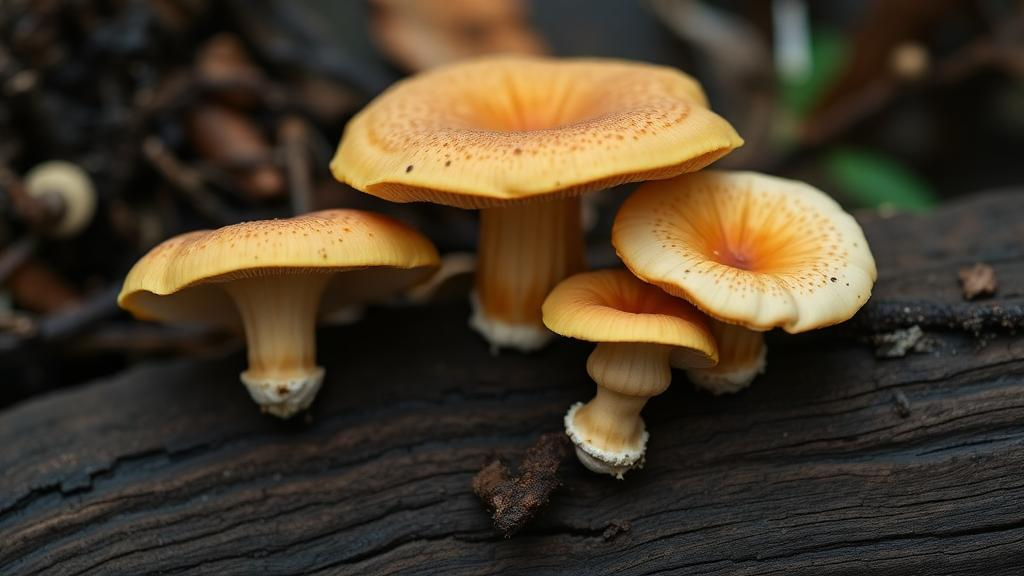
Deep in the subtropical forests of Yunnan Province, southwestern China, a team of mycologists has uncovered three species of fungus new to science, all living quietly on decaying wood. The fungi belong to the genus Phaeoisaria, a group of microscopic saprobes that play a crucial role in breaking down lignocellulose and recycling nutrients in forest ecosystems. The discovery, published in the journal MycoKeys, raises the number of accepted species in the genus to roughly 33 and highlights just how much fungal diversity remains hidden in plain sight on the forest floor.
The new species, named Phaeoisaria bailongtanensis, P. magnoliicola and P. qujingensis, were collected during a survey of hyphomycetous fungi on decaying wood at different localities in Yunnan, including Bailongtan Park in Kunming City and Qujing Normal University in Qujing City. Two of the species were found on dead wood of Magnolia delavayi, while the third was isolated from unidentified dead wood. Remarkably, all three new species, together with the known species P. clematidis, were recovered from a single decaying wood sample collected at Bailongtan Park, suggesting an extraordinarily high local diversity of the genus on a single substrate.
Identifying fungi this small requires a combination of classical microscopy and modern molecular biology. The researchers examined the fungi under compound microscopes, measuring reproductive structures such as conidiophores, conidiogenous cells and conidia to the micrometre. They then extracted DNA from fresh cultures and amplified four genetic loci: the internal transcribed spacer (ITS) region, the large subunit rDNA (LSU), the small subunit rDNA (SSU) and the RNA polymerase II second largest subunit (rpb2). Sequences were aligned with reference data from GenBank and analysed using maximum likelihood and Bayesian inference to build a robust phylogenetic tree of the genus.
The results were unambiguous. Each of the three new species formed its own well-supported independent clade within Phaeoisaria sensu stricto, distinct from all known congeners. P. bailongtanensis occupied a sister position to P. loranthacearum with maximum statistical support, P. magnoliicola was sister to a clade comprising P. mononematosa and P. sparsa, and P. qujingensis clustered with typical synnematous species such as P. aquatica, P. obovata and P. siamensis. The combined dataset included 53 strains and 5,273 aligned characters, providing strong statistical power to resolve species boundaries.
Morphologically, the new species are equally distinctive. P. bailongtanensis entirely lacks the erect synnemata typical of the genus and instead produces two different types of conidia, one globose to subglobose and the other allantoid to reniform. Dimorphic conidia were previously considered rare in Phaeoisaria, with only P. sedimenticola reliably documented, making this the second confirmed species with the trait. P. magnoliicola is also non-synnematous, producing short, thick-walled conidiophores and small obovoid conidia with a truncate base. P. qujingensis, by contrast, produces robust synnemata up to 736 micrometres high and clearly broader than those of its closest relatives, along with fusiform to elongated obovoid conidia.
To rule out the possibility that the new species were simply recombining genetically with close relatives, the team performed pairwise homoplasy index (PHI) tests on the concatenated multi-locus dataset. These tests, based on LogDet transformation and split decomposition, detected no significant recombination within any of the new lineages, providing additional evidence of reproductive isolation. Sequence divergence analyses further confirmed interspecific distinctness, with genetic distances exceeding intraspecific variation thresholds for each new species relative to its allies.
In addition to describing the new species, the researchers re-examined the original nineteenth-century type collections of P. clematidis, a species first described by Fuckel in 1870 from rotten branches of Clematis vitalba in Germany. Two dried syntype specimens loaned from the herbarium in Geneva were studied microscopically, and a lectotype and isolectotype were formally designated to stabilise the name. The fresh Chinese collection was designated as a reference specimen, and its morphology was found to be conspecific with the syntypes, exhibiting all essential diagnostic features including synnematous conidiomata, polyblastic conidiogenous cells and hyaline aseptate conidia.
The re-examination also augmented the original description with details Fuckel never elaborated, such as the polyblastic, sympodial conidiogenous cells with denticulate loci and guttulate conidia. Quantitative measurements from the lectotype and fresh material now provide a modern morphological benchmark for circumscribing the genus, which has long relied on P. clematidis as its best-documented reference species. The study also confirmed the occurrence of P. clematidis in Yunnan Province, extending its known distribution from Europe to Asia.
Ecologically, the findings carry significant implications. Phaeoisaria species are predominantly saprobes with remarkable adaptability, occurring on diverse substrates in freshwater, marine and terrestrial habitats worldwide. They drive lignocellulose decomposition and nutrient cycling in forest ecosystems. Intriguingly, specimens of P. clematidis and P. qujingensis in this study were occasionally found colonising dead fungal colonies on decaying wood, a specialised ecological niche never previously documented in the genus or its family. This observation suggests potential mycoparasitic or symbiotic life strategies and reflects complex nutritional interactions among wood-inhabiting fungal communities that warrant further investigation.
China has emerged as a key diversity centre for Phaeoisaria, with 18 documented species predominantly associated with decaying wood in freshwater and terrestrial habitats. The three new species expand the known diversity of the genus in subtropical forest ecosystems of Yunnan and provide fundamental data for understanding its ecological distribution. The researchers note that future work should focus on expanding taxon sampling in understudied habitats, constructing multi-gene datasets including protein-coding markers such as rpb2 and tef1α for all known species, developing genus-specific molecular barcodes, and investigating sexual morphs, conidial dimorphism and trophic modes to clarify the roles these fungi play in nutrient cycling and environmental responses.
Subject of Research: Mycology; Fungal taxonomy; Phylogenetics
Article Title: Phaeoisaria bailongtanensis , P. magnoliicola and P. qujingensis spp. nov. ( Pleurotheciaceae , Pleurotheciales ) from Yunnan, China, with an augmented description of Phaeoisaria clematidis
Article References: Shang, Q.-J., Yang, J., Hyde, K. D., Wijayawardene, N. N., AL-Shwaiman, H. A., Elgorban, A. M., Filimban, F. Z., Watsuntorn, W., & Dai, D.-Q. (2026). Phaeoisaria bailongtanensis, P. magnoliicola and P. qujingensis spp. nov. (Pleurotheciaceae, Pleurotheciales) from Yunnan, China, with an augmented description of Phaeoisaria clematidis. MycoKeys, 137, 139-173. https://doi.org/10.3897/mycokeys.137.199957
Image Credits: AI Generated
DOI: 10.3897/mycokeys.137.199957
Keywords: Phaeoisaria, bailongtanensis, magnoliicola, qujingensis, Pleurotheciaceae, Pleurotheciales, Yunnan, China, augmented, description, clematidis, scientific research
Cite Scienmag News
Roger Howard. (October 19, 2026). Three New Fungal Species Discovered on Decaying Wood in Yunnan, China. Scienmag. https://scienmag.com/three-new-fungal-species-discovered-on-decaying-wood-in-yunnan-china/
Roger Howard. "Three New Fungal Species Discovered on Decaying Wood in Yunnan, China." Scienmag, 19 October 2026, https://scienmag.com/three-new-fungal-species-discovered-on-decaying-wood-in-yunnan-china/. Accessed 19 October 2026.
Roger Howard. "Three New Fungal Species Discovered on Decaying Wood in Yunnan, China." Scienmag. October 19, 2026. https://scienmag.com/three-new-fungal-species-discovered-on-decaying-wood-in-yunnan-china/


