


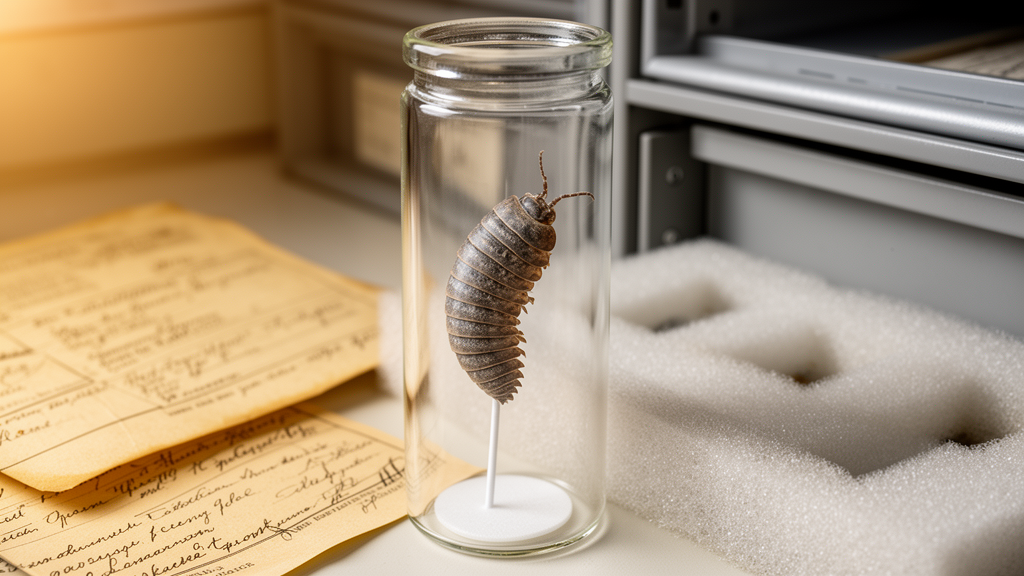
Deep in the collections of the Museum für Naturkunde in Berlin, a small, damaged woodlouse has been waiting for more than a century to tell its story. The specimen, a single female collected in Madagascar in 1904 by the explorer Alfred Voeltzkow, was described by the Danish crustacean specialist Gustav Budde-Lund in 1908 and then essentially vanished from scientific attention. Known only from this one individual, it spent the intervening decades in taxonomic limbo, listed in catalogs and checklists but never reexamined in detail. Now, a new study published in Natural History Collections and Museomics has finally given the animal the attention it deserves, and the result is striking: the woodlouse is so unusual that it cannot remain in the genus where it was originally placed. It has been transferred to an entirely new genus, named Revelosa, a reference to the Latin word for revealing or uncovering.
The species in question, originally described as Armadillo cassida, belongs to the family Armadillidae, the most species-rich family of terrestrial isopods, with nearly 700 described species. These are the pill bugs and pill woodlice of the world, crustaceans that abandoned aquatic life for land and developed a remarkable ability to roll into a ball for protection. Budde-Lund was one of the most prolific describers of such animals in the late nineteenth and early twentieth centuries, but his work has long been a source of frustration for modern taxonomists. His major 1885 monograph lacked illustrations entirely and offered only rudimentary descriptions, and even in later publications he typically illustrated only a handful of characters per species, leaving many of his taxa effectively unrecognizable to researchers a century later.
Compounding the problem, the Berlin holotype is far from pristine. The head is detached from the body and missing all of its mouthparts and both antennae. Most of the legs have lost their distal segments, with only the basal portions preserved in many cases, and one leg is missing entirely. The pleon, the rear portion of the body, is relatively well preserved, though the right uropod lacks its endopodite and one of the pleopods is absent. Some fragments of the specimen, likely including mouthparts and additional leg segments, are held at the Natural History Museum in London, but these proved inaccessible to the researchers, who could neither examine them in person nor obtain images of them. Given that the species is known from a single specimen and that the terrestrial isopod fauna of Madagascar has not seen any taxonomic work in thirty years, the prospects of obtaining fresh material any time soon are slim.
Despite these constraints, the examination of what remained proved remarkably informative. Working with non-destructive methods to avoid further damaging the irreplaceable specimen, the researchers used high-resolution macro photography and detailed illustrations to document every observable feature. The animal measures nine millimeters in length and 5.5 millimeters in width, with a densely granulated dorsal surface covered in small scale setae. Its eyes contain 25 individual ocelli, the simple light-sensing units characteristic of these crustaceans. The body is wide and flattened, a shape that corresponds to what ecologists call a clinger ecomorphotype, an animal adapted to clinging to surfaces rather than rolling into a ball, suggesting it likely had limited ability to conglobate, the defensive rolling behavior that gives many of its relatives their common name.
But it was a set of more subtle features that truly set this woodlouse apart. The frontal shield, a plate on the head, protrudes far above the rest of the head capsule and is deeply cleft, split down the middle. This cleft condition is extraordinarily rare within the family Armadillidae, known otherwise only in the Australasian genus Merulana, though in a much smaller extent there. Even more telling, the uropod exopodites, small appendages at the rear of the animal, are inserted on the medial edge of the uropod protopodite rather than on its dorsal surface. This single character state deviates from what is observed in every other known member of the family, where the exopodites are always inserted dorsally. The telson, the terminal segment of the body, is also atypical: relatively long and triangular with a rounded posterior margin, rather than the hourglass shape that characterizes the typical condition in Armadillidae.
Taken together, these features made it clear that Armadillo cassida could not remain in the genus Armadillo, which is now understood in a much stricter sense than in Budde-Lund’s time and is distributed in the Mediterranean and adjacent parts of western Asia, biogeographically far removed from Madagascar. The researchers therefore established the new genus Revelosa, with Armadillo cassida as its type species, and transferred the species accordingly. The new genus is defined by a distinctive combination of characters: the cleft frontal shield, the triangular telson, the medial insertion of the uropod exopodites, the wide and flattened habitus, and small ventral lobes on the first two body segments. The resemblance to Merulana in the cleft frontal shield is best interpreted as convergent evolution, or homoplasy, given the enormous geographic separation and otherwise distinct morphology between the two genera. Similarly, similarities to the Afrotropical genus Pyrgoniscus in body shape and ventral lobe structure do not reflect a close relationship, as the two differ fundamentally in the key diagnostic features.
The case also highlights some of the practical frustrations of working with historical material. The specimen labels in both Berlin and London record the collection locality as Sahana, but Budde-Lund’s original description states Sakana. Both are real places in the Analanjirofo Region of northern Madagascar, separated by roughly 130 kilometers, and it remains unclear which represents the true type locality. However, an examination of other specimens collected by Voeltzkow on the same expedition suggests that the majority were recorded from Sakana, raising the possibility that Sahana on the labels is a transcription or labeling error. Meanwhile, the London fragments are cataloged under the unavailable name Bethalus cassida, likely a renewed identification never formally published, though there is no morphological justification for placing the species in the genus Bethalus, which differs substantially in having a non-cleft frontal shield and a typical hourglass telson.
Beyond resolving the fate of a single species, the study makes a broader argument about the value of imperfect specimens. Singleton species, those known from only a single individual, are surprisingly widespread across taxonomic groups but have often been underappreciated in biodiversity research. Many were described during early phases of exploration with insufficient detail by modern standards, and their descriptions lack key diagnostic features. Obtaining new material is frequently not feasible, particularly in neglected and underfunded groups such as terrestrial isopods. Delaying reexamination in hopes of fresh specimens risks indefinite taxonomic stagnation, which in turn causes cascading errors across ecology, biogeography, and conservation, since species names form the foundation for virtually all biological research.
Type specimens, even fragmentary ones, serve as the name carriers of biological classification and hold enduring relevance regardless of their condition. Revisiting them can clarify longstanding ambiguities, correct historical misplacements, and stabilize taxonomy, even when preservation is poor. The researchers argue that partial revisions based on unique but imperfect material make important contributions by opening new research avenues, reducing taxonomic noise, and contributing to more coherent classification systems. This is particularly pressing for the Armadillidae, which are considered among the most difficult terrestrial isopods to identify, with a taxonomy so confused that it can only be clarified gradually given the vast number of included genera and species. Incremental improvements of the kind demonstrated here are vital for addressing what taxonomists call the taxonomic impediment, the shortage of resources and expertise that slows biodiversity documentation.
The rediscovery of Revelosa cassida nicely illustrates both the challenges and the opportunities presented by historical and neglected material. The species was insufficiently described, erroneously assigned to a genus on another continent, and left unstudied for over a century. Though fragments of the holotype remained inaccessible, the researchers were still able to identify distinct morphological characters, including one that deviates from the condition observed in all other known members of the family, justifying the establishment of a new and highly recognizable genus. The correction resolves a long-standing taxonomic error, enhances understanding of morphological diversity within the Armadillidae, and contributes to a more accurate picture of Madagascar’s oniscidean fauna, a fauna that remains poorly documented and urgently needs further attention.
Subject of Research: Taxonomy of terrestrial isopods
Article Title: Incomplete but invaluable: Reassessing the holotype of a singleton madagascan woodlouse ( Oniscidea , Armadillidae )
Article References: Kästle, B., & Degenhardt, O. (2025). Incomplete but invaluable: Reassessing the holotype of a singleton madagascan woodlouse (Oniscidea, Armadillidae). Natural History Collections and Museomics, 2, 1-12. https://doi.org/10.3897/nhcm.2.165728
Image Credits: AI Generated
Keywords: Incomplete, invaluable, Reassessing, holotype, singleton, madagascan, woodlouse, Oniscidea, Armadillidae, scientific research
Cite Scienmag News
Juliet Wilcox. (October 18, 2026). A century-old woodlouse specimen from Madagascar just got a brand-new genus. Scienmag. https://scienmag.com/a-century-old-woodlouse-specimen-from-madagascar-just-got-a-brand-new-genus/
Juliet Wilcox. "A century-old woodlouse specimen from Madagascar just got a brand-new genus." Scienmag, 18 October 2026, https://scienmag.com/a-century-old-woodlouse-specimen-from-madagascar-just-got-a-brand-new-genus/. Accessed 18 October 2026.
Juliet Wilcox. "A century-old woodlouse specimen from Madagascar just got a brand-new genus." Scienmag. October 18, 2026. https://scienmag.com/a-century-old-woodlouse-specimen-from-madagascar-just-got-a-brand-new-genus/


