


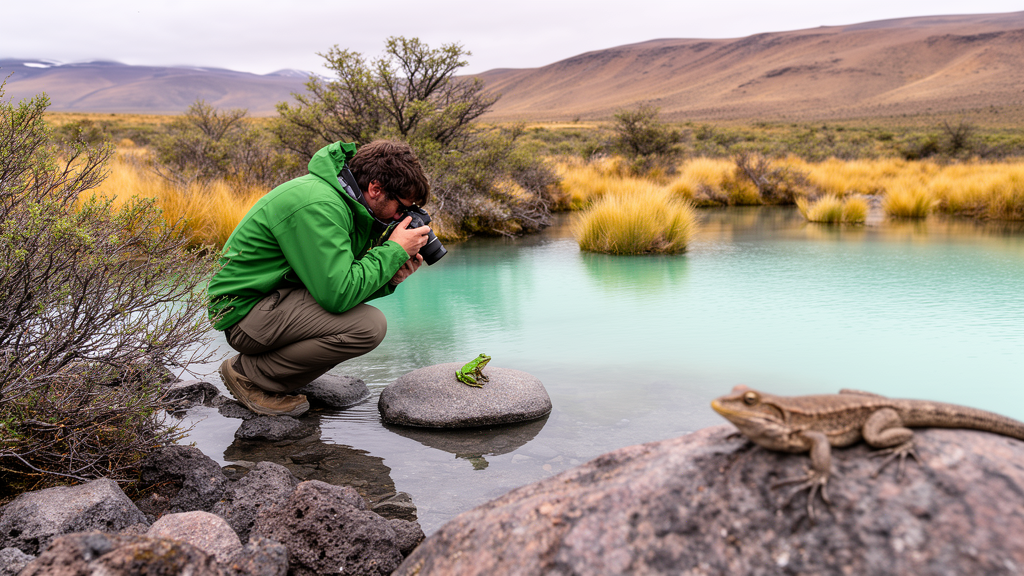
Deep in the mid-west of Neuquén Province, Argentina, a protected patch of windswept steppe has just revealed its complete cast of cold-blooded residents for the first time. Laguna Blanca National Park, created in 1940 to safeguard nesting waterfowl, has never had a dedicated inventory of its reptiles and amphibians. A new study published in Neotropical Biology and Conservation changes that, confirming 18 species of herpetofauna within the park’s 11,250 hectares: 13 reptiles and 5 amphibians, several of them found nowhere else on Earth.
The research team assembled the list from four independent sources of evidence. Field surveys ran from October 2022 to March 2023, with four researchers conducting visual encounter surveys at seven lagoons and along transects between water bodies and the Llano Blanco Stream, totaling 223 hours of searching per person. These observations were cross-checked against voucher specimens held in four Argentine herpetological collections, decades of published scientific literature, and online biodiversity databases including iNaturalist, Ecoregistros, GBIF, and the IUCN Red List. Records whose photographs could not be confidently identified were discarded, a filtering step that lends the final list a conservative weight.
The results show a fauna dominated by lizards, which account for 61 percent of confirmed species, followed by anurans at 28 percent and snakes at 11 percent. Reptiles fall into six families, while amphibians belong to three. The richest assemblages were found near the lagoons, where rocky shores and wet meadows known as mallines create a mosaic of microhabitats in an otherwise arid landscape. Lizards of the genera Liolaemus and Phymaturus, the signature groups of Patagonian reptile diversity, were found basking on basaltic walls and sheltering under peripheral rocks, while species such as Liolaemus bibronii and L. sagei favored sandy substrates among shrubby grassland.
Not every species on the list was seen alive during the surveys. Fieldwork confirmed only 12 of the 18 species, with the remainder documented through museum specimens, literature, and databases. The researchers also flagged six additional species as probable occupants, based on IUCN distribution maps extending to within 100 kilometers of the park and on similarity of habitat. Among these candidates are two more lizards, a worm lizard of the genus Amphisbaena, and three snakes, including the xeric-steppe specialist Tachymenis trigonatus. Confirming their presence will require sampling in other seasons and in sites the surveys did not reach.
The taxonomic housekeeping embedded in the new checklist is itself scientifically significant. Earlier compilations, most notably a 2005 list of reptiles in Argentina’s national parks, contained species now known to have been misidentified. The lizards once recorded as Diplolaemus darwinii, Liolaemus boulengeri, and Phymaturus palluma, among others, correspond to different species: D. sexcinctus, L. sagei, and P. querque respectively. Two species, Liolaemus purul and Phymaturus querque, were described from within the park only after that earlier list was compiled. Such corrections matter because conservation decisions rest on knowing exactly which species occupy which territories.
The conservation picture that emerges is sobering. Five of the 18 confirmed species, 28 percent of the total, carry a threat category on national or international red lists. Three reptiles, Pristidactylus araucanus, Phymaturus querque, and Phymaturus zapalensis, are listed as Vulnerable nationally, while the amphibians Atelognathus patagonicus and A. praebasalticus are classified as Critically Endangered and Endangered globally. Seven taxa, nearly 40 percent of the park’s herpetofauna, are designated Species of Vertebrates of Special Value by Argentina’s national parks administration, a status reflecting threat, endemism, or scarcity within the protected-area system.
The genus Phymaturus deserves particular attention. Every species in this Argentine lineage is listed as vulnerable nationally, a consequence of a highly specialized biology: the lizards are saxicolous, living on rocks, viviparous, giving birth to live young, and herbivorous, a combination that makes them sensitive to habitat disturbance and slow to recover from population losses. Laguna Blanca National Park shelters two of these species, and prior research on their thermal biology and reproduction has been conducted with individuals captured inside the park. The authors note that population assessments within park boundaries remain lacking.
The amphibian story carries the sharpest warning. Atelognathus patagonicus, an endemic frog of the basaltic lagoons of central-west Neuquén, once thrived in Laguna Blanca itself, the largest and only permanent water body in the area. From 1986 onward it vanished from that lagoon, a decline traced to successive introductions of invasive fish, mostly perch, which brought habitat loss, competition, and predation. Clinical signs of ranavirus and the chytrid fungus Batrachochytrium dendrobatidis, two pathogens implicated in amphibian declines worldwide, have also been recorded in this species. The frog survives in smaller, disconnected lagoons within the park, but its main sub-population is gone from the water body that gives the park its name.
These pressures persist even inside protected boundaries. Livestock trample lagoon shores and drink from the water, degrading precisely the habitats where herpetofaunal diversity peaks. Prolonged droughts, intensified by climate change, threaten the shallow lagoons that are fed by underground infiltration and prone to desiccation. The park has fenced some lagoons, including Batea, Verde, and Antiñir, but cattle sometimes breach the barriers, the researchers observed. Ecological restoration of Laguna Blanca through continuous fishing of invasive fish stands as a primary objective of the current management plan, and the authors recommend stronger control of livestock activity as a complementary measure.
The study also reframes the park’s significance. Although it is the second smallest of Patagonia’s 17 national parks, it harbors roughly 20 percent of the reptile and snake species and 30 percent of the amphibian species recorded in Neuquén Province. Of about 50 lizard species in the province, 12 are protected within the park. It is the first herpetofaunal checklist for any national park in Patagonia, and no provincial list yet exists for Neuquén. Comparison with the Auca Mahuida Natural Protected Area, some 200 kilometers away, shows only four shared reptile species, underscoring how distinctive the park’s assemblage is. As the authors emphasize, checklists are dynamic snapshots of knowledge, and this one provides the baseline from which future monitoring, taxonomic revisions, and conservation actions for Patagonia’s most imperiled frogs and lizards can proceed.
Subject of Research: Herpetofauna inventory and conservation status of Laguna Blanca National Park in Argentine Patagonia
Article Title: Herpetofauna of Laguna Blanca National Park, Argentinean Patagonia: species list and conservation status
Article References: Rolón, M. C. J., Vera, D. G., De Los Santos, F. L., Harkes, M., Tettamanti, G., Calvo, R., Di Pietro, D. O., Velasco, M. A., Avila, L. J., Williams, J. D., & Kacoliris, F. P. (2024). Herpetofauna of Laguna Blanca National Park, Argentinean Patagonia: species list and conservation status. Neotropical Biology and Conservation, 19(1), 35-50. https://doi.org/10.3897/neotropical.19.e115561
Image Credits: AI Generated
DOI: 10.3897/neotropical.19.e115561
Keywords: herpetofauna, Laguna Blanca National Park, Patagonia, reptiles, amphibians, endemic species, Liolaemus, Phymaturus, Atelognathus patagonicus, conservation status, invasive species, species checklist
Cite Scienmag News
Margaret Porter. (October 18, 2026). Patagonia’s Hidden Frogs and Lizards: First Full Species Census of Laguna Blanca National Park. Scienmag. https://scienmag.com/patagonias-hidden-frogs-and-lizards-first-full-species-census-of-laguna-blanca-national-park/
Margaret Porter. "Patagonia’s Hidden Frogs and Lizards: First Full Species Census of Laguna Blanca National Park." Scienmag, 18 October 2026, https://scienmag.com/patagonias-hidden-frogs-and-lizards-first-full-species-census-of-laguna-blanca-national-park/. Accessed 18 October 2026.
Margaret Porter. "Patagonia’s Hidden Frogs and Lizards: First Full Species Census of Laguna Blanca National Park." Scienmag. October 18, 2026. https://scienmag.com/patagonias-hidden-frogs-and-lizards-first-full-species-census-of-laguna-blanca-national-park/


