


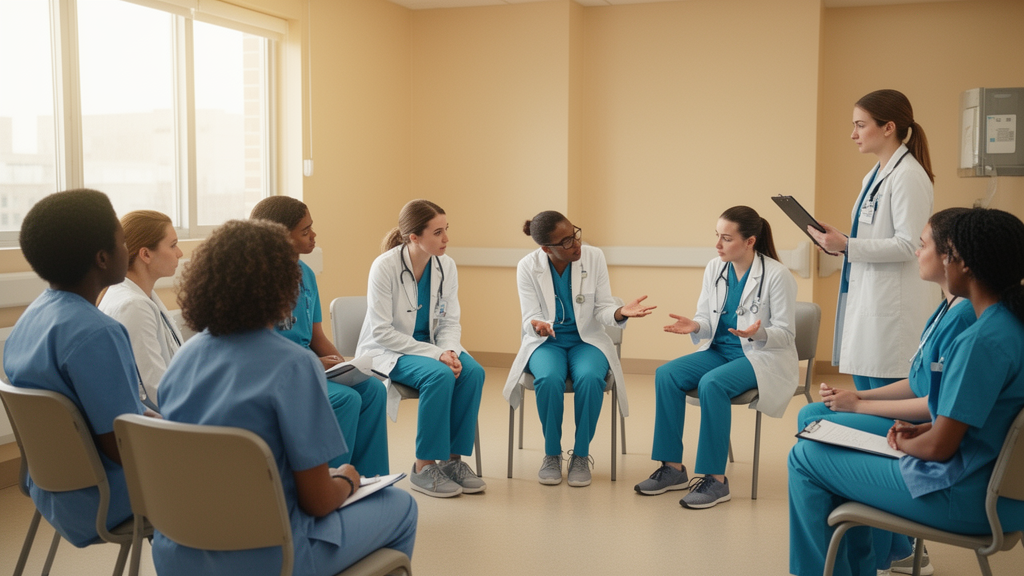
Healthcare workers and the students training to join them face a well-documented crisis of stress, burnout, and emotional exhaustion, driven by long shifts, high patient volumes, and punishing working conditions. A new study published in BMC Medical Education reports that a peer-support training program called Stress First Aid for Healthcare Workers, adapted from a model originally developed by the U.S. Department of Defense, significantly increased participants’ confidence in their ability to recognize and respond to stress injuries in their colleagues. The program was delivered to more than 1,150 participants at Duke University and North Carolina Central University, and the results suggest that a structured, military-derived framework can be successfully translated into civilian academic health settings.
The research team, led by Mitchell T. Heflin of the Duke Health Center for Interprofessional Education and Care, set out to address a persistent gap in how the healthcare field approaches well-being. Traditional wellness programs have tended to focus on individual resilience, essentially asking each clinician or student to toughen up against systemic pressures. The Stress First Aid model takes a different tack: it treats peer support and a culture of caring as central rather than peripheral, positioning colleagues themselves as the first line of defense against stress injury. The program is designed to intervene in what the authors describe as a pre-clinical phase of stress, before problems escalate into conditions such as post-traumatic stress disorder, and it is deliberately accessible to lay audiences without clinical mental health training.
Stress First Aid has its roots in Combat and Operational Stress First Aid, a framework developed within the military and Veterans Affairs system to help service members identify and manage stress reactions in themselves and their units. The healthcare adaptation preserves the core logic: participants learn to recognize signs of stress injury in peers, to respond in ways that preserve life, prevent further harm, and promote recovery, and to know when a situation requires escalation to professional care. The model emphasizes that stress injuries, like physical injuries, exist on a spectrum and that early, low-intensity interventions by trusted peers can alter the trajectory before formal treatment becomes necessary.
To bring this framework to an academic health environment, the investigators partnered across two institutions in Durham, North Carolina: Duke University and North Carolina Central University, a historically Black university. The program was funded by the U.S. Health Resources and Services Administration under a cooperative agreement, and the team recruited 25 faculty and staff champions from both campuses who provided critical input on adapting the training materials and implementing the program. This champion model helped ensure that the curriculum reflected the realities of different professional cultures, from nursing classrooms to medical wards, and that the training felt relevant rather than imposed.
Delivery was deliberately flexible. More than 1,150 participants took part through both synchronous sessions, conducted face-to-face or online, and asynchronous modules developed with the Duke Learning Innovation and Lifetime Education team for the Coursera platform. Roughly 71.7 percent of the participants analyzed in the study attended synchronous training, while the remainder completed asynchronous coursework. The researchers used a pre-post survey design, collecting demographic information and measuring burnout, work-life balance, and self-efficacy in providing peer support before and after the training. Statistical analysis relied on paired t-tests and mixed model analysis of variance to detect changes over time.
The analysis focused on the 336 participants for whom matched pre- and post-training data were available, a group that reflected considerable diversity across roles and professions. Nursing accounted for 61.6 percent of respondents and medicine for 12.8 percent, with the remainder drawn from other health professions. Students made up 68.2 percent of the sample and staff 15.2 percent, meaning the program reached both the current workforce and the pipeline of future clinicians. This breadth matters, the authors argue, because stress and its consequences do not respect professional boundaries, and a shared vocabulary for peer support can function across hierarchies that often separate students, staff, and faculty.
The headline finding was statistically unambiguous: participants reported significant improvements in self-efficacy across all measured items, with p-values below .001, and these gains held regardless of profession, role, or training modality. In practical terms, whether someone was a nursing student, a staff member, or a physician faculty member, and whether they learned in a live session or through online modules, the training moved the needle on their confidence to deliver peer support. The program also earned high satisfaction ratings for course quality, content, pace, resources, and faculty, indicating that the material was not only effective on paper but well received by the people who experienced it.
Several design choices appear to explain the program’s reach. The flexibility of synchronous and asynchronous delivery allowed the training to fit around clinical schedules and academic calendars, removing a common barrier to participation in wellness initiatives. The interprofessional framing, anchored in Duke’s Center for Interprofessional Education and Care and aligned with interprofessional education and care competencies, meant that peer support was taught as a shared professional skill rather than the domain of any single discipline. And the pre-clinical orientation of the Stress First Aid model lowered the psychological threshold for engagement: participants did not need to see themselves as mental health providers, only as attentive colleagues equipped with a structured way to check in and respond.
The authors are careful about the limits of what the study shows. The pre-post design demonstrates improvements in self-reported confidence, not yet reductions in burnout or measurable changes in patient care, and the matched sample of 336 represents a subset of the more than 1,150 people trained. Self-efficacy is a meaningful and predictive construct in behavioral change, but the team acknowledges that ongoing evaluation will be needed to assess whether the training translates into long-term reductions in burnout and improvements in the care that patients receive. The study was reviewed by the Duke University Health System Institutional Review Board and determined to be exempt as a quality improvement and educational program evaluation, with participation voluntary and anonymous.
Even with those caveats, the findings arrive at a moment when health systems are searching for scalable, low-cost ways to support their workforce. Burnout among clinicians and students has been linked to turnover, medical error, and diminished quality of care, and individually focused resilience programs have repeatedly fallen short of addressing the cultural roots of the problem. A peer-support model that can be delivered online or in person, that works across professions and institutional hierarchies, and that measurably increases confidence to intervene early offers a template other academic medical centers could adapt. If future evaluations confirm durable effects on well-being and patient care, Stress First Aid may prove to be one of the more consequential imports from military medicine into civilian healthcare education.
Subject of Research: Peer support training to reduce stress and burnout among healthcare professionals and students
Article Title: Training in peer support across roles, professions, and institutions: Stress First Aid for current and future healthcare professionals at partner academic centers
Article References: Heflin, M. T., Alston, B., Hoffler, U. N., Thompson, J. A., Lancaster, D., Allam, L. A., Chavis, T., Barzee, M., & Convoy, S. P. (2026). Training in peer support across roles, professions, and institutions: Stress First Aid for current and future healthcare professionals at partner academic centers. BMC Medical Education. https://doi.org/10.1186/s12909-026-10437-x
Image Credits: AI Generated
DOI: 10.1186/s12909-026-10437-x
Keywords: Stress First Aid, peer support, burnout, healthcare workers, medical education, nursing, Duke University, North Carolina Central University, stress injury, well-being, interprofessional education, HRSA
Cite Scienmag News
Courtney Benton. (October 18, 2026). Stress First Aid Training Boosts Peer Support Skills Across Healthcare Roles. Scienmag. https://scienmag.com/stress-first-aid-training-boosts-peer-support-skills-across-healthcare-roles/
Courtney Benton. "Stress First Aid Training Boosts Peer Support Skills Across Healthcare Roles." Scienmag, 18 October 2026, https://scienmag.com/stress-first-aid-training-boosts-peer-support-skills-across-healthcare-roles/. Accessed 18 October 2026.
Courtney Benton. "Stress First Aid Training Boosts Peer Support Skills Across Healthcare Roles." Scienmag. October 18, 2026. https://scienmag.com/stress-first-aid-training-boosts-peer-support-skills-across-healthcare-roles/


